|
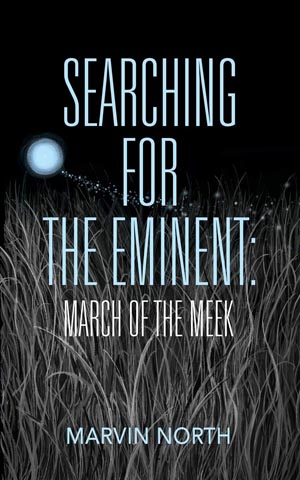
I feel like writing a review of 'March of the Meek' is premature because it reads like a book-length prologue rather than the first in a series. I see a suggestion online that 'Searching for the Eminent', the series name which is far more noticeable on the cover than the book's actual title, will end up as a trilogy, but it seems like there's a heck of a lot more to come in only two further books. Maybe it'll end up running longer. Only time will tell.
That's because this first book certainly serves as an introduction, especially to primary characters but also to a time and place, a far future dystopia and potentially the last city on the planet, Last Theli by name. However, primary characters aside, it's also fundamentally a teaser, because we're unable to explain much more about what's going on and why after we've finished than we could have done before diving in; just by reading the back cover blurb. There are very few characters here beyond a set of clearly pivotal ones and even fewer locations. We quickly fashion simple questions that are not answered by the time we turn the final page. I'm sure they will be answered later in the series but that doesn't help right now.
We don't know where Last Thesi might be found, beyond it being a walled city surrounded by plains and then forest. We don't even know if it's on Earth, though there's enough that's familiar to hint that it probably is. The least successful aspect to the book for me was the awkward way in which it's set up like a fantasy world with warriors and magicians and mysterious powers that have wreaked havoc on the planet, but incorporates a host of very recognisable aspects from our own world: the RM Mart, a grocery store complete with protein bars, and a chrome radio picking up broadcasts of old music interspersed with local news and commercials. It's like two parallel worlds bleeding into each other.
The most successful aspect is the characterisation, because that's clearly Marvin North's focus at this point. Almost everyone in Last Theli lives within the guarded walls of the city, though I have to confess that I'm unsure why they're guarded given that there's nobody to guard against. Outside the walls are a few farms growing food and so few others that we might be forgiven for assuming that the four we focus on are it. The suggestion is that there are no other cities left, nobody to be a threat, not even wild animals because they've all died out, prompting meat to be born magically rather than bred and grown.
Initially, we believe that there are only two characters living outside the city and its feeder farms and they're the two we focus on, Maven and Rekco. Maven is a warrior, with a history that we only slowly find ourselves let in on. Rekco Curse is his thirteen-year-old apprentice, a highly important age in this world where reaching fourteen equates to becoming an adult. Rekco's father is, or was, Rekston Curse; a mysterious figure who's apparently one of those rare people who can change the world, something that's more than needed at potentially the end of this one. He's supposed to be dead and he has a grave, but Maven doesn't believe he's in it. Rekco wants to know a lot more but the answers to his questions aren't forthcoming in this first book.
Pretty quickly into the novel, these two characters discover two more, who magically appear one day along with their cabin. We soon find that Gofun and Kyoku used to live on the other side of the forest, but decided to move closer to the city, so flew over or teleported past it and set up shop in close proximity to Maven's place. Gofun is a wizard and Kyoku his apprentice, only twelve-years-old but highly talented. Just as Maven and Gofun are wildly different masters, the former disciplined and organised but the latter quirky and apparently off the cuff, Rekco and Kyoku couldn't be more different as their apprentices. Rekco's a child at heart learning to be a man and doing a decent job of it. Kyoku's just an asshole, never having benefitted from interacting with anyone but Gofun.
So much later that it's surprising to us, a third young character appears, this one female, which is a notable thing in this future dystopia where women generally can't conceive and, when they do, are far more likely to birth boys than girls. We assume that this fact contributed to the general fall of civilisation, but we're not given answers to those questions yet either. This particular girl is Cathy Wyman and, while she's fourteen, adulthood arrives a year later for girls in this world, so she still resides at Last Theli's orphanage. She's the oldest child there and the only girl, but any suggestion of seniority can be quashed by the fact that the head matron, Gace, particularly despises girls and torments Cathy at every possible opportunity.
Of course, because so much time and attention is lavished on Rekco, Kyoku and Cathy, we have zero doubts that they're going to dominate the future books. However, at this point, we have very little idea why they're important. We're given snippets about how important Rekco's father is, so we're probably safe in assuming that he'll follow suit. Kyoku is a magician and his magic is clean and very different to what the all-powerful Runic Guard, frequently mentioned but never encountered, use, so surely that's the key factor there. Cathy, we have no idea, beyond the discovery that both of her parents were heroes. However, they're colour-coded as heroes like this in an anime: Kyoku has blue hair, Rekco has green hair and Cathy has pink hair. That seems notable to us, though we have no idea if it's notable in this world.
Beyond that, I can't say too much because North is so ruthlessly skimpy with his answers. What may be important is that many, including me, might be put off by that fact. I want to be given answers to my questions and I have little interest in reading a book whose author doesn't want to comply. I found this a little slow to get into because it was so clearly a character study; with the only answer being given being who. Never mind how or why, we have to settle for who. And, while that doesn't change much from the first chapter to the last, I found that the characterisations were enough to keep me interested. In fact, I became more interested the more I read, until I was flowing quickly through this first book and ready to roll straight into the second, if only I had a copy.
So this is a success, but in spite of what it does rather than because of it. It ends naturally enough but the second book is going to have to be as free-flowing with its answers as this first was sparing with them, or this isn't going to wrap up well at trilogy length. ~~ Hal C F Astell
For more titles by Marvin North click here
|
|