|
Ms. Bishop has been writing stories in her Black Jewels or Realm of the Blood universe for more than a dozen books starting in 1998 and, for the most part, they have been totally excellent. It is a remarkable world and society and I love spending time there. In this world, people are divided into two particular types: ordinary humans and the Blood. The Blood are those born with certain powers. At a young age, each Blood's power is defined by their "birthright jewel", and when they attain their maturity, their power can be increased. In addition to the levels of power, some are born with other talents such as healing or precognition. Most of the stories have a very dark storyline, often dealing with how young Blood are 'broken,' losing their powers and, often, their very minds. While such a crime is possible against males, Ms. Bishop particularly targets young female witches; raped both in body and mind. So if this is a particularly distasteful subject, I might gently suggest this series isn't for that reader.
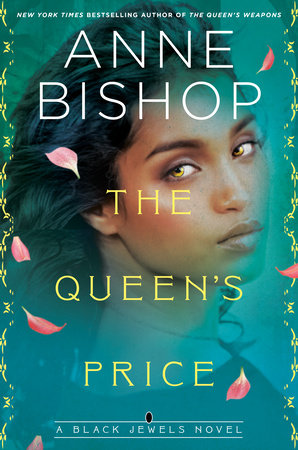
This is the third book in an arc and, due to the lack of loose ends, is probably the last in this arc. Daemon is still trying to establish a school in the Hall, similar to what his father did with the First Dark Circle. Daemon was part of that program, along with his lifelong love, Jaenelle. The previous two books in this cycle addressed conflicts that threatened to not only break the school but destroy all the potential Queens. This one is no different but the threat is less…dire. This story is more a coming-of-age tale. Even though most of the characters come from long-lived races (there are short-lived ones, as well) and many of them have lived a very long time, they are still considered adolescents with much to learn. (I challenged this concept in my last review.)
Daemon's only and beloved child, Saetien, has lost much of her power and has been exiled from his Hall. Her actions in the last book seem to have permanently ostracized her mother, Surreal. She is lost and searching for meaning to her life when a broken Black Widow sets her on a quest. It took her to a Sceltie village where Jaenelle had lived and established a school for the Sceltie puppies. (Sceltie dogs are Kindred which are animals who are Blood just like humans.) It was a quest to discover who Jaenelle's sister, Wilhemina, was. It was a distasteful quest for Saeti; having to ask questions or hear about the hated Jaenelle was more than uncomfortable. But without any other purpose in her life, she tried to follow the Black Widow's advice. But trying to keep Wilhemina and Jaenelle separate in their histories was a lost cause. To understand one, she had to understand both. She meets a Demon-Dead Prince who had reason to know Jaenelle quite well; better than Daemon in some instances. But he won't talk about Wilhemina until Saeti figures out what questions to ask. Through his memories, we learn some moderately interesting stuff about Jaenelle's early years and a bit more about what she suffered when she initiated the Purge at the end of the first trilogy. But nothing terribly insightful for the dedicated reader. Saeti had a lot to learn and unlearn.
In the Hall, Daemon has about thirty young people accepted into his school. In his efforts to find ways to bring them to an understanding about their power and their responsibilities; he starts looking through old journals kept by members of the First Circle and even his own long-gone father, Saetan. He fixes on a couple tactics to 'ramp up' their instruction; but, much as it did for Saetan, it didn't go as planned. Unfortunately, his methods actually left open an opportunity for someone to subvert and pervert his instruction. An opportunity to actually taint the young Queens and Warlord Princes; an opportunity to start another generation down the same path as Dorothea before the Purge.
So, this reader is back to her earlier criticisms: namely that since everyone is so long-lived why is it they don't seem to know their own history? Even without details, their history is so bloody and destructive due to bad Queens; they ought to know enough now to remember that the two men, Daemon and Lucivar, who have, between them, destroyed hundreds of bad Queens or witches, are still very much alive and just as dangerous as ever. Why would anyone ever think they could get something by these men without paying an ultimate price? It seems to me that history is not an integral part of their instruction. Doesn't really make sense.
There is also a small storyline about Jillian, Lucivar's daughter. It is somewhat amusing. A new character, Brenda from Sceltie, is introduced and she's quite challenging to Daemon and fun for the reader. But since her power is slight, I don't foresee her being the focus of a future story.
The story makes much of three rules for Queens: their Purpose, their Duty, and their Price. The Queens are taught the first two but the third makes its appearance in this story and it's the main point. The Queen's Price is about sacrifice; personal sacrifice. A good Queen always puts others' welfare above her own. It's not exactly a great revelation; and, again, why hasn't this always been on the curriculum since Jaenelle's sacrifice so many hundreds of years earlier?
Sigh…I love this series. I love it for the world building. I love the uniqueness of the characters and their other-worldliness. But the stories are feeling more and more lame. And that's not really unexpected. When you blow up the world three books in, how do you top that plot? If I had the author's ear, I would encourage her to leave Kaeleer and venture out into the other countries where the inhabitants are even less like humans. And, yes, if you've read her other series of The Others, there is a whiff of that.
I do hope there are more - and original - storylines to come; I still love this universe. ~~ Catherine Book
For more titles in this series click here
For more titles by Anne Bishop click here
|
|