|
I've read and reviewed six books by Genevieve Cogman, but they've all been part of one series, her 'Invisible Library' series. That's fantasy, but built on a historical grounding, the primary world that the leads spend most of their time in being an alternate 1812 London. There's also a connection to classic literature, given that the key character from there is a clear Sherlock Holmes equivalent. It isn't that much of a stretch to see this as a different take on the same interests.
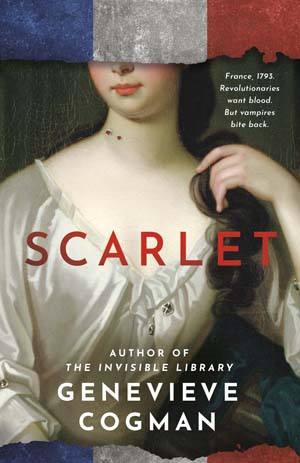
It's fantasy again, not least because there are vampires, who are known and long established. The historical aspect is more obvious because, unlike the 'Invisible Library' series, we spend the entire book in one time and one place, which is Western Europe in 1793. We start in London, but shift into the countryside and then over to France, because, if you know your history, we're right slap bang in the middle of the French Revolution. And, if you know your literature, you should be able to guess which public domain literary figure the author's going to bring into play.
And yes indeed, we'll meet him soon enough but our focus is on Eleanor Dalton, a young lady who's working as an indoors maid in the household of Lady Sophie, Baroness of Basing. While most of her duties are just what you're imagining, she has other duties too because the Baroness is a vampire. Young Eleanor has scars in her arms from cuts from a lancet, so that she and other maids can give blood for their mistress to drink. While this is an interesting setup and Eleanor enjoys working for her ladyship, she's brought in to meet her guests, Percy and Marguerite, who are utterly shocked to see her.
Percy, of course, is Sir Percy Blakeney, a wealthy but lacklustre nobleman bored by everything but, given that the novel in which he first appeared was published as long ago as 1905, I surely can't be providing a spoiler by pointing out that he's also the dashing and heroic Scarlet Pimpernel. He has his eye on Eleanor because she happens to be the spitting image of a certain rather famous French aristocrat. I'm sure you can guess which one because, even if you can only name one of them, it will surely be the right one, but the back cover blurb doesn't spoil it so neither will I.
And, while you can probably write the rest of the story in your mind from there, Cogman does it in glorious style. 'Scarlet', a title with a neat double meaning, not merely referring to the Pimpernel but to the blood that the vampires in this alternate Europe drink, runs close to three hundred and fifty pages but it's a quick and dynamic read. I actually devoured it in one sitting, having finished a book soon after going to bed for the night and making the mistake of promptly starting this one. I didn't get a lot of sleep that night but I started and finished this before I did.
Part of that is surely the author's skill, which doesn't surprise me in the slightest, given how much I've enjoyed her 'Secret Library' books (note to self: apparently there are two more that I haven't seen yet). This is more grounded, with just as much intrigue—how could there not be when the job at hand is to sneak into another country, rescue very heavily guarded people and whisk them back out again?—but focused very much on specific goals.
After all, the vast majority of the French have a single goal, to reclaim their country from the rich and powerful, whether human or vampire, by chopping off their heads in public. The League of the Scarlet Pimpernel plan to save these rich and powerful people. And that's about it. There aren't a lot of different factions of different species from different planets each with their own agendas. It boils down to a couple of sides and we know which one we're on from the outset. For now, at least.
Part of it, however, is the tantalising worldbuilding. This is a world we know because it's ours, but it differs just a little because of the presence of vampires. This is the first book in a series, so I firmly expect more from the vampires as that series builds. It may well be that the two sides diverge into three, with the French, the English who care to be involved and the vampires battling against each other. We will soon see, when the second book comes out. For now, I found Cogman's treatment of vampires fascinating, because it's very deliberately far from consistent.
The first vampire we meet is in the prologue. She's the Comtesse d'Angoulème, both an aristocrat and a vampire, as haughty and arrogant as either might suggest, but she's quickly taken down by a mere human being, Citizen Chauvelin of the Committee of Public Safety. That she doesn't die at this point is neither here nor there. Her centuries-long power is taken, just like that, and that's a crucial detail. The second is Eleanor's mistress, Lady Sophie, who appears to be a good person, not because she resides on the other side of the English Channel. The third is very different again, the vampire out of European horror stories, eager to feed on human blood.
In short, this isn't the traditional vampire novel, because it doesn't feature traditional vampires, at least not entirely, but it's a long way from the urban fantasies that we tend to see nowadays. I am fascinated to see how Cogman builds them in this series. I'm seeing the historical timeframe of the classics; the aristocratic approach of 'Dracula' but also the feral savagery of 'I am Legend'; the "out" status of the Anita Blake or Sookie Stackhouse novels; and potentially the need for them to go on the run, like in 'Near Dark', and potentially war with the human race, like in the final movie in the 'Underworld' series, but framed as a class struggle. There's a lot there.
I'm also interested in how Eleanor grows as a character. She's a housemaid as this story begins but her goals of moving upward within a single household shatter when she's recruited by the Scarlet Pimpernel. Initially, she's just a prop, a tool to meet an end, but she proves herself much worthier than just that, and effectively becomes accepted by the League. By the time the book ends, she's effectively a spy working in a clandestine organisation working behind enemy lines. Embroidery's no longer her chief skill. There's a huge potential for her to grow and I'm looking forward to seeing how she does so.
'The Scarlet Pimpernel' was the first book of many. Baroness Orczy wrote eleven novels and a pair of short story collections, on top of referencing the character and his organisation in other novels set in the same period that were otherwise unrelated or followed ancestors or descendants. Now let's see how far the 'Scarlet Revolution' series will run, because it has just as much potential but adds a whole new element in vampires. ~~ Hal C F Astell
For more titles by Genevieve Cogman click here
|
|