|
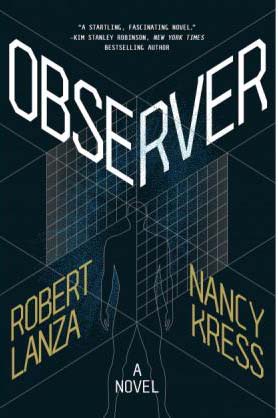
I wanted to believe in this book, going in. The premise is terrific.
Caroline, a black-listed-by-the-internet, surgeon is approached with a job offer too good to be true. Her great-uncle, Samuel, has a state-of-the-art research facility on the Grand Cayman Islands and he wants her to be his surgeon in a radical experimental research project. Suspicious, of course, Caro’s reluctance is overcome with the promise of exorbitant amounts of money; money she desperately needs to care for her sister and two nieces; one of which is seriously disabled. Once on the island, she is overwhelmed by the ideas that both her great-uncle and his best friend and physicist are trying to create with science. Quantum physics are in play here. And the authors provide a very good grounding – for laypersons – in a very comprehensible way. The expositions did not bore this reader. The idea behind all of this is that the observation of something makes it real. For the most part, up to the last century, everyone believed that reality created life. Quantum physics (and I may not be using the best descriptor here) says that reality doesn’t exist until we think it does – an over-simplification.
Caro’s job is to surgically implant hardware into a person’s brain which will then be accessed with software; their experiences recorded in both color and movement (rather unlikely with current technology.) There is no great conflict within this story; some tension is attempted with investigations by the FBI and lethal attention from the always-present-for-new-ideas hate groups. The story tends to wander a bit but pretty much stays focused on Caro and her resistance to something that she cannot (and, she is sure, will not ever) experience on her own.
For purposes of the story, Samuel and his best friends, Weigert and Julian, have developed a procedure (surgery and software algorithms) by which a person is able to leave their current ‘reality’ and enter into a new reality, which they create. Obviously, this touches on the multi-verse but not as Marvel describes it. In this scenario, the ‘new’ reality continues even after the observer that brought it into being, leaves it. The concept is that the first observer believes people and things to exist and as those people observe what’s around them, the things and places become a new reality and continue on. In this ‘new’ reality, one can recreate dead loved ones. This reader thinks the authors want us to believe that those ‘new’ people are the exact same people. I have trouble imagining that since the first observer ‘creates’ the new reality based on their memories; even literature knows that doesn’t work.
The plot is sufficient, albeit simple. The characters are adequate but rather shallow. The story is all. The authors obviously thought that this book is a good vehicle to bring incomprehensible science to laypersons. It’s an illusion. At best, it may awaken curiosity in some to study the subject more in-depth. At worst, it gives people talking points about a subject that they cannot comprehend which will not stop them from drawing conclusions, however erroneous. Witness the unchecked internet.
Anyone born in the last fifty to seventy years has probably heard the term “quantum physics” without knowing exactly what it means. And while this story sensationalizes the concepts, it does, at its heart, attempt to bring an understanding to laypersons. But, for this reader, it raises more questions than it answers. It feels like the authors thought this was sufficient for a fundamental understanding. And I get why it’s dressed up in fiction with a possibly implausible scenario; it has to sell or the message won’t get out.
Some of my questions that aren’t answered are: how does shared consciousness work? If objects are ‘solidified’ or ‘collapsed’ with the observation of someone 10,000 years ago but the object isn’t observed again until now, how do we decide what we see? Is it enough that animals observe something to collapse it; but if so, how does shared consciousness work that we see the same thing they do? And if, as this book postulates, life creates reality, then how do we create life? Is the moment of union between an egg and sperm observable? (That last one will definitely make the pro-life or pro-choice platforms go even more crazy.)
Basically, I came away with two beliefs: foremost is that people will not get it; no more than they understand Einstein’s Theory of Relativity since Hollywood and fiction like to give us stories about the tragedy of time passing differently for fictional characters. Secondly, that fundamental understanding and acceptance will not come for the majority of people unless that understanding permeates their lives. Ideas need to be planted in children, examples need to be part of our culture. Unfortunately, these ideas and examples are not in ready supply for an average person leading an average life. And so long as they remain in the esoteric region of science, only accessible with a high enough IQ, money, and time/interest to pursue years of study, they will never be part of the human experience. I cannot imagine an answer to the conundrum but I’m sure that the human race will not benefit while only a few know the answers to our reality. Hopefully our sun doesn’t die before that changes.
I do recommend this book; if for nothing else, the questions that should challenge your own beliefs and understanding of the universe. ~~ Catherine Book
For more titles by Nancy Kress click here
|
|