|
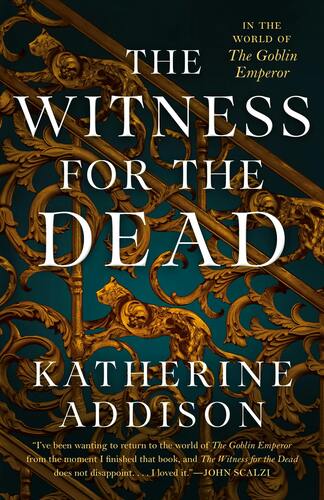
This one has been quite a while coming. I found Katherine Addison in 2022 with the second volume of a trilogy that was a spinoff to a standalone novel, which is really not how anyone should find an author, any author, and especially not this one. I thoroughly enjoyed 'The Grief of Stones' but a lot of it went over my head. That's because it's set in a fantasy world that's so vividly imagined that I felt like I'd missed out on the grounding I needed to understand the basics. For instance, I couldn't tell the difference between names and titles, let alone the many nuances of culture.
Clearly I needed to go back to the first book in this trilogy, which is this one, but, before I did that, I needed even more to go back to the much larger standalone, 'The Goblin Emperor'. I finally read that one a few months ago and was absolutely blown away by how much deeper Addison chose to go in cultural worldbuilding than I had ever imagined. The only author that I could compare her to is J. R. R. Tolkien and he didn't do this much in four hundred and fifty pages.
'The Goblin Emperor' plays out as a genuine story, with the emperor and almost the entire line of succession wiped out in one supposed accident, the tragic crash of an airship called 'The Wisdom of Choharo', and the young and naïve Maia suddenly elevated to emperor, thrown in the process into the same tangled web of courtly ritual and etiquette as we are. Mostly it plays out as a deep and glorious character study as he struggles to navigate this bewildering situation and stay alive in the process. However, it's so detailed that it's practically a college course. It's a twelve course meal of a book and we need time to recover after we're done.
The spinoff trilogy seems far more accessible, being fundamentally mysteries, but I would highly recommend that potential readers read 'The Goblin Emperor' first. I found the cultural backdrop far less daunting than I remember feeling when trying to grasp 'The Grief of Stones' without any grounding. I've met Othala Thara Celehar now, not only as the lead in that book and this but as a key supporting player in 'The Goblin Emperor'. He's the Witness tasked with quietly investigating the crash for the new emperor while the official investigation blusters around and gets nowhere. I've therefore caught on that Othala is his title and Thara is his first name.
As of this book, he's assigned to the city of Amalo, which is a long way from the emperor's court, a location he's not unhappy with, even if others are. One strand of plot here deals with the jealousy of officials in Amalo frustrated with Celehar's appointment outside their chain of command. He's got work to do but he doesn't report to any of them and they don't like that one bit. For his part, he doesn't care about any of that because he's a humble man who doesn't have a job but a calling. He has the ability to talk with the recently deceased, so ably functions as a Witness for the Dead for whoever petitions him for help.
That turns out to be quite a few people, so this trilogy doesn't boast one mystery per book but an array of them, layered over each other, which feels thoroughly realistic. The primary one this time out revolves around a corpse fished out of the canal. He soon discovers that it's Arveneän Shelsin, the senior mid-soprano at the Vermilion Opera, which prompts him to talk with Iäna Pel-Thenhior, the director of that company, who I know from 'The Grief of Stones' becomes Thara's best friend. Here, he starts out as a suspect, but never seems likely to be a killer. He's also an absolute peach of a character and I enjoyed every scene spent in his company, watching that friendship grow.
While Celehar is following leads to find out what happened to Min Shelsin, he's petitioned to solve a family dispute tied to a contested will, House Duhalada unable to go about its business until it's resolved and that business including one of the largest importers in the region. They're unable to even scatter Mer Duhalar's ashes until they know who the real heir tasked to do that is. He's also looking for Min Urmunezhen, who's missing and presumed dead, along with her unborn child. Her brother, Mer Urmunezh, believes them to have been murdered by her opportunistic husband but he has no idea where to find either the husband or the bodies.
While this is far more focused on the mysteries at hand than the language, culture and history of the land, those things are still apparent. While Celehar investigates, we learn about varieties of tea, traditional quilted dragons and even ancient history that feeds ghosts. This isn't a textbook like 'The Goblin Emperor' and it gets down to business much quicker, but it's still set in a joyously rich fantasy world. I believe Celehar is the only character to continue from 'The Goblin Emperor' to this book but the issue of the Duhalada inheritance reaches Prince Orchenis, who has Celehar temporarily reassigned to Tanvero to deal with a ghoul.
In turn, that leads him to deliver a letter to a relative in Amalo and that puts him at the scene of an entirely new airship catastrophe when 'The Excellence of Umvino' explodes in its hangar. That appears to be a genuine accident, unlike 'The Wisdom of Choharo' in 'The Goblin Emperor', but it naturally has a lot of people asking a lot of questions and he's stuck in the middle of them. Life as a Witness for the Dead in Amalo is not a trivial job nor a quiet one, though it's often a thankless one. It feels highly appropriate for the task to be a religious calling not just a mere appointment.
I liked this book a great deal. It's not as deep as 'The Goblin Emperor' in any of a dozen different ways, but it's more accessible and far more plot-driven. Given that Othala Celehar was likely my favourite character in that book, I can easily understand why Addison chose to spin him off into a series of his own and I hope that it doesn't end after three books. He's a deep character, one who believes sincerely in the importance of what he does and counts as a seriously good human being, even though he was technically a disgraced prelate before we met him, because he dared to love another man. Truly good people rarely make good characters because they're often boring but I would cite Thara Celehar as a pristine exception to that rule.
I also thoroughly appreciated the mysteries. They're very different in nature and take Celehar in very different directions. The opera singer is the most traditional, given that every question that he asks brings another facet to the mystery. The missing sister is relatively traditional too but is harder for Celehar to work because he has no easy starting point. The disputed will is inherently tied to the talents of a Witness for the Dead, so would be handled very differently in a traditional mystery novel. The ghoul is pure fantasy worldbuilding and the airship disaster is believed to be a lot more than it truly is. This is a real slice of life in a fantasy world and there's even a little extra story after all the threads are tied up.
I thoroughly enjoyed 'The Goblin Emperor' and appreciate it as an important work of fantasy, but I'm not likely to ever go back to it. This is the sort of book I'll absolutely come back to and I'm very much looking forward to revisiting 'The Grief of Stones' before diving into the third volume, 'The Tomb of Dragons', which came out this year. I see that there are already a pair of very short short stories that fit within this 'Cemeteries of Amalo' spinoff series, 'Lora Selezh' before this first book and 'Min Zemerin's Plan' between it and its first sequel. I hope there will be many more because it could run forever and never get tired. ~~ Hal C F Astell
For more titles by Katherine Addison click here
|
|