|
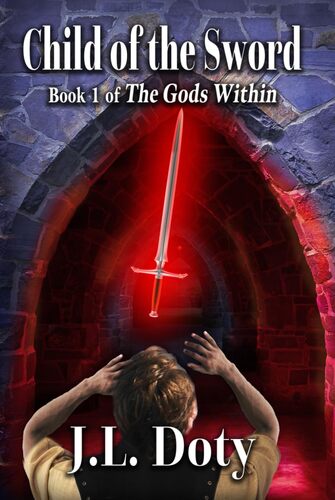
Jim Doty is another TusCon regular that I meet every year but, unlike the others whose books I've been reading and reviewing of late, I've done panels with him. In fact, we even became each other on one panel, at least briefly, though I can't remember the details around why. Long story short, I have known Jim for a long time and yet somehow I'd never picked up one of his books. I fixed that state of affairs last year with this, the first book in a series called 'The Gods Within'. This year, I'll need to pick up the remaining three and whatever else I can find of his. I enjoyed this enough that I stopped taking notes about halfway through, because I was too invested in the story.
There are few flaws, but one is immediately obvious, namely its extremely tight margins. This is a longer book than its page count suggests, because the header and footer are combined at the top and the text extends as far up, down and into the gutter as the printer would allow. I had to open the book wider than I usually would, just to be able to see all the text. It's a surprising choice, not least because it looks good otherwise, with decent, if routine font choices, good indents and, wow, even good smart quotes. I only caught a couple of minor typos, so Telemachus Press does good work. Only their margins puzzle me.
Our focus in this first book, and potentially in the other three, is Morgin, though he goes by a few different names. When we meet him, he's simply Rat and he doesn't remotely look like a primary character. He's only six or seven years old, a stinking diseased thief with one eye swollen shut who has become addicted to gesh. He's entirely feral and probably wouldn't live much longer, but he's got an unusual talent of moving between shadows. It's an instinctive form of magic and it renders him effectively invisible to almost everybody. I say almost, because he bumps into Lord Roland, a clan witchman, who can see through that magic, and suddenly Rat is hauled off to Elhiyne.
This is a fantasy novel with a mediaeval setting and it's well-drawn. It's not deep worldbuilding in a Tolkien sense, with languages and mythologies, but it's deep in a structural sense, whether it's societally with a hierarchy of clans who either hate each other or maintain uneasy alliances, or in planes of existence. Magic users are aware of three of those, divided over twelve levels. We're in the middle of that structure in this book, somewhere within the four levels where gods, mortals and demons can meet. Mostly that means the Mortal plane, but Morgin shunts onto the Nether plane at points, if presumably not the Celestial plane. I'm guessing we'll learn more about these in later books.
At Elhiyne, Rat grows into Morgin, an adopted son who isn't immediately popular. However, time moves on and lessons are learned. JohnEngine, initially a tormentor, becomes a fast friend, even though DaNoel never does. There are countless other people in House Elhiyne, of Clan Elhiyne, of the eighth tribe of the Shahot, and Doty doesn't shy away from such an ensemble cast. Somehow, he manages to keep this deluge from getting confusing, perhaps by focusing on the ones we need to know about now but gradually shifting that focus. It's like a juggling act, where he keeps many balls in the air at once but takes turns in highlighting them, only a few at a time, until we can see them all in their places.
Morgin gains a third name relatively early on, within forty pages, and that's AethonLaw, given to him by a demon summoned in a clan ritual. This name has meaning and, while it's relatively clear what that will lead him to, there's a lot of growth needed to get there and, to people like Olivia, a powerful old witch who leads Clan Elhiyne, there's no guarantee that he'll make it. He wields skills that nobody else can but he struggles with a lot of basics. He's a contradiction who has to find the means to harness the power he clearly has and that makes him a consistently fascinating, if also a little frustrating, character.
Doty does most of the groundwork needed in the first seventy pages without it ever quite feeling like he's doing groundwork. Plenty of things happen, so it's never dry, but he introduces us to a lot of people, whether already at Elhiyne, added to it like Rat and France the swordsman, or outside it, especially during the celebrations around the marriage of AnnaLine and SandoFall, the former Elhiyne but the latter not. With so many guests from so many clans, there's every opportunity for chaos to erupt and it does, at an inn, as Morgin, initially unseen in the shadows, defuses a fraught situation and publicly embarrasses Valso, of the powerful Clan Decouix, in the process.
From here, years continue to pass, two or four at a time, so children become adults, alliances are tested and everything gradually focuses in towards war. It's no surprise when it finally comes, but, however carefully it's planned, it arrives in circumstances that leave Rat/Morgin/AethonLaw in an unusually isolated position. While that sometimes felt awkward late in the first half, it's all to set things up for a magnificent second half. Here, we dip a little into history and mythology and see a lot of different angles to what magic can do in this world, but all that happens during a good deal of action. Doty knows how to build and the best scenes and grandest scenes, which all come during the second half, sit firmly on the bedrock of earlier scenes that are lesser only in context.
I liked this a lot. Rat was an unusual character from the outset and, while he does find some sense of belonging as Morgin, he remains unusual throughout. This is very much his story and we stay in his company even as the broader story grows far beyond him. He has a knack of focusing it back in on himself, almost like the eye of a storm, and that gives us a fascinating perspective of events on a seriously grand scale. He's truly a character to shape an era, though rarely in the sort of ways we tend to expect in fantasy novels with characters who shape eras. He doesn't fit into the template particularly well, but it's never unbelievable when he does something astounding.
With so many other characters to share the rest of the spotlight, none can steal much of it, but I'd call out a few as worthy. Olivia, the face of Elhiyne, is magnetic from the outset and only becomes more so after an unexpected loss in magical battle. Rhianne has major potential even before she becomes Morgin's wife, but she often falls away in focus, only to continually reestablish herself as a worthy character. I look forward to reading far more about her as the series runs on, even if the fundamentally broken relationship between the two of them is likely to heal at least somewhat.
In short, a lot happens here and we learn about a lot more, but, even though we do reach a point where volume one can wrap up pretty naturally, there's clearly a heck of a lot more to come. The series seems to run to four volumes, with this opener followed the same year of 2012 by a second, 'The SteelMaster of Indwallin'. 'The Heart of the Sands' followed a year later while 'The Name of the Sword' arrived in 2015. Given that relatively tight release schedule but nothing since, it feels like that completes the story. Outside this series, Doty has written many other fantasy and sci-fi novels, both standalones and series, through major publishers, small presses and self-publishing. Clearly I need to read more of them. ~~ Hal C F Astell
|
|