|
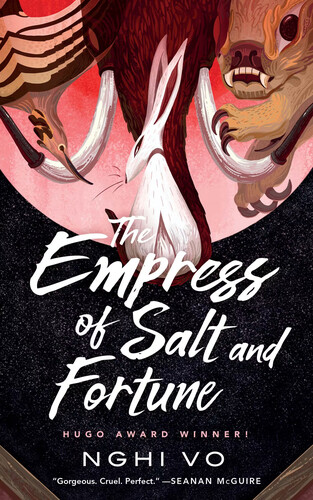
Nghi Vo's 'Singing Hills Cycle' of novellas about Cleric Chih and his talking hoopoe partner, Almost Brilliant, are designed to be read in any order, so it theoretically is no problem that I've only read books six and seven. However, like everything else I've read of Vo's, they're so good that I want to read the rest and the logical place to start, even if it isn't strictly necessary, is with this one, which was her first substantial published work and her first to receive acclaim, winning her first Hugo in the process, for Best Novella. She won a second for Best Short Story last year, for 'Stitched to Skin Like Family Is'.
Of course, this is also the first novella in the 'Singing Hills Cycle', so it's the point at which we meet Cleric Chih and Almost Brilliant for the first time. I know from those later books that Singing Hills is a monastery and their mission is to collect stories, in the broadest sense of that term. Some are mythical stories, legends and folk tales, preserved in myriad versions that vary in details here and there to cater to local tradition. Others are journalistic stories, the news that over time becomes history, telling what happened in particular places at particular times. Many are just details, like the inventory that our friends expect to take at the compound called Thriving Fortune near Lake Scarlet, where In-yo, the Empress of Salt and Fortune, spent a period of exile.
The later books mention various emperors and empresses but with their reigns kept as backdrops for stories that may be smaller but are still nonetheless important. I wondered if this first one, an initial volume named for one such empress, would bring us closer to them, or at least one of them, but Vo only brings us that within a story. What's special about this story is that we can't be sure if it's true, in part or whole, or made up out of whole cloth. It seems like we ought to take it as read, because, as outrageous as it becomes, it's entirely plausible and internally consistent. However, I couldn't help but remember the movie 'The Usual Suspects', which did exactly the same thing but exposed during the finalé how unreliable its narrator was.
That narrator here is Rabbit, an old woman now but a child of five when she was sent by her family to the capital in lieu of five caskets of orange dye. She worked menial jobs until she was ten, when In-yo arrived, the new empress from the north. Even at this early point in her story, she brings in a personal opinion, identifying it as such but still including it within her story. Who's to say that she doesn't continue to do that, merely not calling it out. Certainly, if any of her story is true, she has an agenda. That opinion, by the way, is that history will remember In-yo unfairly as an ugly woman but that she "had a foreigner's beauty, like a language we do not know how to read." That is such a nuanced way to look at it that I'm sure it'll stick to me.
In-yo came to the Palace of Gleaming Light from the far north, presumably as part of some sort of political alliance. We never quite learn where the far north is, beyond being, well, far north, but it was crucially outside the boundaries of the land ruled by the Emperor of Pine and Steel. However, once she fulfils her duty by giving him an heir, he no longer has any use for her and sends her away into exile, with Rabbit and an army of others. What's notable here is that each section of Rabbit's story is prompted by an artifact that Chih is inventorying. This one he thinks is just trash, a scroll of birch bark with a lock of hair, a black feather and a blue silk thread, especially given that it's on his list right after a broken broom and a broken compact.
However, as Rabbit explains it, it's an important message, from the emperor to his empress, one that sentences her to exile. Just as the personal opinion suggests that not everything she tells is true, this is indication that they might be: as she explains it, she had to translate its meaning for the empress too, when she received it. In-yo thought it was rubbish too. However, the lock of hair says that her mother is dead. The jacana feather means exile. Birch bark over willow means exile over execution. She'll live but no longer at the palace.
There are a dozen chapters here and, excepting the first and last, only one fails to begin with the inventory item that sparks the next part of Rabbit's story. Everything, it seems, has meaning: the sealskin tunic closed with a tooth carved by the empress's uncle; the box of black salt; the canister of marked flat sticks. Each item, or at least one item from each batch, prompts more from Rabbit and gradually Cleric Chih and Almost Brilliant, not to forget we in the cheap seats, learn a history that hasn't previously been told.
The question, of course, is whether it's true. In-yo eventually returned to the palace and has been remembered for bringing the clerics of Singing Hills back from exile too. However, there's a gap of six years between her exile and her return during which no records were kept. Is Rabbit telling us what could be considered a serious journalistic coup, the true story of the rise and fall of imperial dynasties? Or is she spinning a tall tale that, for personal reasons, she wants to serve as the truth down the centuries? Is she a reliable storyteller or is she Verbal Kint in 'The Usual Suspects'? That isn't anything we can know for sure. I know what I think. You might think differently.
What's so wonderful about this structure is that 'The Empress of Salt Fortune' is really a minimal piece of art, two human beings and a hoopoe bird talking about an inventory. We may be forgiven in assuming that there can't be much here of substance, but it could well be that Rabbit's story is the truth behind half a dozen years of effective media blackout, full of intrigue and action, death and glory. And even if we buy into this, with fortune tellers as spies, pilgrimages as recon and star charts as coded communications, are we hearing the story of In-yo's revolution or Rabbit's? There are multiple ways even to take the details in the present about the Empress of Wheat and Flood.
I adored this, but I have a tendency to adore anything that Nghi Vo writes. It would appear to be a lot more focused even than 'A Mouthful of Dust', the story behind a famine, and less deep than 'A Long and Speaking Silence' with all its musings about belonging. However, in such a minimal way, it's a story of dynastic change, of war and peace and revolution, of revenge on the grandest scale. While it's a novella for fans of 'The Usual Suspects', it's also a novella for those who enjoyed 'The Man from Earth', a science fiction film that similarly tells the biggest of stories through nothing more than a room of people talking to each other. No wonder it won awards. ~~ Hal C F Astell
For more titles by Nghi Vo click here
|
|