|
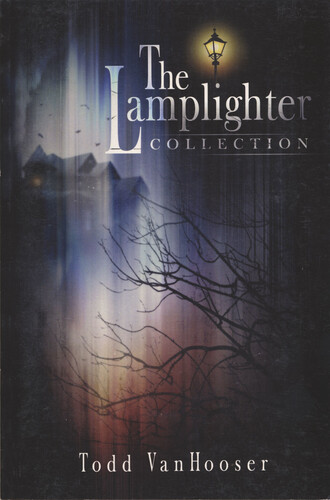
I have absolutely no idea why I've not got round to reading anything by Todd VanHooser yet. He's a well-known figure here in Phoenix, whether he's focusing on books or games, and he ran his own Laughing Moon Con for eight years at Desert Edge High School in Goodyear. Most of his work ties to his 'Laughing Moon' series, which looks like epic fantasy, but I've apparently never had money when I've seen him, so don't own those books. Instead, I have 'The Lamplighter Collection', which collates seven short stories, though one probably qualifies as a novelette.
After a quick roll of the eyes at the fact that the text is not justified, I'll talk up this collection as a strong set of interconnected stories, all focused on ghosts and/or murder. If my reckoning is good, then four of them are set in the town of Lafington for sure, with two others possibly there too and and just one set elsewhere, in the neighbouring town of Adam's Hope, so I'm assuming they're all tied up in the same general place. However, while there's mention of Laughing Moon Lanes in the first piece, I presume that's just a nod and not an actual tie to VanHooser's more expansive series.
That piece is 'The Ole Lamplighter', it's the likely novelette and it's a fantastic way to start. We're in Lafington where the title refers to an inn, built in the Victorian era but abandoned for the past seventeen years and supposedly haunted. Brad's sat on the other side of the street watching one particular window until it lights up precisely when Johnnie said it would, at 2:28am. It's an unusual light too, neither an electric light nor a candle. It's lit up before, many times, and Johnnie has got its frequency down. As we soon find, he's really done his homework.
The reason he cares, and he cares deeply, is because Compley, who ran the Laughing Moon Lanes, took Johnnie's sister Julia there seventeen years ago because she loved ghost stories. They made it to Room 204, the room that's now lit up again, but she never came out again. Johnnie wants his revenge on whatever took her and he's brought in the old gang to help him, not that they have an inkling of just how serious he is right now and how far he plans to go.
I liked this a lot. It's neatly set up as a mystery with a strong hook and it builds with flawless logic into an effective cosmic horror ghost story. There's grounding in geography, not just because the Ole Lamplighter is a local landmark in Lafington but because Brad starts out tuned into Ron "The Night Owl" Johnson on the radio. There's grounding in history, detailed effectively in the data in Johnnie's research. There's grounding in character, because we spend time with five people, each with their own reason for being there. And there's drama and conflict and action and...
It's surely the best piece here, but it does benefit from being the longest. It lasts forty-six pages, while nothing else here makes it past eighteen, and that helps to deepen it. All the others have a smaller focus and so fail to reach the same depth or impact, but none of them let the side down. I wouldn't call any of the seven weak and most of them are very strong. Justification aside, this is a book to recommend any time of year and especially at Hallowe'en.
I could wonder why 'The Long Whisper' seems to sit apart from the others, because it mildly hints at a potential lapse of theme and in so doing only serves to highlight that theme all the more. Of course, that theme is the location and that just raises another question. There are specific ties at points, like how the kids in 'Cry Baby Bridge' can't break windows in the Ole Lamplighter due to it burning down in a different story, but mostly these pieces stand apart, not specifically connected but layering on top of each other to deepen the location of Lafington. And, given that, why didn't VanHooser write a few more such pieces so that critics like me don't call the collection skimpy? I'd love to see an expanded version of this with more stories.
That story is 'The Long Whisper' and it's an effective piece, even if it feels a little isolated. It also has ghosts and history and architecture but goes for a creepier feel than the cosmic horror of the opener and achieves it. There's madness here too, which seems like it ought to show up more often in a location like this but is mostly confined to this one story. Maybe we could call Xander in 'Ruby' and Richard Morelock in 'Catharsis' mad too, given their respective choices, but neither is on the level of Kent Wheeler, glassy eyed and straight-jacketed in a lunatic asylum.
While the location is generally shared, the tones are very different. 'Catharsis' must feel like it's infuriatingly calm to Dr. Jack Krendal, given how on the spot he's put by Richard Morelock, but he reaches an unexpected ending that works just as much as a beginning. I want to know more about this story after it's done but we only get a mention in 'Wayward' unless that's even more twisted than I think it is. It's a 'Twilight Zone' sort of noir with a karmic ending, so I'm guessing that there isn't an additional layer that would change that a little.
'Cry Baby Bridge' is a Hallowe'en story, with kids looking for a scary experience and walking into a scarier one than they wanted, on an abandoned bridge on an abandoned highway. This ties back to 'The Ole Lamplighter' not just because that inn gets mentioned but because it introduces us to the ghost of Old Man Fable, a farmer who I presume is the same Kelson Fable who built it, though it was a farm then that was only converted to an inn later. It's arguably the weakest story to end the collection but it's still more than able to deliver shocks.
That leaves 'Ruby' and 'The Back Nine', which are very different murder stories. The former is all about kids, or at least young adults, old enough to chase tail but young enough to not be good at it. It's weirdly karmic and boasts an odd happy ending. Ruby Tursley ain't all that but 'Ruby' is the story most overtly focused on both ghosts and murder. 'The Back Nine' ditches the ghosts but ups the murder aspect, with a family of hitmen. Two of them chat on the back nine at the Hickory Leaf Country Club and another 'Twilight Zone'-esque story emerges from their conversation.
Put all this together and it's quite the versatile collection. Everything's consistently about ghosts and/or murder either in or close to the town of Lafington, which therefore becomes another place to only visit within the pages of books. Given that consistency, I loved how varied it is. 'Wayward' and 'The Ole Lamplighter' are night time stories that wouldn't have the same impact during the day. That goes double for 'Cry Baby Bridge' which only works on Hallowe'en. However, 'Catharsis' and 'The Back Nine' are quite happy to thrive in daylight and the latter demands it.
Frankly, the downsides have little or nothing to do with the writing itself. The book feels skimpier and more insubstantial than it is, as if it's merely a preview rather than an actual collection. The lack of justification is always unforgivable. The layout is clean otherwise, though the line spacing seems overly generous, playing into that skimpy feel. All this could be solved by a new edition, an expanded one with as many stories again. What do you say, Todd? ~~ Hal C F Astell
|
|