|
I first encountered Antoine Volodine when Gina M. Stamm translated 'The Inner Harbour' for the University of Minnesota Press. I reviewed that a year ago and I've wondered about it ever since. I hadn't encountered post-exoticism before and still don't quite know what it is, but it endowed the post-apocalyptic landscape of 'The Inner Harbour' with elusive and evocative edges. This novel is a further instalment of this sprawling series, apparently the forty-ninth and the last that uses this particular pseudonym.
Given that the narrator used to be a novelist, I wonder if he's an avatar for Volodine. If so, he's set to die as this story opens, bathed in napalm. We're at war; and, while we don't know the sides, the Americans are on the other one, a coalition of killers. The narrator is described as an indigenous soldier, so this is invasion. While Iran is very much in mind as I read, the use of napalm conjures up thoughts of the Vietnam War, especially given that the author behind Volodine is French and so was Vietnam until that point. Make of that what you will, as indeed I'd advise about a whole heck of a lot here.
He knows that he can't escape being imminently bathed in napalm but, rather than let his entire life flash before his eyes, being a novelist, he'll choose to write another one within this moment. Of course, we wonder whether he's the lead character in this novel, whose name is Sam. We don't know either way, but Sam seems to occupy a future post-apocalyptic landscape, devastated by an immense war that ended two hundred years earlier. Maybe the narrator threw himself fictionally into the future, a world without rifles or indeed cars, as a method of escape.
This novel revolves around a succession of relatives, most of them female and most of them aunts, though there are a bunch of grandmothers too and some cousins. Given that he has sex with quite a few of them, I had to wonder if these terms are always meant to be literal or might occasionally be honorifics. If it's the former, there's an awful lot of incest going on. Then again, much is vague, not least age. We're told that Sam could be anywhere between 17 and 312, while his Grandmother Wolfong, Grandmother Rebecca's mother, is apparently two hundred. When he visits a couple of cousins, he notes that "we were, basically, give or take a century, around the same age".
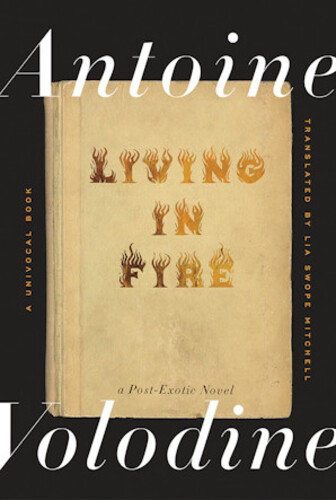
Anyway, Grandmother Rebecca is the first in this procession of relatives and she makes him read 'Living in Fire', her own transcription of her husband Iakoub's story. How we see the layers here is entirely up to us, but it could well be that 'Living in Fire' is the book we're reading, the book that its lead character is writing in his final moments and the book that he reads within that. That's a special level of meta and it brings back the potential for this lead character, Sam to be an avatar of the narrator of the novel he's in, who's in turn the avatar of Antoine Volodine, the pseudonym that wrote the novel the narrator is in, who's in turn the avatar for Jean Desvignes, the man who sits at the top of that meta stack. Or not. Who knows?
Anyway, Grandfather Iakoub's story is called 'Living in Fire' because he literally lived in fire. This is a thing, it seems, and he did it and so will Sam, says Grandfather Rebecca. A few chapters later, we watch him start to learn, taught by Uncle Slutov, except that session is interrupted when his uncle is carried off by a firebird. It isn't difficult to see all this as wishful thinking on behalf of a narrator who doesn't want to die in a great cloud of napalm. What if it couldn't touch him because he knew how to live in fire, was indeed trained to do so. Then it could just wash over him, leaving him alive and untouched. Don your cloak of fire, soldier.
If that's the case, then it would seem likely that all the other chapters, featuring other aunts and grandmothers, have similar meaning to this narrator. However, we don't know him well enough to really say. Unless there's some tie to an earlier post-exotic novel that I'm missing because I'm two books into forty-nine, then all we really know about him is that he's a soldier, former novelist and imminent heap of burning flesh. Maybe he's just flexing his imagination. Maybe there's meaning to everything and it's our job to reverse engineer it, to construct the profile of this man and see him for who he truly is, not just another victim of a coalition of killers.
Certainly, they're a characterful lot. Aunt Moïrane lives in a yurt on a steppe and sings outside in overtone style, so presumably throat singing. Aunt Mahsheed is hanged for killing five people at a bank robbery. Aunt Maïa is a sorceress, who officiates over a sky burial. Aunt Sogone is a historian who preserves culture in a world that seems to have largely forgotten what that is. Aunt Yoanna is a witch who has a collection of homunculi, a dozen of them in terrariums in an underground room on the other side of the river, accessed through a secret tunnel.
They're all replicas of family members and they're all trash, she tells Sam; especially Grandfather Bödgröm, who can't stand her. Sam runs his homunculus through with a needle. The next chapter is his funeral, that sky burial, run by Grandma Abazane who left him twenty years earlier. This is a profoundly personal section and it's hard not to imagine there being meaning behind it, but how we apply it to a novelist narrator we know precious little about, I have no idea. We can maybe see the scene with Uncle Zam's two daughters, Silsie and Madonna, as a way to gain control, but that seems like a stretch with Grandfather Bödgröm's homunculus.
Two thirds of the way into this novel within a novel, Aunt Sogone elucidates that, "We've already moved into dream mode, Sam." The response to that isn't given in dialogue, just as text from the novelist narrator: "Which was a sufficient explanation, really." In any other setting, it would feel like that was a copout. Why this? Why that? Why the other? Well, it's all a dream. Don't look for a deeper explanation. Here, on the other hand, that feels like it has meaning too. Once again, the suggestion is to make of that what you will.
I can't say I didn't like this book. In its way, it's a lot more accessible than 'The Inner Harbour'. It's engaging and kept fresh by a constant stream of new relatives who are each memorable in their own unique ways. Certainly, they're an order of magnitude more memorable here than the world that they live in, which is only ever described sparsely. We meet so few people who aren't part of this sprawling family of Sam's that I'm starting to wonder if there were any such. Is that a key, the suggestion that everyone belongs to the same family in the end? As always, I have no idea.
I guess the only way to know would be to ask Aunt Sogone, because she has access to an enormous amount of data in an enticing wealth of esoteric formats that I'd dearly love to know more about: "cassettes, reels, magic eggs, disks in various formats, memory cards, electromagnetic bands, witch cubes, films, bionic keys, storage containers." So, let's pull out a magic egg or witch cube to see it gives us any answers.
Alternatively, we could read the interview with Antoine Volodine that serves as an afterword. It's conducted by Yann Étienne for 'Diacritik', who and which are real, not just another imagination of Jean Desvignes. Étienne asks good questions and has clearly read many books in this post-exotic series. Volodine's answers alternate between neat insight and complete evasion. Then again, it's the prerogative of an author to do that and especially the pseudonym of one who's about to die, perhaps in a torrent of napalm.
The only thing I'll add is that, when I reviewed 'The Inner Harbour', I looked up Antoine Volodine and discovered a long list of French language novels, whether by that pseudonym or others, like Manuela Draeger and Lutz Bassmann, who also contributed to this series. I noticed that few had been translated into English. Looking afresh for this review, I see that that's no longer the case. Most of them seem to have been translated into English, but not all recently, suggesting not that he's becoming a target for translation but someone to increasingly talk about. I can see that. ~~ Hal C F Astell
For more titles by Antoine Volodine click here
|
|