|
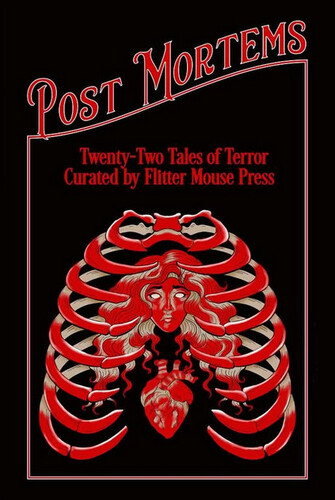
I see that the Flitter Mouse Press website has vanished into thin air and I'm now one of just half a dozen followers of their Facebook account, but I see a call for submissions to craft a sequel to this anthology. I hope they get a good response and that volume happens because this is both worthy from the standpoint of quality and important from the standpoint of giving local authors a voice. While there's no editor listed, I believe it's a lady who lives up the road in Glendale and a number of included authors are local, too. I know four of them personally and this counts as the first time at least one of them has appeared in print. I remember that feeling. It's everything.
I should emphasise at this point that it isn't a local anthology, merely an anthology that features some local authors, more than just the four I happen to know. There are also contributions from a variety of authors from the east coast, from Maine to Florida, and as far away as South Australia. Perhaps most importantly, there's nothing here that doesn't seem worthy of being in print, even though, as with every anthology ever published, the quality does vary and it's not hard to call out personal favourites. Mine were pretty clear cut after a single read-through.
The first story isn't one of them, but it's only first as the contents were ordered alphabetically by author, which is an odd choice. Usually, an editor figures out a flow carefully so that an anthology starts strong and ends strong but never feels like it dips in between. That's an art form of its own just like writing a short story. 'Weeping Willow', credited to a ghost named Alice, is a weird ghost story that unfolds with dreamlike logic. It's decent enough, though I'd have liked a bit more to the ending. It could easily have been a few pages longer and would have benefitted from them.
More obviously, there are some minor proofing errors in it, like missing punctuation, occasional missing words ("had" is a lot more important than it might seem) and a jarring sentence in which a "body was decompensating into the earth". Decompensating? I mean, technically it may not be wrong, but I'm pretty sure it's meant to be "decomposing". As I read more stories and found that some had no proofing errors at all while others had different ones, I can guess at the reason as a result of copy/pasting from submissions with later work mostly restricted to layout. If so, I'll cut it some slack as an anthology from a local small press.
For instance, 'Fun Deadly Things' needed spacing between sections, as did 'The Crimson Wing', a story with frequent double spaces instead of singles, but that problem is restricted to this story. 'The Mezzanine' has no justification but it's the only story that doesn't. 'Redemption' has a typo in its very title but none of the rest do. It also has bad smart apostrophes but other stories don't fall into that trap. 'Resolution' doesn't use smart quotes but others do. We're only seven stories in at this point and the only solution needed was a good proofreader, but it's more apparent this early just through sheer chance, because of the unusual ordering.
And I'll shut up about all that now and focus on the stories themselves, because they're why this anthology is worth reading. What stood out most to me were the unusual perspectives taken by a majority of the authors. I'm not sure what was in the call for submissions but the originality level is far above the norm. Even that opening story has a weird dreamlike logic to its ghost story. 'Fun Deadly Things' simply exudes colour. And 'It Ends on Ding' starts with a court martial nightmare about a ringing bell. That's not your typical short story, even in an anthology with a red and black cover.
Later in the book, 'Legends Only Die if You Let Them' and 'Mercy Death' are two other stories I'd be hard pressed to compare to anything. The former, by Cody Heinig, is a boxing story, one that I could easily imagine bumping into in an old pulp, but it has a darker undercurrent that explains a crucial detail, why Giovanni Labos, "The Bull", is punching harder again, even as his career fades into the sunset. This is apparently a debut story and that seems hard to believe. The latter, is an exquisitely thoughtful short story, bringing us apparitions that we fight but maybe shouldn't.
The first two stories I'd call highlights are unusual too. 'Redemption', by Emee Camp, is easily the longest story thus far and it uses its word count appropriately. It's a story of ghostly revenge in a recognisably Edgar Allan Poe style, but it's done with pirates and it's done very well indeed. Tam Chronin's 'Resolution' is a story of necromancy, as was the novel of hers I've reviewed, 'Everyone Dies Alone', because they're connected by characters. I believe we could call this a prequel story. Its conceit is that an important man wants his son saved by any means necessary, given that he's dying at twenty-five, but what the necromancer is told is cancer turns out to be a euphemism. I'm impressed with how that sets up possibilities and ramifications. I do want this series to grow.
Tam is one of the authors I know personally. The other whose novels I've previously reviewed is J. J. M. Czep, who has two stories here. Like later writers represented twice, I like one story notably more than the other, but they're both good. The substantial one is 'Scent of Dahlia' and it seems to be to be part of a much bigger work, perhaps an excerpt from a novel. I would have liked a few of these stories to be longer, but not like that. This is the only one that feels like it's more than a short story.
It's a post-apocalyptic story set in the Arizona desert, where AZ also stands for After Zombie, and the lead character is a blind scout called Dahlia. I'd read that novel, without a doubt, and I should underline how Czep never seems to write the same thing twice. That's a good thing, even if I still want a sequel to her debut novel. By comparison, her other piece, 'Scene Girl' is a fun little romp with vampires and unusual leads. There's that U word again. It never seems to be far away in this book.
That's three highlights for me but I'll add more. 'Champs Like Us', by Nick Hertzberg, is a wickedly cool story of extreme wrestling fanfic and domestic strife. It's woven together nicely in a shorter space than I'd expect would work. 'Obscura Magazine', one of two from Zak Cowell, is right up my alley, as a look at a fictional magazine that I seriously want to read. They absolutely had me with "insane, off-the-wall, borderline schizophrenic art-vomit". That's my bag, man. It's a decent story with enough multi-syllabic adverbs to make its obvious influences happy, but I also wanted more from it.
The same goes for 'Into the Spider's Web', a wonderfully escalated piece with unusual characters in an unusual situation finding, well, what's truly unusual. This one's by Leslie Cradler and I'd cite it as one of my favourites, but I wanted more from its ending, too. It's the right one but it doesn't seem like it's all there. Then again, endings were definitely a problem for a few of these authors and that's not atypical in small press anthologies like this. Maverick Hughes fell prey to that with 'The Disappearance of Sarah Graham', otherwise a neat meeting of black widow and demon.
I've skipped over a number of stories here and they all deserve a mention that doesn't include my nitpicking paragraph. I should highlight the other two by authors I know because both of them do stick their landings, even though they're relatively straightforward otherwise. 'The Mezzanine' is a simple possession tale from Bernard Betelgeuse but it's neatly told and that ending is effective in ways many of these endings aren't. The same goes for 'Hobgoblin' by Rhea Dionne. It's another first story but it gets its ending right. For a story that leads to a suicide attempt as "nothing was going to change", it also leads us to a pretty significant change, but I like it and anyone who ever got bullied for being different will, too.
What have I missed? I like the mindset behind 'Fun Deadly Things', that colourful story by Brandi Danielle Baird. 'The Crimson Wing' is manifestly gothic but set in the late twentieth-century. Josh Bell is clearly visual and he makes this evocative. 'The Midnight Train' is decent but derivative; it isn't hard to like but other authors have done it better. Joe R. Lansdale springs quickly to mind on that front. 'The Curse of Rathotem', by S. T. Talbot, is a mummy story but a highly atypical one. It wouldn't be original to use "original" yet again here. I've used it too much already.
And that leaves three stories by female authors whose names place them in the second half of the alphabet and thus right at the end of this book, given that three quarters of them begin with A, B, C, D or H. Chauntell May Saunders contributes the best pair of stories of any of the double-uppers with 'Bone by Bone' and 'The Collector'. The former is a dreamlike story of a witch but the latter is an impeccably cool story of a siren and a murder by the sea. It's poetic and lyrical and breathless. I like it a lot. And it's highly appropriate that Caitlin Umbower wrap up proceedings with 'A Spell to Release' because it's all about endings. It's an old fashioned vignette of a story but it's beautiful and emotional and it's the perfect way to close a book and remember. ~~ Hal C F Astell
|
|