|
Preston Blake's first act in this book is to tell a minister to hurry up. It's his only son's funeral and he's been dead for five days. The lack of decorum is because Geoff has died before. And he'll soon be back again, because he was continually backed up during his life and there's an army of clones out there ready to house his latest backup. Preston has lost a son but he has four thousand reset buttons and he's about to press one of them for the second time.
As you might imagine, we're in the future. The first Geoff Blake lived from 2057 to 2066. That was five years ago, so the second Geoff Blake's dates are 2057 to 2071. His younger sister Di is cloned too, but she's still on her first time around. She's twelve and healthy, unlike her brother. Preston and Dina, their parents, will choose a new Geoff from their list of clones to match their needs and here's where this particular take on cloning distinguishes itself. You may well have anticipated me getting there because of those dates above.
The typical take on cloning is that only one clone is alive at a time. If the original is dead, then one of the clones is pulled out of storage and put into place, perhaps legally taking over the original's identity. As those clones are often kept in embryo form, it takes a while for that clone to catch up to the age the original reached. Sometimes there are ways to accelerate that process but it tends to be a dangerous time for the clone. At least that's what I tend to think of when this sort of story comes up. Mary G. Thompson has a very different take on this, driven by the idea of privilege.
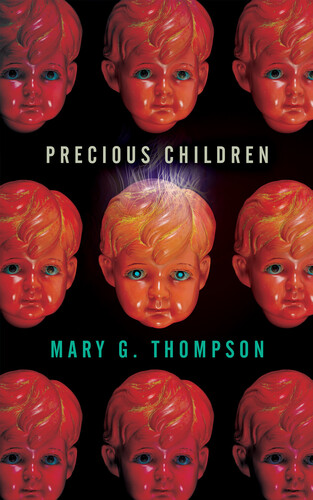
In this future world, the rich and powerful have the money to hire Generations, Inc. to clone them and create their children literally in their own image. Geoff is Preston's clone, a Preston Geoffrey Blake, Jr., and Di is Dina's clone, Dina Blake, Jr. When those children were created, they were just the first of a series of clones, taking the concept of "an heir and a spare" quite literally. Geoff and Di have thousands of spares each and they're all alive at the same time, because of a government program.
The President's Population Program offers "premium cloned" "genetically superior" children for adoption, courtesy of "several of the Greatest American Families". The privilege simply drips off that press release, because we know that none of those claims are based in science. What makes this child genetically superior to that one? What defines a great American family? Is "premium" a tier? What are the other options? I'd guess that if we surveyed a thousand random Americans and asked them to describe what these clones look like, we'd get one answer a thousand times.
And here's where privilege goes into overdrive. Preston and Dina sent out thousands of clones for adoption to families who are, I guess, less great. That's advertised as a positive for them because they probably couldn't have kids of their own and now they've got a great one, but the small print in their adoption contract says that, should the original Geoff die, his parents can select the clone they're bringing up to be their backup and take him back. Generations, Inc. will transfer the latest Geoff backup into this clone and nanobot injections will destroy whatever personality had built up in the clone over however many years, thus restoring a new Geoff who's very close to the Geoff as they lost him.
Think about that. In this case, Preston and Dina choose Nathan Carson as their new Geoff. Nathan is a Geoff clone, but he's also fourteen years old and has spent that time with adoptive parents. In the blink of an eye, the Blakes take Nathan back to effectively serve as a container that will house the essence of their son: his soul (what Generations, Inc. call Congruence) and his memories up to the point of his last backup. Then they'll systematically destroy Nathan's essence so there aren't any conflicts between the two. The body of Nathan then becomes the body of Geoff, which legally it always was, and Nathan's just gone.
If you're thinking that's a clever way to describe murder, you're not alone. Di thinks the same way and the possibilities that spring from that are merely the beginning of the twists that Thompson throws at this story. It played to me like a layered set of ideas. The first of them is the basics that I've just talked you through and, once we get that picture, it's worth putting the book down to let us think about what that means. It's only a pretty picture to people like Preston and Dina, or "the Greatest American Families" and the more we think about it the worse it looks to us.
When you're ready to pick the book back up again, it's to read the next layer that Thompson puts into place. That consolidates what we've already figured out but adds even more ramifications to complicate the morality of it all. Rinse and repeat a few more times and you have this novel. That approach means that I can't dive particularly far into what happens because spoilers come early. What I will say is that, just as the President's Population Program press release is built out of the assumptions people like the Blakes make, so is the science commercialised by Generations, Inc.
How do the Blakes know that they're getting what they've paid for? How do they know that Geoff is a Preston clone? There are probably some pretty good indicators they can work to, I guess. How do they know that the second Geoff is the first Geoff in the second Geoff's body? Maybe there are indicators there too, but I'm starting to see the potential for loopholes to creep in. And talking of loops, how secure is that process? Can all the Generations, Inc. employees be trusted? What could they do to the data on their servers if they wanted to? How hard is it for them to be hacked? Who else would have access to subvert the process? What motivations might they have to do so?
You don't need a background in cybersecurity to suddenly realise that the technology that people like the Blakes are relying on at Generations, Inc. is really a house of cards. And once we're at this point, there are a hundred directions a writer like Thompson could take this particular story. She takes one in particular and I'll let you discover which by reading the book yourself, merely adding that her choice blurs the genres somewhat.
Initially this is science fiction, set here on Earth but in the future. It's rooted in technology but it's a very human story, musing on the old chestnut of identity but after drenching it in privilege. This could be seen as an old story but it's framed in a thoroughly topical way. As the wealth gap builds in America, it's trivial to identify people who would identify with the Blakes instead of the clones. We could each compile lists and the crossover would be vast. That trawls in social commentary, an important aspect of speculative fiction. Any definition for sf applies just as well here.
It continues to be sf throughout but the more pages turn and the more complications seep in, the more it expands into other genres. It finds thriller territory when plots start to take form. Maybe we could call it a technothriller and maybe not, as it's never the typical Tom Clancy type, but it's a thriller of some description. It's also clearly a horror novel, especially for more liberal readers. It doesn't resemble the overt horror/sci-fi hybrids of someone like S. A. Barnes, but it's still a horror/ sci-fi hybrid nonetheless. In some ways, it could be considered a murder mystery too, but again not in any traditional fashion.
In short there's a heck of a lot here. It seems exquisitely simple at the outset, but then we start to think about it and the more we think the more complicated it gets, especially as Thompson layers on more and more as she goes. I could see this turned into a TV show, but while it would work well as the season arc for season one, it could be condensed into three or four episodes with a growing set of extrapolations of its single setup constituting the rest of the season, or indeed a few more.
I haven't read Mary G. Thompson before, probably because she mostly seems to writes YA or for a younger audience. This isn't her first sojourn into adult fiction though and I hope it isn't her last. I want to read more from her. ~~ Hal C F Astell
|