|
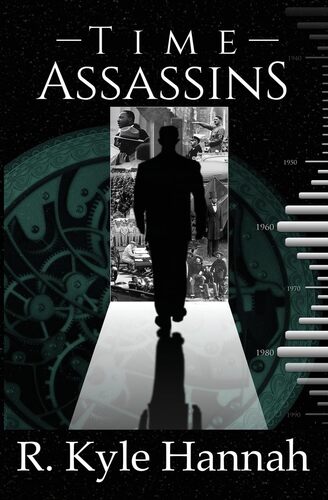
I was in two minds going into 'Time Assassins'. On the positive side, Jumpmaster Press sent me an assortment of their most popular titles after seeing my reviews of Catherine Wells's 'Aztec Eagle' trilogy. Most popular ought to translate to quality. On the negative side, damn, how many typos in the back cover blurb? I caught six in paragraph four alone, plus the potential abuse of hyphens and apostrophes. That really didn't bode well, but the text inside turned out to be solid. Most of the problems there are with apostrophes, whether non-smart or backwards. I caught fewer word problems over three hundred pages than I did in that single paragraph on the back cover.
As to the story, there's a lot going on in those three hundred pages and it only begins a story, for two further books to continue, but it's a good one and a logically complete one too. Given that it's about time travel, which can and does change timelines, there's the potential for those two later books to follow on from this or to layer onto it. Certainly this one starts simply and gets more and more complex as it goes, one of its obvious successes. Another is that it kicks off in the future and, while it only explores various pasts from there, they're both past and future to us. Well, kinda, as we can never be sure whether a particular timeline is ours. Some clearly aren't. Others might be.
I should emphasise the biggest success, which is that this all makes sense to us because there are two ways to look at the flow of events here. One is chronologically within a timeline, which is how the people who live there, potentially us, would see it. Fortunately, there's a second, which is the flow of events as they change timelines. That's how the Assassin's Guild sees things, for no reason that's been made aware to us thus far. They keep track of the changes in timelines, causing them as assassins but recording them as historians, too. The Guild archives must be utterly fascinating.
And, yes, I should absolutely get the elephant in the room out of the way right now. JFK was killed by Lee Harvey Oswald, as our history has recorded, but he was deflected into the bullet's path by Assassin 22 in order to save the life of Texas Governor John Connally. That might sound odd to you but it allowed his great-great-granddaughter to become president, too; further into the future and so save the United States from an immense financial crisis. I hope that clears everything up. No, I won't be taking questions. Let me walk through this portal in time and you'll never see me again. Talk to R. Kyle Hannah.
As you can imagine, Hannah has a vast amount of fun playing with time and real people. Just wait until Reagan's assassinated in 1980 and Martin Luther King takes office instead, only to fail at an important response when the Soviets take Europe. Obviously, that isn't our timeline but I have to point out that it isn't our geography either. In this timeline, Scotland isn't part of Britain, almost believable, but also contains Scotts, which isn't. Oh, and, Greece is apparently not part of Europe and China isn't part of Asia. I'm not sure how changing a timeline changes those little details, but hey, I wasn't there.
While I had fun watching Hannah have fun, he fortunately kept from having too much fun because he finds the time—sorry, not sorry—to build an actual plot. There are two primary strands to the story, which do connect but not necessarily in the usual ways. It's more that messing with things in a grand way tends to affect everything else, which is why there are moral rules that are drummed into every apprentice at the Assassin's Guild. Don't irrevocably damage a timeline. Don't change history to undo the Guild. And "assist history to benefit mankind".
Both threads ignore those moral rules, but for believable reasons. The first follows Apprentice 58, who has the rare ability to know instinctively when a timeline has been changed. Presumably, it's the reason why Prof. Jackson Donovan sends him to his death to protect a secret. He manages to escape, of course, or that would be a short plot thread, and it's into France in 1782. He's happy at this point, I think, to just be alive and safe from the Guild, but eventually he realises that he isn't aging. Instead of relishing this, he decides to use this great power to seek vengeance, putting an awfully long plan into motion to get noticed by assassinating American presidents.
The other thread is sparked by Reginald Mayweather IV, who's absolutely the wildly rich asshole you might have expected from the name. He's a trillionaire and he comes to the Assassin's Guild Council, formally the Directorate of Temporal Studies Council, to request the assassination of his most frustrating business partner, Douglass Dent, along with his entire bloodline. The Council is never going to say yes to that. See the moral rules. Mayweather has precisely the sort of high-up connections that get that decision promptly overridden. Funding, you know. And so this obviously doomed mission is back on. You can imagine how well it doesn't go.
Our guide through all this chaos is Jason Lassiter, an eighteen-year-old who dearly wants into the Assassin's Guild, quickly becoming Apprentice 101. It's his training that gives us some background, like those moral rules. It's his class assignments and tests that give us deeper background, with a focus on certain important individual missions. You know, the big ones. That's how he notices that the same person was at both Lincoln and Kennedy's assassinations (see thread one). Why he's the logical choice to fix things when Mayweather screws up the entire history of the Guild (see thread two), I don't know; but he is and it helps us keep a semblance of track.
I liked this book a lot, though it certainly has its flaws. Everything detailed inside the prior three paragraphs is a positive and there are a dozen associated positives to every detail waiting if you feel like this is a concept you have to explore for yourself. The biggest problem for me is that the Apprentices and Assassins lose their names when they gain their numbers. Jason Lassiter gets to be Apprentice 101 in our sight and he's never far from it, so we'd likely remember him even with a less memorable number. His girlfriend, Apprentice 97, follows suit, but I kept mixing up a bunch of the others. I'd follow a scene and then realise that Apprentice 58 isn't Apprentice 46. Or was that Assassin 58 and Assassin 46? Sometimes I had to reread a few pages to be sure.
Another problem, but one that's inherent to this subgenre of speculative fiction, not just this one book, is the lack of space for justifications. I explained why JFK had to die, because the Guild had a detail of knowledge that nobody else in Dallas in 1963 had. They didn't want to kill Kennedy but it had to be done because of that "assist history to benefit mankind" moral rule. Governor Connally was more important because of what his descendant was destined to do. However, there's a crazy long list of people who caused a lot more damage than a financial crisis and they lived on.
Why didn't the Guild take them out at an appropriate time? Hitler in 1933, for instance. Cortés in 1519 on his way to the New World. King Leopold of the Belgians before he founded the Congo Free State in 1885. I'm sure that Hannah would be able to conjure up reasons why these men remained in place as long as they did—and Apprentice 58 does save Hitler from von Stauffenberg's attempt at assassination, presumably just to piss off the Guild—but he would never have the space to do it often enough and in enough detail to satisfy everyone. Cecil Rhodes? Pol Pot? Ivan the Terrible? There are only so many pages.
Maybe Hannah will address some of that in subsequent volumes. As I mentioned at the beginning, this story has the potential to either continue in a relatively traditional manner or continue with layer on layer until the author would need some seriously detailed flowcharts to make it all work. What's to say, especially as we can't confirm which timeline is the true focus for the Guild, that it won't continue with someone assassinating the precise someone before the British colonies went rogue so that much of North America right now would be under King Charles's rule? Well, that or Queen Elizabeth's. 'Assassin's Gambit' came out in 2014 and 'Assassin's End' in 2016. Tell me that's not a tempting thought?
Thanks, Jumpmaster Press, for sending this one over for review. The third and final book you sent looks to be as different from this as this is from 'The King's Regret'. I'll happily dive into that next month. Keep up the good work. And send a Guild Assassin back to take care of the back cover blurb writer responsible for paragraph four. ~~ Hal C F Astell
|
|