|
'The Empress of Salt and Fortune', the first novella featuring Cleric Chih and their talking hoopoe, Almost Brilliant, both of the Singing Hills monastery, was a powerful look at the art of history and the bias inherent in storytelling. I couldn't tell you for sure what In-yo, the titular empress, did in her exile at Thriving Fortune because the story told to Chih is spun by her servant Rabbit who's a part of the story herself. She could have told the unbridled truth, and she's surely convincing and internally consistent, or she could have made everything up out of whole cloth for reasons of her own. Chih can only record. It's up to others, like us, to decide what's truth.
This second novella, which is unconnected except through its lead character, takes a deeper look at storytelling, nodding at Scheherezade's framing story as it does so. It's fair to say that she was highly incentivised to make her stories up on the spot, because failing to do so would result in her death. The same applies here, as Chih, sans Almost Brilliant because she's sitting a clutch of eggs, finds themself in a similar situation high up the Kihir Pass. He's being guided by Si-yu, who travels with her mammoth, Piluk, because we're in the north country of In-yo, when they're stopped by a trio of tigers.
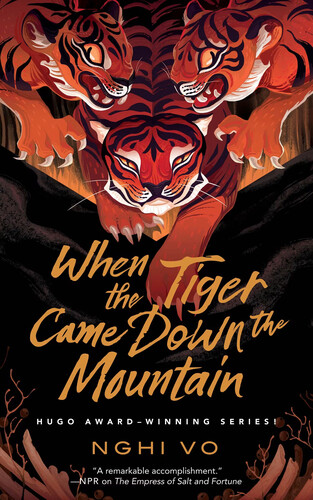
Now, these aren't your usual tigers. Sure, they can appear as the usual striped big cats with teeth and claws, but they don't have to. They can also appear as naked women and they can talk. As this series is built on vaguely Chinese bedrock, I presume they're shapeshifters rather than weres but maybe gods or demons instead. Ho Sinh Loan describes herself as the queen of the Boarbacks and the march to the Green Mountain. Sinh Hoa and Sinh Cam are identified as her sisters, but that's as likely an honorific as a relationship. None of it really matters, of course. What matters is that they're in charge and they want to eat Chih, Si-yu and Bao-so, a fellow guide they rescue from the tigers, for dinner.
Now, while Piluk is big and stompy, the advantage is firmly with the tigers until Chih tells a story because, just like Shahryar in 'The Arabian Nights', they want to hear it and, more importantly, to correct it. The story is about Ho Thi Thao, a tiger, of course, and whether Chih is honestly telling it as it's documented at Singing Hills or whether they're simply making it up on the spot, is open to debate. Either way, the tigers want it to be right and as long as they listen and correct, Chih and his friends remain alive.
So this is our framing story and we promptly dive into what Chih knows of Dieu and Ho Thi Thao, a mythic fantasy romance between a human scholar and the tiger who entraps her. While we might question whether Rabbit's tale in 'The Empress of Salt and Fortune' is agenda, we could read this recounting as a conflict of two agendas, one human and one tiger. Each species inevitably brings their own inherent bias to bear, even if they don't mean to skew it deliberately. Add in the strong incentive for Chih to spin it in such a way that it actively engages the tigers and it becomes rather a tangled web.
In other words, Chih may be making this up to save their lives, based on their memory of a story, or truthfully recounting what was written down by humans who considered it Dieu's tale with Ho Thi Thao the villain within it. The tigers, who see Ho Thi Thao as an ancestor and historical figure, may be correcting it fairly, given their inside knowledge, but could well be spinning it in reverse, given that they see it as Ho Thi Thao's tale with Dieu merely a love interest. The truth may be in between but we can't truly be sure what's fact and what's fiction. Even the three tigers disagree with each other at points and some of what they bring to bear is clearly mythical.
How it plays to us is similar to 'The Empress of Salt and Fortune' in that the tiny cast of characters is effectively restricted to one location while the stories they tell are far more expansive. Dieu is a scholar who's finished up eighteen years of study and is now ready to take the imperial exams, held every four years in Ahnfi in the Hall of Ferocious Jade. She's also female, as is Ho Thi Thao, a detail that turns this into a queer love story that's probably unusual for the time and place, even if we discount the fact that Dieu is human and Ho Thi Thao isn't.
Initially, the tiger appears to the scholar as a priestess who flirts with her without Dieu realising it. There's disconnect even at this point, the tigers seeing this as utterly obvious because of how etiquette works in their world but the human version missing it out completely. That progresses to Dieu spending three nights in Ho Chi Thao's bed, which is a euphemism we're trained to notice. While the framework of everything that follows is mostly consistent, whether it involves haunted mansions, floating ghost palaces or the capital itself, the details vary immensely and we hear all of them told both by Chih and the tigers.
Eventually, the story within a story reaches its end and the framing story also finds its conclusion, but, even more than in the first book, it doesn't matter as much as what this tells us about stories and storytelling. That the characters are vivid, even the three tigers easily delineated, only helps to deepen it, but it's hard to acknowledge who the primary characters are. Some might see them as Chih, Si-yu and the three tigers who surround them. Others might see them as Dieu and Ho Thi Thao. For my part, I see the primary character as story, not either story but story in general.
This is impeccably deep stuff, a novella working as fantasy adventure, as a queer romance and as a meta look at the very art that made it possible. 'The Empress of Salt and Fortune' spent quite a while tumbling around in my head like a complex geometric figure I was trying to line up with my expectations of what it should look like. This is deeper still and I marvel at how much it achieves. ~~ Hal C F Astell
For more titles by Nghi Vo click here
|
|