|
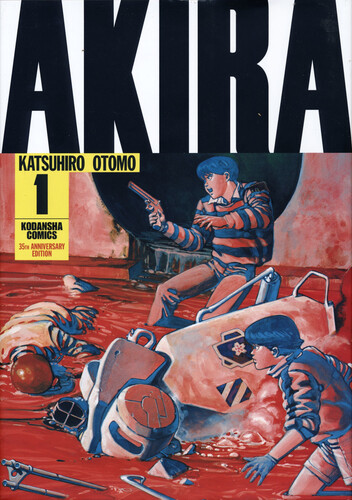
This month's CASFS Book Social shifts a little out of the norm to trawl in 'Akira', a groundbreaking Japanese manga, first serialised biweekly in 'Young Magazine' from 1982 to 1990 and adapted, by its creator in condensed form, into a legendary cult anime of the same name in 1988. I remember the film well as the first VHS release from Manga Video, who broke anime in the UK as it did so. I put a standing order in at my local shop for everything they put out. However, I haven't read the manga before, which ran a hundred and twenty chapters over six volumes, though I now have the opportunity, because my son bought it for me at our local matsuri a couple of years ago.
This is the 35th anniversary box set from Kodansha, which is a fantastic and substantial edition. It includes all six volumes of the manga in deluxe hardcover editions that use thick matte paper and smell gorgeous. They read right to left, of course, in the Japanese manner, and there's absolutely no bleedthrough. The translation is impressive, not only focusing on the speech bubbles, but with care to translate signs and graffiti in between panels. There's even a section at the front (i.e. the back when reading in this direction) to explain all the sound effects. Finally, there's an extra book called 'Akira Club' and even an exclusive iron-on patch. I don't usually spring for deluxe collector's editions, but this was a gift and I value it.
I'm tackling volume one this month, which is called 'Tetsuo' after the character with the broadest story arc. We meet him at the beginning of the black and white pages, as part of a biker gang that has taken a run out to the old city with Kaneda almost leading them straight into the huge crater that took out the Tokyo Bay Bridge in 1982.
It's here that I should explain that we're in the near future, though only if we were reading this on its original release back in the eighties. This near future is 2019, a year before Neo-Tokyo is due to host the 2020 Summer Olympics, which shows how prescient this was. Tokyo actually did win the bid to host in 2020, even though that status wasn't awarded until 2013 in Buenos Aires, three decades after this manga prediction was first published. As far as I'm aware, Katsuhiro Otomo didn't get a single other thing right, but hey, maybe this is all non-fiction that was cleverly covered up. Yeah, I don't think so. I'll still give him kudos for getting the Olympics right.
It's Neo-Tokyo now because that huge crater was the result of a new type of bomb exploded over Japan in 1982 and we see that first in a handful of colour pages told in huge panels. World War III unfolds in a single panel stretching across the top half of a double page spread. We rebuild in the panel underneath it. And then we jump thirty-eight years forward to Neo-Tokyo in 2019 to follow Kaneda and his biker gang into the old city. In lovely black and white, the old city looking organic with its roads an able substitute for veins. Of course, if it's organic, it's also very dead.
After stopping at the crater, what they call "the heart of destruction", they head back, racing for the tab on dinner, and suddenly there's a little kid in the middle of the road. Tetsuo slams on and wrecks his bike, ending up in hospital for his troubles. The kid, who's small but looks ancient, goes transparent and then vanishes entirely. Kaneda can't believe his eyes. And back we go with them to school, because they're all fifteen and on their last chances at Eighth District Youth Vocational Training School. They're scum, says the headmaster, and Mr. Takaba uses his fists to punish them. For all that it influenced cyberpunk, Neo-Tokyo is clearly not a shiny place.
There are surprisingly few characters in play, to the degree that we don't even learn the names of most of Kaneda's classmates and gang members. Kaneda and Tetsuo are the two most obvious, an imminent leadership battle turning into something else entirely and leading all the way to the big showdown at the end of this first volume. Instead, the next most obvious are Ryu and Kei, siblings who work for the underground organisation that freed Takashi, that weirdly old kid, thinking him to be the mysterious Akira of which they've heard. Other than that, the most obvious character is the huge Colonel, who's in charge of the Akira Project and sends soldiers out to do his bidding like he's throwing out confetti.
While Akira is clearly the MacGuffin of the whole series, we don't learn much about it here. It gets an impressive double-page spread early in the second half and Kyoko, who's a weirdly old girl, says that Akira will awaken soon. All we know is that it's huge, in size and importance, it cost a fortune and it's going to change everything. You know, just like a lot of MacGuffins. Here, though, there's a more immediate MacGuffin and that's a capsule of some sort of drug, which Kaneda snatches at a crucial point in the story, turning himself into a target for almost everybody else.
It's the point at which the Colonel gets Takashi back, having brought out Masaru, another weirdly old kid in a very cool hoverchair, to help him. It's Masaru who throws the capsule at Takashi, so he can stabilise. Clearly these weirdly old kids have some psionic powers but they're dangerous when untreated. Whatever this capsule is, and we can only assume from context that it's a ridiculously overpowered drug if used by anyone but a weirdly old kid, it's important to keep them safe. That assumption is only underlined during the final showdown for this volume, because Tetsuo is now a weirdly old kid who just doesn't look weirdly old yet and the Colonel wants him.
While there's a good deal of groundwork done here to set the stage for the epic story that would unfold over a couple of thousand of pages across six volumes, a good deal of this one is dedicated to action against intricately faceless backdrops. There are lots of canal systems, laboratories and industrial facilities. The final showdown takes place in warehouses. Against all that are oodles of chases, gunfights and explosions, involving a vast quantity of buildings and plenty of vehicles too, not just the futuristic bikes for which the series is rightly known but also cars, trucks and military helicopters. While everything (after the first few pages) unfolds in black and white, it's as vivid as if it was in colour.
Most of the action involves Kaneda in some fashion, mostly due to him being a wildly headstrong jerk who also happens to have possession of the MacGuffin capsule. He's a textbook example of a primary character who's simply caught up in the flow of a story as he bumps into it. It happens to him and around him but rarely because of him. The sides, if we can call them that, are the weirdly old children of the Colonel's supported by an entire military industrial complex and the obscured underground organisation run by the mysterious Nezu that boasts Kei and Ryu as members.
Otomo, who both wrote and illustrated 'Akira', as is so often the case in Japan but not the United States, wasn't new in 1982 when he began this story. He had a decade of work behind him, with an important precursor to 'Akira' called 'Domu' published a little earlier in 1980 and 1981. If that was successful, this was a sensation and it sparked an entire franchise. He would successfully adapt it into an anime himself and I've seen other feature films he wrote or directed, like 'Metropolis' and 'Steamboy'. This does feel like a magnum opus, though, and I'm already looking forward to diving into volume two next month. ~~ Hal C F Astell
For more titles by Katsuhiro Otomo click here
|
|