|
Albert Uderzo, once again serving as both writer and artist, however many editions of this album also feature the late René Goscinny's name on the cover, caught a lot of flak for decisions that he made in this one. Personally, I didn't have a problem with most of them, even the highly unusual choice of location for the traditional final panel banquet, within which many other traditions are adhered to. However, one of those decisions does fail so deeply that it doesn't just feel wrong, it actively subverts the entire point of the story. The more I think about it, the worse that decision gets. But I'm getting ahead of myself.
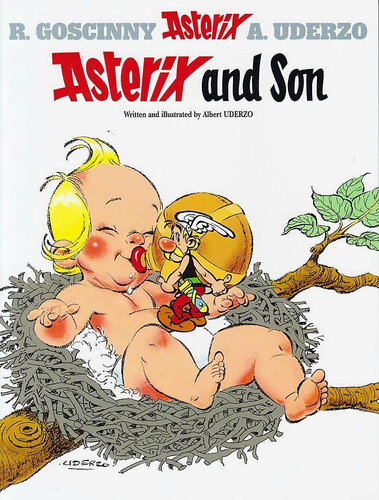
Initially, it's an absolute joy, one that pays plenty of homage to tradition. Uderzo begins the story in the Gaulish village, for a start, where Asterix and Obelix are apparently such good friends that they're sleeping together. Well, in separate beds, I should add, but in the same room in the same house. I thought Obelix had his own. Any which way, he dreamed that the storks delivered babies in the night and, sure enough, when Asterix opens his front door, there's a baby in a basket there on the doorstep waiting for him.
That leads to a barrage of situation comedy, the inept Obelix trying to help out without having a clue how to do anything useful and the ever-capable Asterix taking care of business regardless in frantic fashion. It all feels effortless on Uderzo's part, even when Impedimenta starts dropping a rude hint or six about the baby's parentage. After all, it was left very deliberately outside the hut of a bachelor warrior. You draw your own conclusions! Anyway, everything escalates even further when Obelix brings the baby a gourd with a teat to teeth on, apparently neglecting to empty the magic potion first. Suddenly, he's using Bucolix's cow as a rattle.
Now, as much fun as this gets, there's a question to answer, namely who this baby belongs to. The only clue is that it's wrapped in embroidered Roman linen, so they go to ask all the Romans in the vicinity, starting with an unexpected one. Crismus Cactus is Prefect of Gaul and he's in the vicinity to take a census of the conquered Gaulish villages. Oops! Poor timing, my dude! They can't help in Compendium, Laudanum or Totorum, but someone in Aquarium points out that the prefect has an ulterior motive: he's really looking for a baby, presumably this one. And, while they don't see this, Crismus Cactus has returned to Rennes to find Brutus there. He's the one looking for the baby.
If you haven't already worked it out, I won't tell you, but Getafix makes the initial breakthrough, pointing out that the only possible reason to leave the baby in their village is to keep it safe from the Romans. It's the one place they wouldn't dare to come. Well, not obviously, that is, but there have been plenty of Romans visiting in disguises before, in earlier albums, and it's inevitable that that tradition is soon followed here too. Unfortunately for fake pedlars and fake nursemaids, the baby, almost as soon as the magic potion from the gourd wears off, jumped into the cauldron. We know it's safe because Obelix did that as a baby too and it never wore off again. Even if he's here to be safe from the Romans, he's now more than able to defend himself against them!
It's here that Uderzo starts to deliver some new punny names. We're halfway through the book at this point and thus far there's only been Crismus Cactus, a lesser take on Crismus Bonus from the very first album, 'Asterix the Gaul'. However, the fake pedlar is Aromatix and the fake nursemaid is Aspidistra. The former doesn't have a good time of it, especially when the baby prefers rattling the pedlar peddling rattles than the rattles of the pedlar. The latter sings soldier songs, in punny translations: Lilium Marlena, It's a Lovely Bellum, even Pack Up Your Troubles in Your Old Sarcina. The end result is much the same.
And, with that done, Uderzo starts to subvert the traditions he's adhered to thus far. Then again, there's only so far this plot can go without revelations and they take us well into spoiler territory. The characters who join the story in time for that are ones we've met before in earlier books and, while I very much like who they are, they show up far too late and far too conveniently to work as well as they should. What's more, there's that bad decision to flavour the final scenes and I'll have to talk about that, given the circumstances. Put simply, Brutus attacks the village with fire and it burns effortlessly and completely.
Let's think about that a little more. This is the one village in the entirety of Gaul that's managed to hold out against the Romans. They've done it over and over again, in the face of every possible attack by an all-powerful empire. They've successfully defended against stupid attacks and clever ones, blatant assaults and subterfuge, every possible plan the Romans have conjured up. And yet Brutus can just show up with some flaming arrows and, a panel later, they're conquered. Well, to be fair, the Gauls remain unconquered because they charge out to beat up Brutus's men precisely how we expect. But they have no village left.
I'd argue that this should never have happened. There were ways to handle this end section of the story without losing their village and they're hardly obscure. Every other detail that was needed, from the traditional scenes with the pirates to our introductions to the baby's parents could have been there pretty much exactly as they are, even if the village wasn't burned. And, let's dig just a little deeper. The whole point of placing the baby on Asterix's doorstep is because it's the safest place for him in the whole of the Roman empire. How we can go there and then have Brutus burn down the entire village, including Asterix's doorstep? I don't get it.
The only scene that relies on the village being burned is the final panel banquet, which is held in a different location because the usual one isn't there right now. However, wherever it is, it's still a final panel banquet. Obelix is still devouring boar. Cacofonix is still tied up and gagged so he can't sing. Dogmatix is still chewing a massive bone. Sure, there are a couple of rather unusual guests at the head of the banquet table, whose gratitude apparently trumps this stellar opportunity for conquest, but I'm okay with that. There's plenty of irony there. But the village should be there too. ~~ Hal C F Astell
For more titles in this series click here
For more titles by Albert Uderzo click here
|
|