|
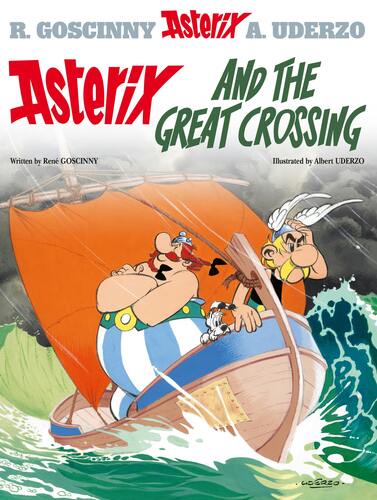
Twenty-two books in and with precious few left for writer René Goscinny, he and illustrator Albert Uderzo demonstrate that they're still full of novel ideas. Case in point: the glorious first page, a somewhat brave and experimental opening that I utterly adore. It's laid out in panels, just as we expect, but every one of them is devoid of everything but speech bubbles. Two characters we've never met are conversing, even if we can't see them.
One is called Herendethelessen and his dog is Huntingseåssen. Well a "little døggy" because it's all in English (in translation, of course) but with myriad accented characters. "Wøuld that white thing øver tø stårbøard be ån iceberg, by åny chånce?" Yes, the speakers are Vikings in "icy seas, veiled in dense impenetrable mists". No wonder they're lost from our sight, even when they pull "øver tø pørt just å whisker" to avoid the iceberg that we can't see either. I guess they're used to this.
Then it's back to our favourite Gaulish village to set up the story of how we're going to eventually connect to the Vikings. It begins with Vitalstastistix having to carry his own shield after his shield bearers got sick from eating Unhygienix's fish. I'm surprised he ever does any business, but then you can't have boar for every meal, right? Shut up, Obelix. Nobody asked you. Anyway, it's due to him being at the very end of his stock. His fish come from Lutetia (Paris) but their ox cart drivers are on strike over the price of hay.
That leads to brawls, of course, because however indomitable these Gauls are, they're still more touchy. The first time (and indeed the last time) we see Romans anywhere in this album is when one centurion and a bunch of legionaries hang about outside the village relishing in the fact that they're not involved in the fight for once. They're not involved in the story either, because where we end up is outside even the expansive Roman empire. Two panels is all they get.
It's Asterix, of course, who points out the obvious. Why doesn't he fish for fish in the sea, the one that's right next to them? Unhygienix is happy to wait. Getafix isn't. He needs some "reasonably fresh fish" to make his magic potion, because there isn't much left and who knows when they will find themselves in a story with a lot more Romans than this one. Therefore, it turns into what we could call a national security issue for this enclave of Gauls and someone needs to go fishing. And of course, that means Asterix and Obelix, but it doesn't go well because the latter literally hurls out the net without holding on to one end and a huge storm spins up. There's even a panel that's an obvious homage to the Hokusai wave.
Just to counter that experimental opening page, we promptly get almost the precise opposite: a page where ten of the twelve panels are entirely black except for speech bubbles. It's night, you see, and, while it all starts with our heroes talking (and yes, they took their dog too), the Vikings promptly join in too. It turns out that Herendethelessen was talking to Steptøånssen, now likely my favourite punny character name of the entire series. It probably means nothing to American readers, but 'Steptoe and Son' was the British sitcom on which 'Sanford and Son' was based. Yes, even that iconic show was a transatlantic remake.
The boats drift apart by morning, so the ship that the Gauls spy in the distance is the pirates, who are blessed with two full pages this time out, perhaps to make up for the skimpiest of mentions a book earlier in 'Asterix and Caesar's Gift'. It's a joyous two pages too, as they're celebrating their captain's birthday with an immense feast but Obelix is hungry. They don't sink the ship this time, merely take the food, except for a sausage to avoid being seen as greedy. I guess that, in its way, this is absolutely a happy birthday for the captain!
Meanwhile, back in the regular story, the storm spins up again and sends them west towards the setting sun. They reach land and discover turkeys and a bear and, oh hey, Indians. "It's like a new world," suggests Asterix. Indeed and Goscinny and Uderzo have an absolute blast on what we can safely assume is Manhattan Island. How do we know? Asterix attracts the Vikings by standing on a pile of rocks while holding up a flaming torch. Hey, the Statue of Liberty was French, right? When the Vikings offer beads, there was historical precedent!
Frankly, I couldn't possibly choose between any one of half a dozen moments here as a favourite. Obelix thinks the Native Americans are Romans disguised as turkeys. He punches one that comes at him with a tomahawk and he sees fifty stars. Of course, they don't speak the same language, so the Gauls try to explain who they are in mime. Now it's the Native Americans who think the Gauls are crazy. Herendethelessen quotes Neil Armstrong as the Vikings land. With accents, of course. "Øne småll step før me, å giånt leåp før månkind!" They can't communicate either, as Asterix is unable to put his accents on the right letters. I'm not going to try to type that! But the dogs can communicate fine. "Woof!" "Wøøf!"
If I was hogtied and forced to pick one moment, it would be when right before Obelix finds out he just got married to the chief's daughter. That's a pretty good one too, prompting their escape in the Viking longboat, but, right before it and right after Obelix teaches the Native Americans how to dance like an Iberian, we're treated to a half-page panel of the two Gauls hunting buffalo, bear and antelope, but painted on leather by a talented Native American artist using their own style. He even includes Dogmatix! Wouldn't it be great if some archaeologist dug that up! After they're gone, another artist builds a totem pole with Dogmatix on top of Asterix on top of Obelix.
Of course, there are many punny names, but they're restricted to the Vikings, as stereotypical as the Native Americans, or indeed the Gauls, with horned helmets, long hair and huge moustaches. There's also Håråldwilssen and Nøgøødreaåssen and, a little later, Ødiuscømpårissen, their chief. There are women too, not just Gertrude and Intrude but also Irmgård and Firegård. I should add that these Vikings are Danes rather than Norwegians, because that's where the jokes focus and they focus fast. There's a Little Mermaid joke, a saga joke and at least three 'Hamlet' jokes. Oh, and Huntingseåssen is a Great Dane! Nice.
They even find a Gaulish slave, Catastrofix, who, very conveniently, is a fisherman, meaning that, when they finally arrive home, they do so with fish. And, for once, it's Unhygienix under the tree while everyone else feasts in the traditional final panel, because the fish is too fresh for him. Ha!
I'm sadly counting down to the end of René Goscinny's run on 'Asterix', because he passed in 1977. 'Asterix and the Great Crossing' was published in 1975 and 'Obelix and Co.' followed in 1976. After that, there's only one more album that's credited to both Goscinny and Uderzo, a posthumously published 'Asterix in Belgium'. So I have one more to go during Goscinny's lifetime and one more after that before the series was taken over entirely by Albert Uderzo. Well, until much later, but will explain those details in a year or so. Meanwhile, see you next month for 'Obelix and Co.' ~~ Hal C F Astell
For more titles by René Goscinny click here
For more titles by Albert Uderzo click here
|
|