|
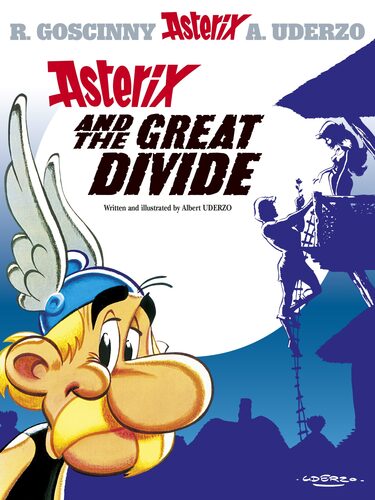
While 'Asterix in Belgium' was finished by Albert Uderzo, it was begun with his traditional writing partner, René Goscinny, and the majority of it was the two of them working together, as they had since 'Asterix the Gaul' in 1961. Sure, Uderzo finished it up solo, but doing that is a wildly different thing to conjuring up an entire album from scratch, which is exactly what he did here. 'Asterix and the Great Divide', for the very first time, was "written and illustrated by Uderzo". It was 1980 and he would continue solo until 2001, but while Goscinny and Uderzo's two decades together gave us twenty-four books, Uderzo solo would only add seven more over the same period.
Initially, it seems very different and for a couple of very different reasons. One is that we begin in a different village and remain there for five pages. Sure, it's "very like the village where Asterix lives" but it isn't the village where Asterix lives and, on the rare occasions when we don't start in that one, we get there quicker than this. The other reason is that everything is clearly metaphor. This village features a huge ditch that has been dug right through the middle, effectively turning it into two villages. Cleverdix is the chief of the left. Majestix is the chief of the right. Nobody can get from the right side to the left side and vice versa.
Just in case we don't read this as political metaphor, Uderzo hammers the point home. Neutrality doesn't work, for a start, because there's one house that's on both sides but it's occupants merely fall into the ditch in the middle. Rather appropriately, that house belongs to Schizophrenix. There is wordplay here too, which I assume was there in the original French language version and didn't arrive with the English translation: "But it would take positively sinister dexterity to solve certain vital problems...", sinister being left in Latin and dexter being right. However, for once, wordplay isn't the point. Metaphor clearly is, even if it's vague. I assumed Uderzo was riffing on a polarised state of French politics, but apparently he was thinking of Berlin, still separated by its wall.
Perhaps most tellingly, the pair of characters who would dearly like to fix this state of affairs have a pair of names that suggest they aren't being listened to: Cleverdix's son, Histrionix, who doesn't like Majestix and his slimy henchman, Codfix, rigging votes; and Majestix's daughter Melodrama, who remembers when the village was happy under one chief, Altruistix, even if he also stole taxes from the village, like his cousin, Alcaponix. Both chiefs speak to their opposing sides. It becomes a battle of thrown tomatoes, then descends into a brawl outside the village. Nothing is solved, but both chiefs claim victory.
So to our usual village, which coincidentally also quickly descends into a brawl, even if it's for less metaphorical reasons. Wouldn't you be upset too if a wayward fish hurled in anger slapped you in the face? At least this brawl is polite enough to stop for dinner. While tempers constantly flare in this village, even when less than fresh fish aren't involved, they also quickly defuse and everyone can return to getting along like a house on fire. See how unreliable metaphors can be? Anyway, as the story is obviously in the other village, we promptly shift back there to find out what it is.
Apparently, it's 'Romeo and Juliet'. Surprising nobody, Histrionix and Melodrama are apparently an item and it doesn't take the former climbing a rope ladder to the latter's balcony to highlight the comparison. Suddenly, the left side of the village doesn't just represent West Berlin, it's also the House of Montague, while the right side serves as both East Berlin and the House of Capulet. Then again, reinventing 'Romeo and Juliet' as 'Histrionix and Melodrama' isn't too far away from the truth. Suddenly ending with double suicide seems entirely appropriate.
However, there's also a villain of the piece in Majestix's henchman Codfix, who claims the role of Count Paris by scheming to marry the leading lady. Uderzo paints him so outrageously as a villain that he eventually trumps all the metaphors and allusions and practically reunites the village in a common opposition to him. He looks rather like Charles Laughton playing the Hunchback of Notre Dame, if the Hunchback lived in Innsmouth instead of Paris and studied Macchiavelli deeply so he could land a job as a Disney villain. He just can't be sure which. He's half every wicked witch that's ever shown up on screen and half Sir Hiss in 'Robin Hood', merely as a fish instead of a snake.
Eventually we realise this story has to connect with our regular characters but Uderzo keeps that hanging for fourteen pages. I can't imagine that Goscinny would have taken that long, and that's a difference I'll keep in mind as I move into the next half dozen solo Uderzo volumes. However, he does get there eventually. The trigger is Codfix persuading Majestix to bring in the Roman army to make him the only chief, in return for Melodrama's hand, of course. The link, after she reports that to Histrionix, is that Cleverdix fought with Vitalstastix at Gergovia. He knows about Getafix and his magic potion and sees it as the only way to keep the Romans out of his village.
And so Histrionix rides over to explain everything and, after Obelix bawls at the thought of a love story with an unhappy ending (boy, would he have kittens at 'Romeo and Juliet'), he joins Asterix and Getafix to lend the help needed. At this point, we're sixteen pages into the story and yet we haven't seen a single Roman. That's highly unusual, but Uderzo makes up for that anomaly too as he brings us plenty of them from here on out. He doesn't give us the name of the local camp but it seems it's run by Centurion Umbrageous Cumulonimbus (say that ten times fast), with a decurion called Infectius Virus and a sentry called Sourpus. Sadly, those are all the names we get.
While I've highlighted just how many departures from the norm Uderzo has taken thus far, I want to emphasise that there's actually rather a lot of traditional fun to be had during the second half of the story. While everything was set up to be inevitable, he proves able to flex his writing chops by twisting away from much of the predictability. Sure, there's a happy ending to be found and an awful lot of Roman bashing and a traditional final panel banquet with Cacofonix tied from a tree branch like a piñata, but how we get to those points isn't in the straight line we might have drawn after the setup and that's a good thing.
For one thing, there's a major subplot concerning slaves and our indomitable Gauls bashing their way into the Roman camp to volunteer their services to their masters as such never gets old. For another, it gives Uderzo a glorious opportunity to let his art drive the story for a change instead of the other way around. Thus far, every time that I've suggested that Goscinny would have done something differently, I'm also hinting that he would have done it better, largely because he was a writer. Here, I'll say the same thing but with the opposite meaning. Goscinny would likely have handled Getafix's other magic potion differently but, while he might have done it without such a blatant plot convenience, he'd have mostly done it worse, largely because Uderzo was an artist.
These are visual scenes first and foremost and I'm actually surprised that Uderzo didn't let more of his panels in this section flow past entirely without words. Sure, some benefit from their puns, but most don't need them at all because they're hilarious all on their own. And, quite frankly, at the point he takes us both into karmic justice and a joyous riff on 'The Incredible Shrinking Man', he delivers some of my favourite panels of the entire series thus far. The one with Asterix calmly towering over an entire miniature Roman legion is utterly priceless and many more over a three-page section aren't far behind it. We've never seen Dogmatix this up close and personal before!
So, while Uderzo is clearly not the writer that Goscinny was, he doesn't try to be. He's willing to be his own writer, pandering to tradition while mixing things up surprisingly well for a solo debut. He shines brightest as a writer doing both at once, such as a couple of pages of mayhem as the Gauls sink the pirate ship yet again but without actually fighting the pirates. It's a Histrionix vs. Codfix showdown with this latest ship merely the battleground. I like that. It's traditional but different at the same time and, twenty-five books into a series, that's the key to keeping things fresh.
I'd call this a success and it bodes well for Albert Uderzo's second solo effort. See you next month for 'Asterix and the Black Gold'. ~~ Hal C F Astell
For more titles by Albert Uderzo click here
For more titles in this series click here
|
|