|
I liked the previous album, 'Asterix and the Magic Carpet' a great deal but I like this one more. It's clear that Albert Uderzo, having decided to continue the series solo after the death of his writing partner, René Goscinny, had come through that transitional period intact. 'Asterix and the Great Divide' was too experimental for a first outing and 'Asterix and Son' displayed some questionable judgement. However, 'Asterix and the Black Gold' in between them, was pretty solid and 'Asterix and the Magic Carpet' better still. This, however, is easily the best of the five thus far.
Rather than explore a historical battle between the Gauls and the Romans, this immediately sets itself up to be about an even older battle, that between the sexes. Initially, it's the children of the village foreshadowing what's to come. Fulliautomatix's daughter wants to join the war games of the boys but Unhygienix's lisping son tells her she can't. That prompts the brawl you'll expect and we're off and running. It escalates, of course.
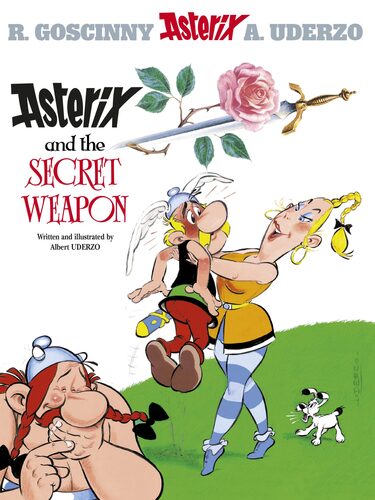
Uderzo takes us to school, where we learn that only druids and bards are qualified to teach. That means that Cacofonix does have an actual function in the village, beyond his voice making it rain. However, the ladies withdraw their kids and, what's more, they've already hired his replacement, a female bard from Lutetia. She's Bravura and her arrival, in breeches no less, sparks everyone in the village to manifest their beliefs about the difference between the genders. Before long, this results in a women's lib movement, led by Bravura, of course.
Of course, all the men betray their misogynism, something ably backed up by the panel where the wives introduce themselves to Bravura as Mrs. Unhygenix, Mrs. Fulliautomatix and Mrs. Geriatrix. If we hadn't noticed already, we're twenty-nine books into the series and we've never heard their actual names. We do know that Vitalstatistix's wife is Impedimenta and she plays a huge part this time out, but I honestly can't remember any other female villagers being named, except Panacea, who isn't in this book. That's pretty telling.
Of course, Asterix and Getafix are the most progressive male villagers, as you might expect, but I wouldn't call them entirely on board. Getafix might point out that they're entering the "modern era of the ancient world", meaning that "it's only right for a woman to be considered the equal of a man, with all the aspirations and ambitions hitherto denied her!" However, that doesn't mean they can become druids! Asterix is polite but when Bravura comes on to him and slaps a kiss on his cheek, he punches her and, even though he's horrified that he struck a woman, is promptly exiled by the village council, which is now entirely comprised of women.
He's hardly alone though, because all the men leave to live in the forest, meaning that Cacofonix, who was the first out, finds himself tied up and gagged again. That includes Getafix, which leaves the village without magic potion, something that does not go unnoticed by the women, who are now running the village, with Impedimenta as their chief, formerly, of course, merely the wife of the chief. Bravura plans to negotiate a peace with the Romans to obviate the need for it, but it's not hard to figure out how that's going to go.
If you think you can write the rest of the script from there, you may or may not be right. Some of what Uderzo throws at the wall is completely obvious, like the detail that Bravura's singing is just as bad as Cacofonix's, but much of it isn't. I should point out here that he's got a wildcard to throw into the mix which plays very nicely with the theme of the piece, courtesy of the gloriously named Manlius Clapham-Omnibus, who has recruited a "very special century" as a Roman secret weapon and he's already set sail for Gaul by the time Bravura kickstarts her women's lib movement.
I had a blast with this one. It's a traditional story but it's given a vicious and overdue twist that is very welcome. Of course everyone makes up by the end, with all the ladies of the village guests of honour at the traditional final panel banquet. Bravura even promises to take Cacofonix back with her to Lutetia to introduce him to Ziegfeldfollix, the impresario. That does remind that there are few new punny names here, even if Manlius Clapham-Omnibus is an absolute gem. Ziegfeldfollix, whose name only arrives in the final panel on the final page, may well be the second.
That's ignoring any raised in song, though Uderzo does have fun there. Cacofonix, continuing the running joke that served as the central conceit in 'Asterix and the Magic Carpet', finds himself hit by lightning while singing 'Sergeant Peppus' Lonely Hearts Club Band' in the forest. Bravura gets most of the songs, though, starting with 'Armorica the Beautiful' and moving into 'Mollia Malone'. "In Lutetia's fair city..." Cacofonix returns for the most crucial songs, at least as far the story goes, but "an anacreontic ode transcending the verbal dimension" is funnier visually than lyrically.
Other than thoroughly enjoying this from spark to reunion, even the twist where the pirates find themselves sunk by Romans for once, instead of Gauls, I think it's Uderzo's focus on Cacofonix that I left thinking about most. He's been a series regular from the very beginning in 'Asterix the Gaul' but, for the longest time, he served little purpose beyond being a running joke who features in an awful lot of other running jokes. Yes, given how this one goes, he's even welcome at the final panel banquet.
However, Uderzo seems to think more of him. He was pivotal in 'Asterix and the Magic Carpet', an album that literally couldn't exist without his involvement. Everything relies on his singing, which still seems bizarre to me, even after reading and enjoying that book. Here, it's probably unfair to go that far, because this album could easily have been written without him being as important as he is, but had Uderzo made that choice, it would have been very different indeed. Without him, it wouldn't have been as easy to introduce Bravura and, without her, a whole new mechanism would have been needed to explore the theme. So yeah, he's pretty crucial here too and that makes two albums running. I wonder what he'll be doing in 'Asterix and Obelix All at Sea'. ~~ Hal C F Astell
For more titles in this series click here
For more titles by Albert Uderzo click here
|
|