|
Just as book twenty-two in the 'Asterix' series closes in on a milestone, the death of writer René Goscinny, so book twenty-two in the 'Adventures of Tintin' series closes in on one, namely its end. It only reached twenty-four volumes and this is where we shift into the end times.
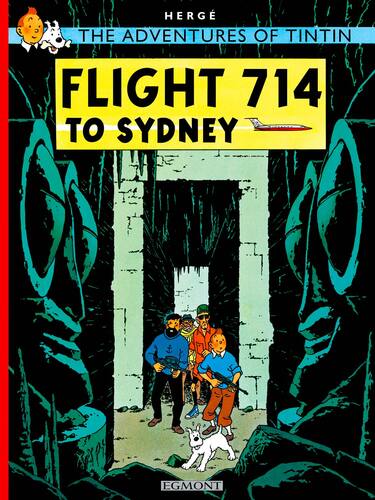
The first volume, 'Tintin in the Land of the Soviets', which I haven't reviewed yet, for reasons, was serialised from 1929 to 1930 and the series continued, almost without interruption, until 'Tintin in Tibet', serialised from 1958-1959. The first real gap, even accounting for World War II, came before 'The Castafiore Emerald' but only lasted a year, that book picking right back up from 1961 to 1962. However, Hergé apparently got bored with his own series, after over thirty years, so 'Flight 714 to Sydney' didn't show up until 1966 to 1967. It doesn't feel like the same 'Adventures of Tintin'.
Next month, I'll be diving into 'Tintin and the Picaros', which followed an ever-large gap, arriving between 1976 and 1976, and then 'Tintin and Alph-Art', which was unfinished when Hergé died in 1983 and was only published three years later, not being collected into album form until 2004. I'll wrap up my 'Adventures of Tintin' runthrough, with that initial volume, which wasn't collected in the English language or indeed in colour until 2017, making it both the first and the last volume in the series. I've had a blast working through these glorious books, but this one emphatically gives me sinking feelings about the last couple.
Frustratingly, it starts really well. Captain Haddock slips a five-dollar bill into the hat of someone he believes to be homeless. Daydreaming about his good deed, he trips over a suitcase and lands on Skut, the Estonian pilot from 'The Red Sea Sharks'. He's now the pilot of a private plane for the tycoon Laszlo Carreidas, "the millionaire who never laughs". Right now, he's flying him to Sydney for the International Aeronautical Congress. That's where they're going too, invited as guests of honour as the first men on the moon.
The joke is that Carreidas is the "homeless guy". Prof. Calculus, as deaf as ever, fails to realise the situation and retrieves the five-dollar bill from the tycoon's hat. Thinking him a natural clown, the millionaire who never laughs promptly laughs and hard, for the first time in years. Of course, he's eager to invite these heroes onto his private plane, but intrigue got there first. Of course, we're immediately suspicious of the new fish. Paolo Colombani, Skut's brand new navigator replaced the old one who fell ill in Teheran. Hans Boehm, the new radio operator, replaced the one who had an accident with a petrol tanker in Singapore.
The replacements were both chosen by Mr. Spalding, a dapper English gentleman who serves as Mr. Carreidas's secretary and soon exposes himself as a villain during the flight. Then again, the whole bunch are villainous in their way, naturally; except for Skut. Carreidas cheats at Battleships using closed-circuit television and, while he doesn't initially want three Picassos, two Braques and a Renoir, when he realises that Onassis is after them, he suddenly wants them at any price. Then again, Onassis was a villain too. If we're talking Aristotle, he groped my aunt.
So far so good, but that's pretty much where the good stuff ends. There are moments to come, to be sure, and I'll happily highlight them, but we're only a dozen pages in and it starts to fall apart at this point. If Hergé had stuck to his initial plot of the villains stealing Carreidas's experimental supersonic plane, the Carreidas 160 capable of Mach 2 with its long nose not unlike what Concorde would end up with, just not quite as pointed, we might have been okay. Instead, we head out to the island Pulau-pulau Bompa with its ridiculously short runway.
Oh hey, there's Rastapopoulos, who didn't get eaten by the Red Sea sharks after all. And, as ever in his shadow, is Captain Allan. The former is broke, so decided that it would be far easier to steal Carreidas's fortune than to make another one for himself. The latter locks them up inside an old Japanese bunker, the plan being that they'll be towed out to sea and sunk. Only Carreidas will be kept alive, because Dr. Krollspell has a truth drug and that'll get the account number for his Swiss bank account. Rastapopoulos has already found out the rest.
And so we go, but the story you're extrapolating in your head from that setup isn't really the one that we end up reading. What matters is that, after their inevitable escape, Tintin and Haddock hide in a cave and in so doing discover that the locals won't follow them for superstitious reasons. Suddenly Tintin knows exactly where to go, because he's hearing messages in his head, right down to how to tilt a giant statue to expose a secret passage. And, just like that, we're in pseudoscience territory that's prompted by aliens.
Now, as enjoyable as they tend to be, Hergé's 'Tintin' stories often rely on plot conveniences that allow an entire adventure's worth of action intrigue to be condensed into sixty-four pages. I now forgive all those plot conveniences, because none of those books relied on material like this. The good guys don't really do a heck of a lot, mostly let the story happen to them. Meanwhile, the bad guys are all pathetic, deliberately played as slapstick jokes. What story there is hinges on all sorts of unlikely topics: telepathy, hypnotism and extra-terrestrials, for a start. Suddenly, Calculus and his dowsing rod seem almost acceptable. Oh, and very little is truly explained, the majority of the details that matter left deliberately unexplained.
What good there is in the last three quarters of the album is visual, especially late underground scenes in the caves, with lava flows and heat smoke, those greens soon changing to blues, for the similarly visually striking scenes with a lake emptying before the eruption of a volcano. After all that, I was shocked to find that I welcomed the page with Jolyon Wogg, one of my least favourite characters from the entire series. Then again, he doesn't interact with anyone else, because he's watching them all on television.
Okay, you got me. It's not all that bad. I did find some of the humour just as funny as usual. Haddock enjoys more alliterative profanity, which is as focused on the letter B as always, but his choice of words doesn't merely include "Bashi-bazouk!" and "Billions of blue blistering barnacles" this time but also "Breathalyser!" I like. The early slapstick scenes with Calculus making Carreidas laugh in unexpected ways are masterfully handled. The professor certainly earns his keep in this one! And maybe I got some laughs out of the use of Krollspell's truth serum. Papadopoulos and Carreidas arguing over who's the most wicked could have gone horribly wrong but I loved it.
That said, that joke gets old pretty quickly and Hergé milks it for far too long. The running gag of Papadopoulos getting bumped on the head was old when it began and the ensuing slapstick isn't ever welcome. Perhaps most frustratingly, there was so much opportunity for Hergé or his studio to draw some wonderful underground cave scenery but they studiously avoid that until almost the end of the album, fifty-some pages in with only ten to go. It probably doesn't help that Carreidas looks conspicuously close to Sylvester Sneekly in his alter ego of the Hooded Claw, which made me imagine him sounding like Paul Lynde.
All in all, this is a minor entry in the series, the first in a long while, albeit mostly explained by the fact that Hergé had apparently "fallen out of love with Tintin. I just can't bear to see him." I now hope that I'll still bear to see Tintin in his final completed adventure, 'Tintin and the Picaros'. ~~ Hal C F Astell
For more titles by Hergé click here
|
|