|
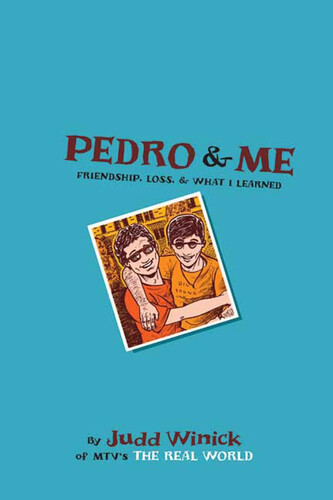
I had no idea going into this book who Judd Winick or his friend Pedro actually were, other than a helpful note under the author's credit on the cover to say that he's "of MTV's The Real World'. I'm not a particular fan of reality TV, so all I know is that it's an example of that, presumably a major one, given that I've heard of it, so I looked it up before diving in and learned quite a lot. I'm happy that I did that because, while Winick does cover a lot of that ground within these pages, he leaves certain things out, potentially for legal reasons, and I'm glad that I knew about them.
For anyone out there like me or, if it's possible, someone who knows even less about this than I do, I should point out immediately that you don't need to like reality TV to like this book. What it tells involves reality TV and we see how such a show functions, at least from the perspective of a pair of participants, but the goal of 'Pedro and Me' is utterly not the same goal of a reality TV show, not even 'The Real World'. Now, fans of that show, especially of its third season, broadcast in 1994, will appreciate this, I'm sure, but they really aren't the target audience.
The target audience is everybody, at least everybody who's willing to read a graphic novel about people. It's fundamentally about two people who have practically nothing in common when they meet, other than that they're about to share a room for three months as part of a reality show's gimmick. That's what 'The Real World' did: it threw different people into the same space, filming everything that ensued. These two people are notably different and their backgrounds still more so, but they clicked. For once, the subtitle is spot on: this is about friendship, about loss and about the basic human process of being open to learn about differences.
Having not seen it, it was useful to look up 'The Real World', which aired for an impressive thirty-three seasons between 1992 and 2019. At least I'd call it impressive except a spin-off reality game show called 'The Challenge' is ongoing at forty-two seasons and counting. Reports suggest that it devolved over time into the stereotypical immature nonsense, but that it also started out with a strong relevance, especially to young adults. The producers chose their participants carefully, to highlight a variety of issues apparent at the time and that's where we get to AIDS.
The Pedro of the title is Pedro Zamora who was one of the first openly gay men with AIDS to show up in this sort of setting. He was an educator and activist and he very deliberately chose to be on 'The Real World' to raise awareness of AIDS to a much larger audience than he was getting while lecturing in schools. He was healthy when filming began but had health issues during those three months that he and the friends he made on the show did their best to avoid mentioning. He died hours after the airing of the final episode of his season.
Of course, Winick was also on that season and he and Pedro were paired off to share a room. The other participant who sparked the drama, was David Rainey, known as Puck. Winick covers how he was screened and interviewed to be selected for the show and so it would appear that Rainey had to have been aware going in that one of that season's participants had AIDS. It apparently wasn't a show stopper for him, but he had views and concerns, shall we say, that prompted verbal clashes with Zamora and those have been credited not merely with making 'The Real World' a hit but also with proving the viability of reality television.
This book, on the other hand, is a heartfelt tribute from Winick to his co-star and friend in graphic novel form. It was first published in 2000, six years after their season of the show but I'm reading a 2008 reissue with a new forward by Winick. It was nominated for an Eisner award and, given how it is practically guaranteed to connect powerfully to anyone who has emotions, I'm rather shocked it didn't win. Joe Sacco won that year with 'Safe Area Goražde', another biographical look at a short but impactful period of time by someone who was there.
The last important thing to mention before I dive into this properly is that, while it perhaps feels inevitable that Pedro and Judd became a romantic couple, they weren't. The use of "friends" is a fair description, not a euphemism. In fact, Winick felt drawn to fellow participant Pam Ling during their season and they started dating after it ended. They've been married since 2001 and are two weeks away from their silver anniversary as I write. Happy anniversary, folks! Zamora, however, exchanged vows with his boyfriend, Sean Sasser, in the Real World house during their season, the first such ceremony to be broadcast on television. Of course, gay marriage wasn't legal in the U.S. at that time.
I've covered a lot of ground in that long introduction that Winick covers here. His introduction is notably shorter because of that and the first two pages are fantastic. They seem incredibly basic, just a list of things that people ask or tell Winick when they meet him, but they're very telling in the economic style of a cartoonist. They echo what he wants us to know going in. That what they went through on the show was genuine, that it was honest and that it was real. Chapter one adds little more to that but personalises it through a neat conversation with a shuttle chauffeur. He's on his way to the airport to fly out to see a very sick Zamora. His driver tells him "you got to give back what you've been given". This book is part of that.
Chapter two is Winick's background and chapter three is Zamora's, to highlight just how different they are. Winick is a middle class New York Jew, who was drawn to drawing early and ran a strip in his art college's paper. He wants 'Nuts and Bolts' to be the new 'Doonesbury' or 'Bloom County'. It isn't, hence the show and the revelation that someone there will have AIDS. He says he's OK with it but really isn't sure. He thinks he's liberal and tolerant but all he knows about AIDS is what he's seen in the media and that's worrying. I feel that because I'm only a year younger than Winick so went through exactly the same thing, merely with British media rather than American. We had a long list of stereotypes. Heading into his season, Winick saw a shroud.
Of course, he had no idea who Pedro Zamora was at this point, that he would be on the show, that he would be the one with AIDS, that they'd be rooming together. Therefore what we learn about Zamora's background is part of what he learned. He was born in Cuba, an eighth child to a family who had to trade on the black market to eat. He made it to Miami at eight but some members of his family had to stay behind. His mum died of cancer when he was thirteen, the year he realised he was gay and became sexually active. While he was an academic high flyer, an HIV diagnosis at seventeen changes his life.
Needless to say, there's a lot for Winick to learn over the next few months and he tells that story autobiographically. This isn't about the show, which is merely a notable backdrop, and there's not a lot from here on about it, though the suggestion that he ended up not even thinking about the cameras because it's just too exhausting. It's about Judd and Pedro and, to a lesser degree, Pam and eventually Cory, who became a sort of clique. One thing I hadn't realised until I saw it is that life goes on for these people even if they're on the show. Judd's still trying to sell his comic strip, Pam's still studying medicine, Pedro's still lecturing to schools. Judd and Pam attend often.
It's easy to fall into these lives, which is much of the point of reality TV. However, this doesn't feel at all exploitative. It merely feels human. I'm aware at this point that there was a lot of drama on this season, perhaps primarily courtesy of Puck, and that's almost ignored here. After he's asked to leave, he was replaced but I couldn't even tell you who by. In fact, I couldn't tell you about that season. We're introduced to everyone on moving day and then we never see most of them again, just focus in on Pedro and Judd. Pam's there a little, but we see her far more after the show ends than we do during filming. By the end, I couldn't even tell you who else was there. Once more for the cheap seats: this is emphatically not a documentary about a season of 'The Real World'.
It's fundamentally only ever about Pedro and Judd. It explores their respective backgrounds and their growing friendship. It explores how that continues after the filming ends and episodes start to air. It explores Pedro's medical issues, which gradually get worse until his inevitable death. We knew that was coming but it's still very emotional indeed. However, the most shocking aspect to this book is that it only gets more emotional from that point on. This friendship didn't end with a death and the changes that it brought to Judd Winick continued on too. They led him to this book which brings Pedro's mission as an educator about AIDS into print. And that's its greatest legacy. ~~ Hal C F Astell
|
|