|
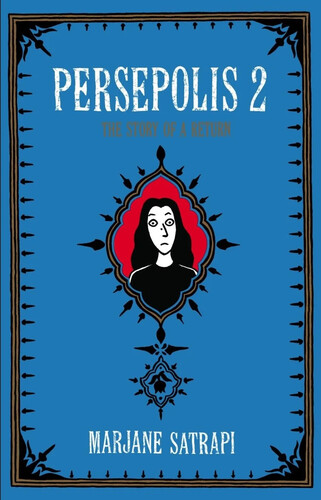
The original publisher of 'Persepolis' in France, L'Association, split the work into four volumes but the English language publishers, whether Pantheon in North America or Jonathan Cape in the UK, chose to break it up into only two and that makes a lot of sense to me. The first book was subtitled 'The Story of a Childhood' and tells of Marjane Satrapi's life as a child in revolutionary Iran, while the second, subtitled 'The Story of a Return' tells of her move away from "a religious Iran" to "an open and secular Europe", only to eventually move back home and, at the very end, leave it again.
This is that second book and it looks consistent with the first but grows far beyond it into a wildly different story, with many similarities but many contrasts too. As it moves forward, it shifts from the former to the latter, eventually perhaps too far for comfort, thus prompting a cultural crisis that's solved by that return to Iran, now as an adult rather than a child, to see it with new eyes.
The first obvious contrast is in location. The first book was set entirely in Iran, beginning a breath before the Islamic Revolution in 1979 and continuing there throughout, except for a brief holiday out of the country. It ends with Marji about to leave for Austria and this second book begins right after she arrives. Surprisingly, the first obvious similarity is in colour, given that unfolds entirely in black and white. However, those are the colours in play. In Iran, everyone wears black and girls and women wore the veil, leaving very little skin visible. In Austria, Marji finds herself staying in a boarding school run by nuns and once more everyone wears black and very little skin is visible.
It's quickly obvious that Marji has never fit in anywhere. She was old enough at the beginning of the first book to remember what it was like before the Islamic Revolution, so she quietly resists it, making her something of a stranger in her own land. Now, she's a stranger in a strange land, with a language barrier from the outset. She speaks fluent French and English but her first roommate, Lucia, only speaks German. It takes time to adjust and learn and find her people. And much of this book really boils down to that search, taking her through a bunch of subcultures and, of course, in the end, back home again.
She's fourteen at this point, but her first real friend is Julie, who's eighteen and French. While she holidays with Lucia in the Tyrol, she hangs out with Julie and her weird friends, eventually moving in with her after she's expelled for being unabashedly rude to the mother superior, even if it's in return for more rudeness. That doesn't really work either, but drifts her into sex and drugs and it isn't long before she's the group's unofficial hairdresser and the school's unofficial drug dealer. A lot happens, so much that it soon becomes obvious why she wrote a graphic autobiography.
Some of this is joyously surreal, like the period that she spends in a wohngemeinschaft, communal apartments, with eight gay guys. Of course, that's when her mother visits, which is as situationally funny as it is important to Marji's progression. A reminder of home is never a bad thing, when she is struggling with the realisation that she's leaving her own culture behind. She finds a boyfriend, only for him to come to the realisation that he's gay, which can't do much for her confidence. Then again, at this point, she's hanging out with anarchists, but rather than discuss political philosophy, they play hide and seek in the woods and grill sausages while singing Janis Joplin.
Some of it is blisteringly honest. I don't just mean her years as a well-meaning school drug dealer, but her time homeless, sleeping on the night tram and being hospitalised for severe bronchitis, a natural progression from her bad habits. Satrapi is admitting, with some caveats, that she made many efforts to find herself in Austria but failed. Maybe the system failed her as well, but she's a failure nonetheless, at life and love and everything else except academic achievement and that leads, eventually, to her return home. It's been four years, enough for her to grow into an adult, but a hundred pages in, we're back in Iran.
There's honesty here too, as she finds a way to reconnect with her culture in her homeland. Some of the most powerful scenes here involve reconnecting with Kia, one of her childhood friends. He grew up too, into a soldier who served on the front and came back in a wheelchair waiting for the visa to go to America and be fitted for a prosthetic arm and leg. This reunion is as awkward as you might expect, but he tells a two and a half page joke that completely breaks the ice and helps her to accept herself, even as her other friends don't, seeing her as a "decadent western woman". It's odd to see that as more powerful than her failed suicide attempt, but it is.
There's much more too, because these scenes aren't far into the second half and Marji's story is a constantly evolving thing until the very end. One of my favourite scenes involves her taking an art class, because it's pretty frickin' hard to study anatomy when the model is covered to adhere to a strict moral code. It takes weeks to switch to a male model and even then they're not supposed to look at him, bceause that's against the moral code too. Of course, morals in Iran are flexible, even "schizophrenic", to use Satrapi's term, one way in public and another in private. However, she also encounters a true religious man, who appreciates her honesty during an ideological test. That's a scene as shocking, in its quiet way, as any of the more outrageous ones.
One thing I missed from the first book was the use of unusual technique, but I gradually realised it only seems absent in the first half. After Marji returns to Iran halfway through, I noted that there wasn't much of note artistically, just the occasional psychedelic drug trip (still in black and white), but suddenly found more and more examples now she's back in Iran. There's a particularly striking image as she wanders through once familiar streets, all now named for martyrs, and feels like it's a cemetery rather than a city. It's a dark image, even though it's ghostly white. Then there's a big tesselation of running soldiers and a powerful full page of political prisoners being assassinated. It's as if Satrapi recovers her imagination as she returns to a nation that won't allow such a thing.
I can't end without mentioning how much I enjoyed Marji's grandmother, who, rather poignantly, is the subject of the final words in the book, as Satrapi leaves Iran once more, this time for France, where she would eventually write 'Persepolis'. She's a strong character in the traditional support mode of a grandmother, but she's also a character who won't hesitate to speak out against what she sees as injustice, as she does when Marji does something inappropriate. She feels like a good character to remember, as we think on how Iran has progressed after this book ends in 1994. She's a good symbol of hope. ~~ Hal C F Astell
For more titles by Marjane Satrapi click here
|
|