|
Chat about this graphic novel project of mine recently touched on how powerful Grant Morrison's 'We3' was without actually having much in the way of plot. There really doesn't seem too much to it, just the three animal protagonists, substantially enhanced in lab experiments, trying to get home again. It's not even a new concept, given that 'The Odyssey', much in vogue now after Christopher Nolan's latest adaptation, is effectively the exact same thing, just with a single primary character instead of three. I'd also previously covered an earlier take on 'The Odyssey' in Gerry Duggan and Phil Noto's 'The Infinite Horizon', a post-apocalyptic take on the story.
The reason I bring that up is because this is an even simpler story, albeit one that's based on true events, so didn't need to be bulked up in adaptation. It goes back to the invasion of Iraq in 2003 by a coalition of allied forces led by the Americans, an invasion that led to the Battle of Baghdad. As fighting approached the Baghdad Zoo, everyone who worked there simply left, leaving animals to fend for themselves, in small spaces already considered inhumane but without much food. Here, a group of departing workers throw in a dead donkey into the lion's enclosure, vainly trusting in its ability to last long enough to matter.
While most of the animals died relatively quickly or were stolen by thieves who took them to eat, as the food shortages that already existed in Baghdad before the invasion were worsened by it, a few managed to escape into the surrounding countryside or into the city itself. The four lions that we follow here are inadvertently freed by stray or badly sighted bombs: an aging male called Zill; two adult lionesses, Safa and Noor, and the latter's cub, Ali. Noor was already planning escape so happily takes advantage. The rest are warier but leave too, as do a number of other animals.
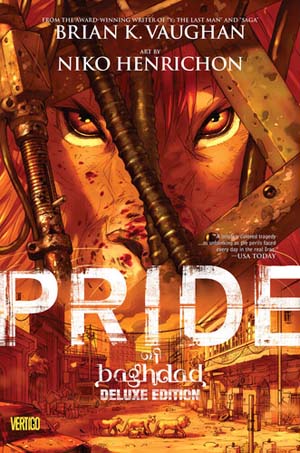
And that's pretty much the entire plot but, in keeping with what I said in the first paragraph, it's all much deeper than that, courtesy of writer Brian K. Vaughan and artist Niko Henrichon. At this point, the former can be praised for building the characters, none of whom are human. So that we understand, he adopts the conceit that all animals can talk and understand each other, even from one species to the next. Noor has been trying to persuade an antelope to help her build an escape plan but, after they're both freed, she resists the urge to eat it, as a measure of decency.
However, I'd argue that, as great as Vaughan's early contributions are, Henrichon gives this even more power because his art is realistic enough for us to view these characters entirely as animals, never anthropomorphic takes on them, but still carry enough human emotion that we recognise it when it manifests. They're scared. They're hopeful. They're wary. They're hungry. All these can be seen on the faces of these lions without any doubt whatsoever, without becoming cutesy or losing the inherent danger their species carries with them. It's great work.
Of course, just like 'The Odyssey', the journey undertaken isn't a simple walk from here to there, not that there's ever really a "there" for these lions. There is just out, away, somewhere else, the hope being it'll be safe and have available food. There's no legendary lion's den hiding outside the zoo just waiting for them. This journey is aimless and driven entirely by instinct and circumstance. However, plenty happens on the way. They encounter a dead human, a dying lion and a live bear. Each generates depth in the characters and thus the story. Once again, Vaughan drives this with engaging scenarios and Henrichon then enhances it with art and especially use of colour.
The colours here are vivid, starting with the pastel green blue of the sky above the zoo, before it gets riven by incoming warplanes. There's a flashback for Safa that's dark in content so also dark in colour, Henrichon going with a deep nighttime blue. The scenes after the bombs run a palette from yellow to brown to represent the dust blown into the air and how it diffuses the sunlight. If the section is more hopeful, it skews back to greens and blues; if it carries danger, it shifts firmly into reds. My favourite panels come inside an evacuated mansion, coloured darker green, with a couple of full page single panels worthy of putting on a wall, one with Safa facing gigantic art of lion, another with the bear chained up inside. A smaller panel of the vast swimming pool is lovely too.
Back to Vaughan and each of the lions is distinguishable not just by looks, Safa the lioness with an absent eye, but through attitude. They're all tough in their way but, faced with almost any single situation, they'd respectively pick four different ways through it. Vaughan also literally gets the final words, after the lions eventually encounter American soldiers and are promptly shot dead, a thoroughly believable scenario because my granddad went through exactly the same thing. After six months leading undercover work in Nazi-occupied Greece, he made his way to Athens, mission accomplished, only to be promptly shot dead by arriving American servicemen. Vaughan relates that succinctly, then, on the next page, adds "There were other casualties as well."
I can't say that I didn't want more of a journey here but, with that ending, inevitable given that it really happened, any extension of page count would only have made it sadder still. It's certainly a sad story, one with an aching sense of inevitability to it. After all, most animals never made it out of the zoo to begin with. These lions had their shot and they made it quite a distance, whether in measured miles or what it meant to their characters, before the bullets finally took them down.
I understand why Vaughan was drawn to this story, I appreciate why he told it as a single graphic novel rather than a run of comic books and I applaud IGN for awarding it their award for the best original graphic novel of 2006. ~~ Hal C F Astell
|
|