|
I've been enjoying my dips into European graphic novels, or albums, as they tend to be called. I've worked my way through all twenty-four albums in Hergé's 'Adventures of Tintin' and I'm making a solid dent into the 'Asterix' series; I'm thirty books in this month, which is the sixth solo album by artist Albert Uderzo after the death of his writing partner, René Goscinny. However, even though I've deliberately tried to keep my graphic novels varied, I've been doing that more by author and genre than location, so I've reviewed little from continental Europe except 'Asterix' and 'Tintin'.
In fact, within my graphic novel project, I didn't review any before them and only two after them: 'The Killer Condom' and 'Persepolis'. The former is by German author Ralf König and the latter by Marjane Satrapi, an Iranian who wrote and published in France. The rest were mostly American, a little surprising as I've deliberately excluded superhero comics, with a smattering of British and a pair of Japanese. Rod Espinosa is Filipino and Margaret Atwood Canadian, but I've reviewed more European titles from submission than not, courtesy of First Second, as Alex Alice, Joris Chamblain, Aurélie Neyret, Pénélope Bagieu are all French; Aimée de Jongh is Dutch; and Boaz Lavie is Israeli.
And yet, continental Europe has been a powerhouse in this medium for a century, much more so, I must admit, than the UK, especially through the bandes dessinées of France and Belgium. To me, that means 'Tintin' and 'Asterix', because they were widely available in English translation, along with 'The Smurfs', which few English speakers probably realise were Belgian. However, that's just scratching the surface and I'm rather happy to see that more and more European titles are being translated into English for the rare Europeans (i.e. we Brits) who only speak one language. So I'll dive in deeper as a new project and see what I can find.
This one grabbed my eye quickly because it has clear echoes of 'Tintin', started as far back as 1946 and ran for thirty years in its first era and thirty more in its second one, which is still ongoing. It's a series called 'Blake and Mortimer', created and initially written by Edgar P. Jacobs, the nom de plume of Edgard Félix Pierre Jacobs, who was Belgian and born in 1904. He was a friend of Hergé, becoming so after painting sets for a stage production of the 'Tintin' tale 'Cigars of the Pharaoh', after which he joined Studio Hergé's art team.
Initially, he helped Hergé colour his early black and white 'Tintin' stories for book publication but contributed art and writing to 'The Seven Crystal Balls' and 'Prisoners of the Sun'. He appears in a few cameos, including the cover of 'Cigars of the Pharaoh', where he's E. P. Jacobini, the mummy behind Tintin and Snowy. Ironically, his greatest contribution to 'Tintin' may be his taking Hergé to the opera. Jacobs sang in opera professionally before he turned to illlustration full time and it was his other lifelong passion. Hergé, however, hated the experience and, in good humour, wrote Bianca Castafiore, the Milanese Nightingale, to lampoon his friend and colleague.
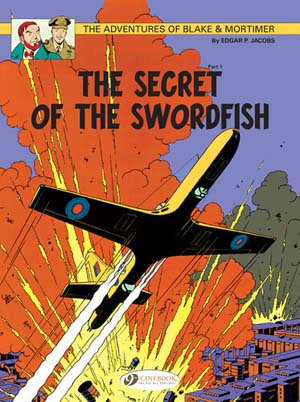
'Blake and Mortimer' debuted in the pages of 'Tintin' magazine in 1946, when 'The Secret of the Swordfish' began serialisation. The titular characters are Capt. Francis Blake, an MI5 agent, and Prof. Philip Mortimer, a scientist. Both are British and they faced off against their nemesis. Col. Olrik, a regular antagonist in the series. While Cinebook, who have been publishing the series in English translation since 2007 with only two titles still to come, are doing so out of order, I'll dive into them in order of publication, which means starting here with their book fifteen.
That's because 'The Secret of the Swordfish', which was initially published between 1946 and 1950, counts as three books in this edition: 'The Incredible Chase', 'Mortimer's Escape' and 'SX1 Strikes Back'. Initially, it saw publication in France in two parts, in 1950 and 1953, in which form they were reprinted until 1984, when they were split up afresh into three. These were lettered and coloured afresh and a number of full page panels there in the serialisation but omitted from the two parts were added back into the three. So, 'SX1 Strikes Back' technically dates to 1984, while its material remains the original story from the late forties. Whew.
The style is immediately recognisable from 'Tintin' but the artwork itself is just as clearly not Hergé's work. The lines aren't quite as clean, but the framing of panels is just as strong from the outset. The genre is clearly yellow peril, even though World War II had been over in Europe for a couple of years when this began. There's a mysterious "Yellow Empire" hiding in Asia, and clearly pushing for a sequel war. Col. Olrik is the first name dropped and he's "a crafty and unscrupulous adventurer" who serves as Chief of Intelligence to Basam Damdu the Usurper, Emperor of Tibet. Col. Taksa is the technical head, showing off traditional, atomic and chemical weaponry.
Tellingly, everyone here looks Asian except Col. Olrik, whose ethnic origin is much more vague but clearly Caucasian. Like our heroes, he could easily be British, though his moustache is flared like a villain's in comparison to Blake's trim equivalent and Mortimer's reassuring beard. Also obvious is how talky this starts out, as some of the earlier 'Tintin' stories could be, with entire speeches laid down in huge speech bubbles. The speech bubble in the middle panel on page six counts for almost a sixth of the page, racking up almost a couple of hundred words. That's an incredible amount and I don't believe I've ever read that much in a single speech bubble before.
However, this soon departs from what we might expect from a 'Tintin' adventure by shearing this clearly grounded world of ours away into alternative history. The intrigue the opening suggests as a default ends resoundingly with a brutal coordinated air assault by the Yellow Empire against all the nations of the world. As early as page nine, Moscow, Calcutta and Hankou are hit with atomic strikes and Rome is wiped off the earth. Berlin follows a page later and Bombay, Paris and London on page thirteen. The entire American Pacific Fleet is sunk. The war is over before it begins. Capt. Olrik has achieved an immense victory for the Yellow Empire, which now rules the world.
If you're wondering who can stand against this might, then only answer to give is, of course, Blake and Mortimer. They escape their Scafell base in the nick of time in the Golden Rocket, blowing the whole place sky high as they leave to prevent Olrik's plunder, and we find ourselves thrown into a cat and mouse chase, with them the mouse and the entire might of the Yellow Empire, Capt. Olrik at its fore, as the cat. As much as I adored the scenes of destruction, vivid yellow and red against a grey backdrop of iconic architecture, by far the biggest success here is the action. There is simply no let up, just mere moments here and there to catch our breath.
Much of that action takes place in the air, with wonderful pages of dogfights, full of busy panels in which planes veer this way and that to avoid missiles and strafing bullets. It's vivid stuff, but even being shot down doesn't stop the chase. That continues on the ground, the pursuers never too far from their prey. At one point, they're so close that Blake and Mortimer pull off a coup by stealing Olrik's very own red wing from under his nose. Of course, that's shot down and the chase keeps on going. No wonder this story was split up into multiple volumes!
The biggest flaw is surely the stereotypical Yellow Empire. I have to wonder if destroying so many major cities will become a drawback later on, especially as it seems like a hard sell to build viable sides out of the wreckage created here. It can't surprise that Blake and Mortimer survive to face the second volume, but so, of course, does Capt. Olrik. The former are apparently largely on their own, aided here by the remnants of the Polish and British air forces, partisan Muslims secreted in the mountains of Asia and other tribal allies, Sikhs and Arabs, perhaps the Sultan of Oman. Olrik, on the other hand, has the massed armies of the dominant global force, behind him.
How that plays out isn't yet clear and I look forward to learning more in the next volume. Instead, I'll call out the artwork, especially the full page panels restored to the three volume version. This is wonderful art, some of which I could imagine readers tearing out of their magazines to put on a wall. Nowadays, they'd be sold as prints with the same result. This story would play as fast action without these pages, but the two volume version without them is clearly the lesser just from this one perspective.
The first such page is a good one, an Asian spy in the service of the British about to be shot while phoning in his report, but the second is a wonderful lesson in composition, the unconscious Capt. Blake floating to ground on his parachute with an array of colleagues around him, all set against the cover of clouds and their doomed spiralling plane. The next one showcases motion, as a truck bursts through an armed checkpoint, while the next one again combines both those approaches to glorious effect, with two planes buzzing Blake's stolen armoured car. It's not easy to choose a single favourite but that has to be mine.
So this is appropriately named 'The Incredible Chase', even if all three volumes to this initial story boast the broader title of 'The Secret of the Swordfish'. That's unfortunate, as the Swordfish is an impeccably guarded secret that, by the time this volume ends, we haven't been let in on. In fact, I couldn't even hazard a guess as to what it is, beyond some sort of gamechanger McGuffin that our heroes simply must reach before their nemesis, Capt. Olrik. Hopefully, I'll learn more next month in the second volume, 'Mortimer's Escape'. ~~ Hal C F Astell
|
|