|
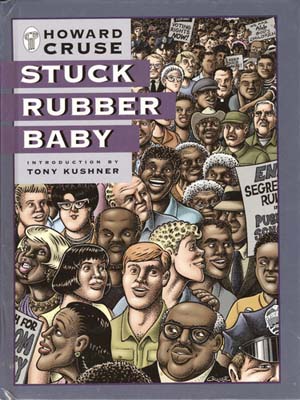
This is a bonus graphic novel for this month, because it looked like it might sit well with 'Pedro and Me' as a second such with a gay theme. However, while it certainly has that, it has a very different take on the subject, one that's even more about the civil rights era in the deepsouth than it is the slow acceptance the lead character has to his sexuality. 'Pedro and Me' is a more emotional read and it was nominated for Best Graphic Novel at the Eisners. 'Stuck Rubber Baby', which came out, pun not intended, five years earlier in 1995, won an Eisner, a Harvey and a bunch of other awards. Ironically, it feels more grounded in reality, given that 'Pedro and Me' tied to reality TV.
Like that book, this is the creation of one man wearing both writer and artist hats. Howard Cruse was born in 1944 in Birmingham, Alabama, the son of a Baptist preacher, and didn't move to New York until 1977, so he was in the deepsouth for the entire civil rights era. He was also "a gay man trying to be straight who had inadvertently fathered a child", according to an interview he gave to Jason Bergman of 'The Comics Journal'. The reason I mention all that is that this feels acutely autobiographical, even though it isn't, as the lead character is Toland Polk and the setting is the fictional southern town of Clayfield.
I'm guessing that there's a lot of Cruse in Polk but they're not the same person and there's some Cruse in other characters too. For instance, there's a son of a Baptist preacher here too, but it's not Polk; it's a black kid named Les Pepper who Polk hooks up with at one point. In that interview, Cruse identifies with some of what he had Les do. So, I'm still guessing but it wouldn't shock me to discover that much of this fiction is substantially true if not quite factual. Certainly some events are real, like the Emmett Till lynching, which is referenced, and the March on Washington, which we see in periphery. The Medley Motel isn't real but its bombing seems to be, translated from a church in Birmingham.
The framing story has Polk remembering back on his life from a much later point, when he's grown old and comfortable with his gay lover. It pops in and out sparingly with a little editorial comment from the older Polk, but the vast majority of the book unfolds chronologically back in the day. The first line is superb: "Looking back, I didn't see all that many dead bodies when I was a kid growing up down south... but the ones I saw stuck in my mind." That's actually a pretty decent summary for the book because Polk is aware of the bad stuff but largely breezes through that landscape with a nonchalance that's gradually threatened as the bad stuff gets closer.
It's also knowingly drawn from the outset, the title on the first page accompanied by hope in the form of JFK in front of the White House and segregationists in front of a burning bus. The former is on the left and the latter on the right and that's very deliberate placement. The first body is on that page too, but it's not a victim of violence. Miss Violet, who used to babysit Toland, collapsed in a ditch. Of course, we have to wonder if that's true or just the story that naïve young Toland is told at the time.
He grows up in his own world, a sort of microcosm of the south. There are plenty of black people in that world, like the family gardener, Stetson, and his son Ben, who Toland happily plays with until it becomes noticed by others. There are plenty of racist white people, like his friend Bo who shows him a photograph of Emmett Till's corpse in a "nigger magazine". And there are plenty of people across the wide range in between, like his father who tells him to never use the N word then adds that Negros aren't very smart. It's been scientifically proven.
For the longest time, race is both the background and foreground to this novel. The gay aspect is more fleeting, the first example a form Polk fills out when he's drafted into the army at eighteen. He realises he's gay so he checks the "homosexual" box and he's back out again, categorised as 4F, disabled and unfit. However, he continues to resist that self-diagnosis, even as he grows into the gay and black communities. He even finds himself a girlfriend, Ginger Raines, who's a budding folk singer. The title refers to babies conceived when the condoms meant to prevent them have sat in wallets for years and ceased to be viable.
All this is engaging but dense. There was a point where it started to feel like I'd read a whole book and I realised that I was only a third of the way in. Then again, in many ways I had, because this is a sizeable volume, two hundred pages, which could be nine or ten issues of a comic book, and larger and denser too. Each of those pages contains a lot of speech bubbles and plenty of narrative too, along with detailed artwork, both foreground and background, Cruse's usual stippling deepened with other techniques. He's called 'Stuck Rubber Baby' a novel and it feels like one, substantial in every way.
While most of the important stuff happens in that first third to ground us in where we're going, it comes alive in the middle third. Everything seems to escalate and Polk starts to find that he can't simply breeze past it the way he has been doing. Partly that's because he's more aware of things, given the people he's hanging out with and the places where they're hanging out, even though he still thinks of himself as a visitor, a white straight man feeling kinship with blacks and gays. Partly though, it's because the authorities don't see it that way. He's one of them and that makes him a target too. This is the era of racist police commissioner Sutton Chopper, the Ku Klux Klan and the 'Dixie Patriot' newspaper, "The Voice of Southern Sanity".
And so it intensifies. It's not emotional so much as it's outstandingly grounded in a time and place that's emotional. There are emotional moments, with plenty of anger, despair and grief, but even the most brutal of them don't carry the punch of some of the later scenes in 'Pedro and Me'. What matters is that they all add up over time to leave a powerful impression. When I remember 'Pedro and Me', it'll be specific scenes or maybe just a snippet of information learned. When I remember this, it'll be for the tone of an entire era, that some are frustratingly trying to return us to, and a way of life, epitomised in the Rhombus, Alleysax and the Melody Motel.
That's not to say that characters aren't well-drawn. They're incredibly well-drawn, not just Toland Polk but his girlfriend Ginger Raines; his tolerant sister Melanie; her frustratingly racist husband Orley; a camp gay sailor called Sammy Noone; Les Pepper, the preacher's son; even Anna Delynne, who isn't actually in the novel that much but gave up her promising career as a nightclub singer to marry a preacher. She's incredibly deep for a supporting character. And I'll remember moments as well, like church organist Mabel's routine to sit at the front of segregated buses or Sammy's very ill-advised drunken trip to the 'Dixie Patriot' offices.
But those characters, as memorable as they are, are all small pieces in a big puzzle and this aims to show us the big picture. I'd suggest that it succeeds incredibly well, hence all those awards, but it also has the balls to not end in a traditional fashion. Some of the story arcs are wrapped up but the general issues aren't, because, once again, this is substantially true if not quite factual. We're still dealing with far too much of this today and the 'Dixie Patriot' is effectively broadcasting out of the White House.
I read the ending partly as a baton pass to the next generation to continue fighting and to do so with self-awareness of our own faults and the faults of the system we're working with. There are good guys and bad guys here and it's crystal clear which side is which, but not a single good guy is without flaws. The message seems to be that it isn't important to be perfect. What's important is to acknowledge that the fight needs to be fought, even incrementally—Orley's final appearance highlights that—and that we can all play our part. It may not bring tears but it'll stay with you. ~~ Hal C F Astell
|
|