|
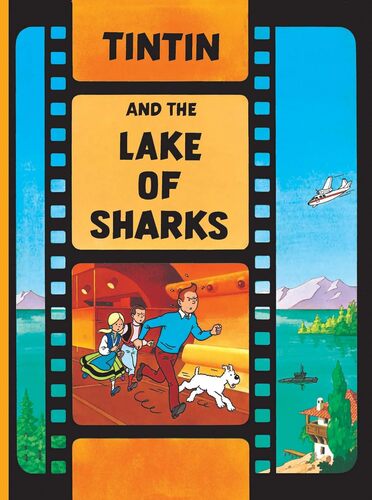
Technically I've finished Hergé's 'Adventures of Tintin', because he only wrote twenty-four stories and only brought twenty-three of them to life in album form. However, before I throw my reviews into print zine form, I wanted to add a bonus album, which I've had on my shelf maybe longer than any other Tintin story. It's not a Hergé original and it wasn't even written as an album. Instead it serves as an adaptation into album form of an animated feature of the same name. The film was written by a friend of Hergé's, Michel Regnier, who went by the nom de plume of Greg.
The adaptation wasn't by Greg but by Bob de Moor, who was one of an array of artists who worked at Studio Hergé on many 'Tintin' albums, starting with 'Destination Moon'. He created the cover for 'The Black Island' and found many of the locations used on a trip to the UK in 1962. He drew an unidentified but probably quite large amount of the panels in 'Tintin and the Picaros', which was the final 'Tintin' album completed before Hergé died. He was also the artist who offered to bring 'Tintin and Alph-Art' to full album form, though Hergé's widow decided against that. He consulted or at least corresponded with Yves Rodier, who later did so as an unauthorised edition.
I don't remember ever watching 'Tintin and the Lake of Sharks', the fourth of five animated films made thus far and the only one not to be based on published albums. It was released in 1972. Two live action films were also released during the previous decade. Most of these were in French, the only one in English thus far being the 2011 Steven Spielberg film, shot using motion capture work, called 'The Adventures of Tintin'. For some bizarre reason, I haven't seen that either, even though it was co-produced by Peter Jackson. I need to catch up with my 'Tintin' films, but this adaptation will have to do for now.
We're at the Museum of Oceanography in an unnamed city to watch a pair of thieves steal what's being billed as the largest pearl in the world. They grab it, the guards notice and then, while they raise the alarm, replace with a fake. The only witnesses are therefore the sharks in the aquarium tanks. Next day, Tintin and Captain Haddock arrive in Syldavia to visit Professor Calculus on Lake Pollishoff. At the Klow airport, de Moor throws in a bunch of regulars, Haddock managing to send Thompson and Thomson tumbling without realising they were even there. Bianca Castafiore only appears as a poster, but the captain takes the opportunity to give her a wicked goatee and spiked moustache. The detectives are on a secret mission, which means that it doesn't take them long to spill that it's something to do with art forgeries.
This is fun but pretty routine for the series. What's interesting is the artwork, because it's at once traditional and not. All the characters in the foreground are drawn in Hergé's famous ligne claire style and it's done almost as cleanly as the master would have performed it. Everyone's perfectly in proportion and instantly recognisable. They even move exactly as we expect them to. However, the backdrops are painted and probably lifted directly from the movie. The result is oddly jarring and many of the larger images remind us of thrift store paintings changed by artists by adding an approaching Godzilla or descending Millennium Falcon.
Lake Polishoff is a wonderful location, because it's an artificial lake with an entire village beneath its waters, submerged during its creation. Tintin's pilot suggests that it's cursed, right before the starboard engine dies and he promptly bails out by parachute, leaving his passengers behind. The inevitable crash is mitigated by Tintin leaping into the cockpit and doing what he can to achieve a successful landing. He mostly manages it, but he and Haddock are rescued from fresh calamity by a couple of children passing in a donkey cart, Niko and Nushka. What's left of the plane falls off a cliff without them inside it.
Niko and Nushka are clearly not villains out to knock off our leads but they're just as shocked that they're on their way to the Villa Sprog. "The lake is a bad place!" says Niko. Of course, the pilot is absolutely one such villain, as we find when he calls in to his superiors with the callsign of Vulture Four. Don't worry, these villains will soon multiply in number to help build the tension. Next up is Prof. Calculus's housekeeper, Madame Flik, who's Agent Rameses when she calls King Shark. The latter's Operation Crab will commence tomorrow.
While Tintin and Haddock make it to Calculus's villa, with the help of Niko and Nushka, they can't go five minutes without something suspicious happening behind them. The professor's papers are stolen. There's a mysterious frogman and a passing advertising plane in the middle of nowhere. A secret cave is discovered by Snowy and, when Tintin ventures inside, he discovers art treasures. It escalates when Niko and Nushka are kidnapped by bad guys attacking the villa with laughing gas. King Shark wants Calculus's latest machine and, while he's technically hidden in every panel, we're given enough clues to know exactly who it's going to be. Yes, we've met him before.
I can understand why he wants the machine. Calculus is playing with 3D projected images, like the bar that Captain Haddock promptly walks through to collide with the wall. I'm not sure quite how that works. I'm also not quite sure how 3D projection suddenly becomes 3D duplication, but that's the real technology in play here. He throws a current into a special paste and it makes a duplicate of whatever's on the other side. It's not stable yet, resulting in inevitably comedic results, but it's almost there and you can imagine what 3D duplication tech would go for in 1972.
I'm sure you've connected a bunch of dots here and conjured up the rest of the plot, but it wasn't ever going to be a particularly surprising one. It's cute and it's enjoyable enough but it certainly doesn't approach the quality of a Hergé album, even one of the less successful ones. It ends up as a curiosity and it does enough as such to be worth reading. While Bianca Castafiore does show up in person late in the album, she's the only supporting character to do so other than the villain I'm not going to name. Otherwise, it's Tintin and Snowy, Captain Haddock, Professor Calculus and the two detectives. I did enjoy the distinct lack of Jolyon Wagg.
And that's it for this runthrough for me: twenty-three official Hergé albums, one more expanded from his notes and this adaptation of an animated feature film. It isn't the largest series in comic book history but it's still one of the most impactful and remembered. I'm very happy that I took a fresh ride through the whole lot. ~~ Hal C F Astell
For more titles in this series click here
|
|