|
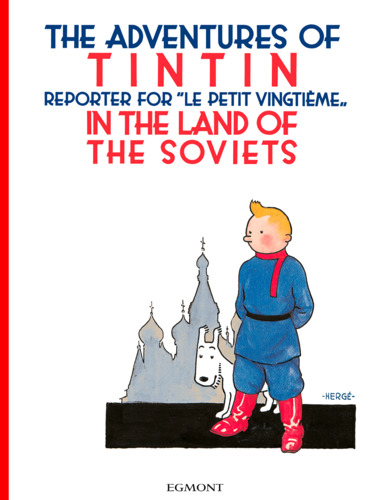
Yes, I left the first book in Hergé's 'Adventures of Tintin' until the end, which doesn't make a lot of sense until I provide some context.
'Tintin in the Land of the Soviets' was first serialised in 'Le Petit Vingtième', which was a children's supplement to the daily Belgian newspaper, 'Le Vingtième Siècle'. It was collected in 1930, but in a limited edition of five hundred copies, each numbered and signed by "Tintin et Milou", the French language names of Tintin and Snowy. Of course, this was in French. It was reissued in 1969, again in an edition limited to five hundred copies, but otherwise it took until the twenty-first century for it to be made widely available. Most notably, that wasn't done by Hergé himself.
When he had brought other earlier books into album form, he didn't retell their stories but he did redraw them to be consistent with his now famous 'ligne claire' style. He brought them into colour too and he cut the serialised stories down to fit into the established album size. I've only read one of his original black and white serialisations, 'Tintin in the Congo', at the other end of this project. It ran 113 pages in black and white with most pages featuring three rows of two panels each. It ran only 65 pages in colour but with most pages featuring four rows of three panels each.
Here, we only have that original black and white serialisation, so it feels very different indeed to the rest of the books in the series. Beyond being monochrome, the art is primitive in comparison to later works, Tintin himself being almost unrecognisable with a less defined hairstyle and a suit whose checks remain ruthlessly horizontal and vertical whatever angle he's in. It seems to unfold quickly because there are half as many panels on each page, even though it runs for twice as long.
It was also commissioned by the newspaper, which was conservative in outlook, deliberately as an anti-communist satire. That lends it a very clear message, one that Hergé may not have shared at the time and surely didn't as he got older. It's fair to say that the earliest books in the series were the ones whose tone was mostly clearly defined by the newspaper rather than the author. That's the main reason why the first three in particular, this, 'Tintin in the Congo' and 'Tintin in America', are often and overtly problematic today.
As such, page one sees Tintin sent to Soviet Russia on the train, with his canine companion Snowy immediately worrying about fleas and rats. Page two features a Bolshevik leaving a bomb to kill the "dirty little bourgeois" before he can find out what's truly happening in the Soviet Union. It's as blatant as anything that was produced by German cinema under the control of the Nazis. That bomb destroys ten entire carriages and vanishes 218 passengers, all presumed dead. Somehow, I must point out, knowing how ridiculous it sounds, Tintin and Snowy, who were sleeping in one, are perfectly fine. They inexplicably survive unhurt.
Maybe that's because the first stop is in what must be the Keystone district of Berlin, where we're clearly subject to the rules of silent movie slapstick. Tintin's immediately arrested as the cause of the disaster, without any evidence, but he escapes wearing a cop's uniform. They crash the combo motorcycle sidecar but then steal the police car from the inept cops in pursuit who stop to look at the wreckage. I should emphasise that this was 1929, so technically during Hollywood's transition to sound, but 'City Lights' was still two years way, so it's arguably still the silent era. The Keystone Cops were history by this point, having been largely wrapped up in the teens.
Here, it's still very much the style of the humour and, while it's always possible that Hergé used it in a deliberately anachronistic fashion to show how behind the times communism was, I don't buy into that at all. Maybe he felt slapstick was just the best way to tackle the material, aesthetically, and that's easier to accept, given that many later characters, especially Thompson and Thomson but often Captain Haddock too, were slapstick all the way to the end of the series.
Here, however, it's as blatant as Tintin being scooped up by a speeding train without injury, which I've seen on the big screen. There are Bolsheviks literally kicking each other in the ass, like every Keystone character ever. Tintin and Snowy even rush into an explosives store with a lit cigar; that does at least warrant Snowy to get bandaged, but the pair are apparently invulnerable. There's a scene with Snowy putting on a tiger disguise only to face a real tiger, which is obviously borrowed from the 1925 version of 'The Wizard of Oz'. Today, the more recognisable borrow is Snowy saying "Now we're in a fine mess", so recognisable a line that we hear it in a specific voice without even a tinge of French accent.
Another surprising aspect is how unsympathetic Tintin is painted, as a brand-new character. He's arrogant, as if he knows that the rules don't apply to him, whether that's the rules of society in a communist country or just the rules of physics. He's judgemental, too. Sure, he's being targetted for assassination by opponents clearly drawn as cartoon villains, but he's only the hero by default not by action. He doesn't remotely feel like the character we would soon love. He's a very rough and tumble prototype who evolved a great deal even by 'Tintin in the Congo', which Hergé rolled right into after finishing this. How he gets his tyre reinflated is utterly outrageous.
At least we can't mistake the Bolsheviks for heroes. There's plenty of overt propaganda here that works on the cartoon level it was intended to be but no deeper. They have fake factories so as to deceive English communist sympathisers from a distance, with fake smoke and fake soundtracks of machinery, but nothing inside. There are fake elections too, where people are free to vote for any candidate but are acutely aware of the guns being pointed at their head if they don't vote for the communist. Moscow is a stinking slum but the bread line only hands out to avowed communists. A fake haunted cabin hides an underground base where Lenin, Trotsky and Stalin have collected the wealth they've stolen from the people.
So there's a lot of negative to be found here and without having to look for it, which isn't much of a shock, to be honest. However, there are positives too. While the art is certainly primitive when compared to what Hergé was doing even within the next decade, it's obvious that he was trying a lot of things out for size here. Page four is the first to feature larger panels, the expected two on each of the first two rows merged into one. Page five has entirely black panels to depict darkness but with the speech bubbles made white to be legible. By page eleven, he's experimenting with a lot of things: different speeds, different perspectives and foreground/background contrast.
If there's another aspect to praise, it's the pace, because this rattles along at a rate of knots, not least because a good deal of it is spent literally in motion: in cars, on trains, in planes. It certainly doesn't seem like 139 pages because we're flipping most of those pages like there's no tomorrow, just to keep up with the action. However, even as we're caught up in this frantic flow, we're always aware that this is problematic material. Even if we discount the overt propaganda, we can't look past how many outrageous plot conveniences Hergé relies on, how much slapstick he borrowed in toto and how little actual story there is. The speed masks the substance.
But hey, this was very much a beginning and what comes next is what I've already worked through over the past couple of years. 'Tintin in the Congo' and 'Tintin in America' are better but also very problematic. 'Cigars of the Pharaoh' sees Hergé finding his way past that and 'The Blue Lotus' is a major gamechanger. The heyday of the series really lasts from there to 'Tintin in Tibet', book five to book twenty, with the few after that flawed in different ways to the first few. It's been quite an illuminating ride, though, and, while this really wraps up Hergé's 'Adventures of Tintin', I'll take a final look at a bonus volume next month in the adaptation 'Tintin and the Lake of Sharks'. ~~ Hal C F Astell
For more title by Hergé click here
|
|