|
Even though 'The Borrowers' seemed simple on the face of it, featuring a family of tiny people in the floor of a house, taking all they need from the human beans living above them, there's a huge amount going on in the way of theme. Are the Clock family scavengers living off others or is theirs a blessed life, with everything provided for them as if it was the natural way of things? I loved the relative play where something small to us is huge to them and so gains a different purpose. And I loved how the Borrowers based their entire worldview on what they see, which is hardly anything of the world we view.
This first of four sequels, published only three years after the original novel, can't boast much of that because we've been introduced to this world and we know how it works. There's still depth to be found but it's much more of a straightforward tale of survival. At the end of the first book, the Clocks are forced to leave the house that's been their only home. That's an especially momentous occasion because they're the last of many families to leave Aunt Sophy's house. Everyone else was long gone before the first book began and they were the sole remaining holdouts.
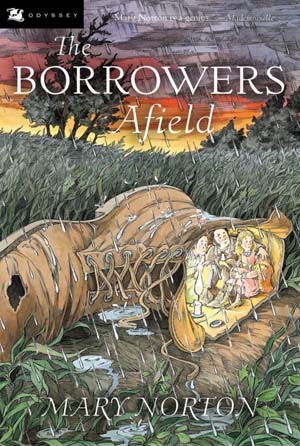
Now they have to venture out into a world for which they're clearly woefully unprepared with the skimpy hope that they'll find the badger sett to which an array of relatives are supposed to have emigrated. They do indeed find the sett and it's full of foxes. Their family's gone. Or eaten. That isn't really a spoiler. It just emphasises the survival aspect of the story, as if this is 'The Incredible Shrinking Man' but bulked up from one man to a family of three. Instead they create a new home inside an old boot that they drag down through a field towards a stream so they have a supply of water.
They aren't completely alone, because there's a wild Borrower out there in the fields by the name of Spiller, even if Homily initially chases him off. Eventually he becomes a sort of feral friend who brings them meat and helps them in moments of greatest need, like when a dog attacks Arrietty. Eventually the owner of the boot figures out where it went and reclaims it and that just starts an entirely new level in this game of survival, an even more dangerous one than the field even if it's inside rather than outside. Sometimes space helps.
I enjoyed revisiting the Clock family after 'The Borrowers', not least because that ended on such a tough note where we couldn't be sure if they actually survived or not. Now we know they do, only to be thrown into a whole new survival horror game. Life isn't easy on the Clocks. Fortunately, the ending to this one isn't remotely vague and we know exactly how we're going to roll into the third book, 'The Borrowers Afloat'. However, I didn't find anywhere near the depth of theme that I got out of the first book.
The question is whether that makes it a lesser book and I'm not sure I'm ready to answer that. It's thoroughly enjoyable and even more suspenseful, because we're never quite sure if the Clocks are going to make it out the other end intact. There isn't as much interaction with human beans, but I guess that's inherent in the change of setting. They're not in a house any more, after all. Instead, there's a lot more interaction with animals, because that's just as inherent. That's neither better nor worse, only different, which is great for a sequel.
However, I wanted that depth of theme and didn't find it here. My biggest takeaway is to wonder if it'll return in future books and that's probably not a good thing. For now, I'll think of this second book as a good one but a far simpler one, something that's reflected in the length of this review, especially compared to the original. At this point, I'm guessing that the series changes with book two and it won't go back to the depth of theme in book one. I guess I'll find out over the next few months as I work through the rest. What I'm hoping is that it'll bulk up in theme again as the cast of Borrowers grows, making this something of a transitional work. Now I want to fast forward to January so I can find out. ~~ Hal C F Astell
For more titles by Mary Norton click here
|