|
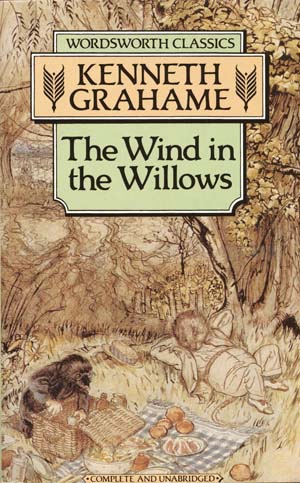
Here's a title I've not read before and have absolutely no excuse for that. It was first published in 1908 and, while it was initially rejected by a few publishers and received negative reviews, was an immediate success with the public, President Theodore Roosevelt among them, who wrote to the author in 1909 to explain that he'd "read it and reread it, and have come to accept the characters as old friends". It reached a hundred editions in the United Kingdom alone by 1951; was adapted into a stage play, 'Toad of Toad Hall' by A. A. Milne, and a whole slew of other media; and is often listed among the most loved books of all time. It's about time I read it.
It has an odd structure, because most of it tells a consistent story that revolves around Toad, who is far more of a rascal than I expected him to be, but not all. Some chapters punctuate this thread as what I can only describe as standalone short stories. As riotous as the chapters featuring Toad are, I'm actually fonder of the others, especially 'Dulce Domum' or 'Sweet Home' and 'Piper at the Gates of Dawn'. The former features one of the best examples of glorious friendship that I've ever read, Rat cheering up Mole in the latter's own home. The latter is mostly about Otter's son Portly getting lost but being looked after by the god Pan until he can be found by Mole and Rat.
Initially, our protagonist is Mole. He starts out the book doing spring cleaning but quickly gives up on it and heads up to the surface for a holiday. He finds himself at a river and, there in its bank, is Rat, a stranger at this point but soon a fast friend. Well, Kenneth Grahame introduces them to us as "the Mole" and "the Rat" but they call each other Mole and Rat, so we'll stick with that. These two are very much characters we'd all like to know and treasure as friends. When Mole walks into the Wild Wood and gets lost in the snow, Rat follows to find him because that's what friends are for. He slips a little at the beginning of 'Dulce Domum' but soon makes up for it in spades.
One character we'd prefer not to know is Toad, but he's a sheer joy to read about. Unlike Rat and Mole, who are poor and happy, or even Badger, who lives in a gloriously expansive sett but hasn't anything in the way of wealth, Toad is filthy rich. He lives at Toad Hall and whether he's gentry or simply thinks of himself as such, we don't know. He certainly has a superiority complex, though he really isn't mature at all, and something of an invulnerability complex too. His wealth allows him to dive headlong into a new fad whenever he feels the urge, though he bores of every one of them soon enough and moves onto another.
When we meet him, his latest fad is gypsy caravans. He decides that he's going to hit the road and let it take him where it will for however long it takes, but he hasn't got far down that road when a passing motorcar scares his horse and prompts him to lose control, ending up in a ditch. After that disaster, he decides that nobody's going to be faster on the road than him and he suddenly takes up motoring with an insane passion. It doesn't go remotely well, of course. By page seventy-five, he's crashed seven times, spent time in hospital three times and been fined regularly.
Eventually, Badger, who's the old wise man of this world, visits to take Toad in hand. It's time for a firm intervention! However, Toad sneaks it, steals a car and gets twenty years. With the aid of the gaoler's daughter, he fashions an escape in disguise as a washerwoman and gets into even more trouble than he was in to begin with. At one point, he even steals the same car he stole last time out, with even more outrageous results because, this time, its owners are on board too. Needless to say, they aren't remotely happy about this turn of events!
While I hadn't read 'The Wind in the Willows' before, some of it has reached me through cultural osmosis, just as a pivotal part of the British literary landscape. I knew Toad was a bad egg but I'm shocked at how bad an egg he really is! I was expecting to use descriptions like "rascal", "rogue" or "scamp", maybe going so far as "mischief" or "nuisance", but I think I have to go with downright "terror". He's a real danger to himself and others, he sometimes relishes in being a villain and, in a less child-friendly story, he'd get people killed. Yet somehow, Grahame manages to give him an endearing quality that manifests in occasional moments of contrition, where his mania subsides and he realises he's gone too far.
The other detail I was surprised by is that there are actual human beings in this story. Most books that feature anthropomorphic animals only feature anthropomorphic animals, in that they're set in a world where rats and moles and badgers substitute for us. This one seems to be that way until it isn't. At one point, Badger explains to Rat and Mole that the Wild Wood used to be a city, a city of people that was built to last, but they left and it's gone and now it's just the Wild Wood. That's a post-apocalyptic setup if ever I've heard one, but in the very next chapter, there's a village with people and Toad is arrested by people and helped by people, until they realise that he isn't an old washerwoman after all, but a toad. What that means for the power dynamic in this world, I really don't know.
Another detail I knew from pop culture, even before I read the book, was a certain famous quote by Rat, who tells Mole that "Believe me, my young friend, there is nothing—absolutely nothing—half so much worth doing as simply messing about in boats." However, to counter that notion, we get a later chapter called 'Wayfarers All' in which Rat is hypnotised by the yarns of an old tar of a rat. Suddenly, boats are for much more than just messing about in and he plans to go south with the Seafarer. "Seawards first," he utters in a trancelike state, "and then on shipboard, and so to the shores that are calling me." It takes Mole to literally sit on his friend until the urge passes to bring him back to his senses.
It would be easy to find fault with this book, as frequently joyous as it is. It's mostly a novel about Toad but many chapters are really short stories, entirely unrelated to the grand arc except for a set of recurring characters. Even the tone is different, some of those short story chapters simply there but others that come alive on the page. I frankly dare you not to feel the majesty of 'Dulce Domum' and there's a lovely reminiscence of summer in 'The Wild Wood'. Nature is a character in this book and often the most powerful one of them all and she's epitomised in the god Pan in 'The Piper at the Gates of Dawn'.
However, it's easy to read and easy to take root in our hearts. It's a book to feel as much as read and, as Roosevelt said, these characters become "old friends" even after a single time through. I look forward to many repeat visits to Mole and Rat, Badger too and maybe even Toad. I'm merely surprised that Grahame never went back to this abundant well for more. Instead it fell to a bunch of others to continue these stories, including such notable writers as Kij Johnson, Jacqueline Kelly and, perhaps most notably, William Horwood of 'Duncton Wood' fame, who wrote four of them. ~~ Hal C F Astell
|
|