|
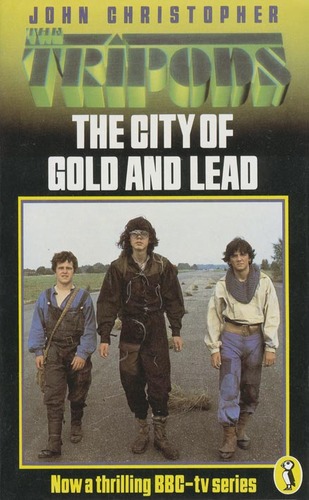
In the first book in 'The Tripods' trilogy, John Christopher built a post-apocalyptic medieval world in which the vast majority of the Earth's population live in subservience to the Tripods, whatever they are, and are perfectly fine with that. We've forgotten so much that we've effectively started again as a civilisation without the knowledge that life was ever different from this new norm. The control the Tripods have over us is through the Caps they install on our heads during celebrations of coming-of-age. Every Capping Day, fourteen-year-olds receive their caps and become compliant with the wishes of our overlords.
We left that first book as three children who left home before being capped make it to the White Mountains, apparently a hive of resistance to the Tripods. Two are English cousins, Will and Henry Parker, and the third is a French boy they met on their journey south. He's Jean-Paul Deliet, who's typically called Beanpole. We start this second book with all three immersed in the training cadre in the White Mountains. There are eleven of them all told and they go through a routine of much exercise, with daily time dedicated to study and sport. There's a plan developed and it's going to rely on three of them, each gambling on the hope that fake Caps aren't immediate giveaways.
The White Mountains are clearly the Alps and north in Germany is one of three cities in which the Tripods live. They hold Games there and the winners are brought into the city. The plan is for one or more of the three contestants from the White Mountains to win in their discipline, go into the city and, after gathering as much knowledge as possible, get back out again and report in. While this sounds reasonable, it's actually crucial because the resistance in the White Mountains know about as much about the Tripods as we do, which is next to nothing. They don't even know if they are vehicles for aliens or sentient machines. The best they have is that Tripods can be stopped or killed, because Will did that at the end of the first book.
While the laws of plot convenience suggest that the three chosen to go will be the three we got to know in the first book, Christopher isn't quite that predictable. It's Will as a boxer, Beanpole as a jumper and a new character, Fritz Eger, as a runner. All three speak German now, but he's native, so will be most believable. After all sorts of shenanigans on the river journey north, they make it to the Games where Will and Fritz win and now the story can truly begin. We want to know what's in the city, who the Tripods are, where they're from, what they're doing and every flavour of why imaginable.
And I really don't want to spoil any of that, so I'm going to be especially careful with what I'll say from this point on. Yes, there are living creatures in the City of Gold and Lead and they ain't from around here. They're on our planet to turn it into something more palatable to them, effectively whatever equivalent to "terraforming" applies to aliens doing that to us. While we have a sort of purpose right now, their plan doesn't include us being around for much longer. They fully expect our species to be extinct in ten years. And they don't feel too bad about that. As Will learns, they see us rather like puppies.
We don't get all the answers, but we learn who they are and how different they are to us. We see their alien architecture and some of their technology, including the trick to how they conquered us to begin with. Most importantly to Will and Fritz, we find out that there's a weak spot on their bodies, one that proves fatal if punched. We learn rather a lot and Will manages to get it all down in a journal, written as marginalia in a book. The ultimate question, of course, is whether, having found their way into the city, they'll manage to find a way back out of it.
I really can't say much more than that, even though I ache to talk about the butterfly exhibit, for one thing, the differences between Will and Fritz's Masters and the general effects of living for a sustained period of time within the environment needed to keep these creatures comfortable on our planet. There's a lot here and some of it is very dark indeed, even though this is presented as a children's book. Christopher clearly planned it out carefully because the crucial change in Will's fortunes happens almost exactly halfway through the middle volume of the trilogy.
However, I'll shut up about all that now. What I will say is that, while this is clearly a continuation, it ought to work surprisingly well as a standalone novel. I'd still recommend that readers start at the beginning and work their way through the three volumes in order, like any sane person would expect to do; but diving in here and reading this as a story of its own would actually work. All that you need to pick up what went before is here and the volume arc is complete. In fact, that leaves me exactly where I was at the end of the first book, without much of a clue what the next will be. I will happily find out next month with the final volume, 'The Pool of Fire'. ~~ Hal C F Astell
For more titles by John Christopher click here
|
|