|
While I'm reading many of the books in this project for the very first time, some unforgiveably so, others are old favourites. 'The Hobbit' is one of those, because it's the first book that I remember reading myself. However, I already knew the story, because my parents had read it aloud to me in even earlier years. Or maybe they started and I finished. I was very young, Of course, I know there were many others before it, Dick Bruna's 'Miffy' books suddenly leaping to mind, but this had a lot of pages and it felt substantial. Even reading it now, into my second half century, it makes me feel like I've been on an adventure myself.
Nowadays, it's as prominent as a children's fantasy book gets, with over a hundred million copies sold, placing it up alongside 'Alice's Adventures in Wonderland' and, in children's fantasy, behind only 'Harry Potter and the Philosopher's Stone' and 'The Little Prince'. The recent film trilogy by Peter Jackson has brought it to an even wider audience. So, while I haven't read 'The Hobbit' in a while, even if I have gone back to it occasionally over the years, the story is still pretty clear in my head. However, a fresh reading did bring surprises, mostly in the context of what else I've read of late.
The first came right at the start, because it seems that Gandalf has been enjoying the business of sparking adventures for quite some time. He brings Bilbo Baggins into an adventure here, as he'll later do with Bilbo's younger cousin, Frodo Baggins, in 'The Lord of the Rings'. However, this isn't at all new. He's done it many times before, capitalising on the Took family's long standing habit of adventure. I wonder how many of those stories made it into the broader history of Middle Earth. I know 'The Hobbit' pretty well and I've read 'The Lord of the Rings', but I failed miserably in trying to get into 'The Silmarillion' and I haven't gone further yet.
Tolkien gets right down to business, chapter one comprising the meeting Gandalf sparks at Bilbo's without telling the poor hobbit first. The adventure at hand is a quest to take back the old home of the dwarves inside the Lonely Mountain from Smaug, the dragon who's been occupying it for a considerable amount of years. Bilbo will be the only hobbit involved, alongside the wizard and an impressive company of thirteen dwarves. Oh, and, hardly uncoincidentally, the quest also involves taking back the substantial treasure that was lost with the mountain. That's important because nobody involved falls out over the mountain or the dragon, but the treasure does prompt discord.
Unlike the movie, which sprawls chapter one out for what felt like forever, the book moves quickly on to chapter two and beyond. Chapter two is the start of the journey and the encounter with the trolls. Chapter three is elves and a couple of weeks spent at the Last Homely House, where Elrond identifies the ancient swords that they acquired from the trolls and also discovers further notes on Gandalf's map written in moon-letters. Chapter four takes them into the mountains, to tackle storms and caves and goblins.
Thus far, it feels like a fantasy quest novel. It's well told, for sure, Tolkien taking the best of what had gone before him and channelling it into something new. And it was new, not least because no author had written about hobbits before. However, it didn't particularly feel new because all the component parts were old. He was just placing them into a new order. Where this becomes a book of legend really starts in chapter five when Bilbo encounters Gollum. As far as I'm aware, there is simply no precedent for Gollum, who frankly steals the show, even though he's hardly in the book, just a characterful encounter for Bilbo in this one chapter. Suddenly, 'The Hobbit' feels special.
As this is as ruthlessly episodic as anything L. Frank Baum wrote, though Tolkien never loses sight of the grand story arc, Gollum is really an important player in a single episode. As each important player in each subsequent episode comes and goes, he doesn't fade. Beorn the skin-changer is an impressive character but he fades. Bard the Bowman is a particularly crucial character who makes it into a couple of chapters, but even he fades too. Gollum never does. When this book is done, he remains as much in mind as Smaug, the infamous dragon, whose own part is shockingly restricted to only a couple of chapters.
The other part that stood out to me was Mirkwood, which is chapter eight. I remember that this had an effect on me as a child, but a fresh time through makes me wonder how impactful it really was back then. While this is very much a children's novel that adults can enjoy, Mirkwood is a truly scary place. Almost as soon as the company starts through, following the path that will take them all the way out again, the light vanishes and suddenly we're stuck with them in complete darkness with giant spiders lurking either side of the path and wood elves ready to strike. Frankly, this may have been my first gateway to horror, even before the early 'Three Investigators' books.
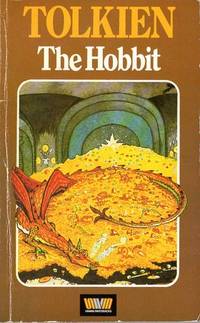
Of course, they make it out in the end, after Bilbo saves them all for the second time, and on they go ever closer to the Lonely Mountain and their goal. Maybe these chapters are a little slower, as they start to encounter people who may not appreciate them poking a bear as dangerous as the dragon who wiped out their town many years ago and is currently leaving them alone. However, I appreciated these chapters this time through and see how important they are to the late thrust of the story. Tolkien builds Smaug wonderfully, giving us his legend and showing us his desolation long before the iconic scenes of Bilbo, invisible because of his ring, sneaking up on him on top of a vast mound of gold.
The other detail that I apparently forgot is that people die at the end, including major characters we've followed throughout. That feels odd for a children's fantasy novel but entirely appropriate for a professor telling his own epic sagas that clearly have roots further back than novelists, back to the time honoured mythologies of Europe. Those deaths, even this late in the book, serve as a powerful reminder of just how dangerous this mission was and how much was accomplished. That sort of win isn't earned without payment. It helps this feel epic, even in a skimpy two hundred and eighty pages. Like I said, it feels like I've been on an adventure myself. Even at fifty-five, I felt like I had to reacquaint myself with my own world after I turned the final page.
Now I need to dig into what else came before Tolkien. I've gone back to the beginning of children's fantasy already, with George Macdonald's 'Curdie' duology, published half a century before this, but their fantasy framework is grounded much more in fairy tale than mythology. Hope Mirrlees created a fantasy world in 'Lud-in-the-Mist' but the tone was very different, that pointing a way to people like Neil Gaiman rather than Tolkien. Even C. S. Lewis's 'Narnia' books wouldn't show up for another thirteen years.
I believe I need to read more Macdonald and also dive into the works of William Morris, who was a fascinating man far beyond his contributions to literature. I see mention of Jules Verne's 'Journey to the Center of the Earth' as an influence, as well as a much more obscure 1899 novel by Samuel Rutherford Crockett called 'The Black Douglas', though that may have influenced 'The Lord of the Rings' more than 'The Hobbit'. Either way, I guess I have homework to do. ~~ Hal C F Astell
For more titles by J.R.R. Tolkien click here
|
|