|
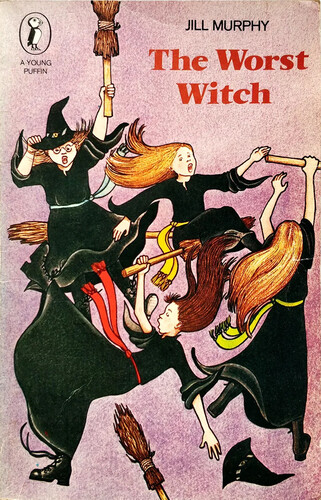
I must have read this way back in the day, but I'd forgotten how insubstantial it is. That's by design because it's written for a younger audience than most of the children's classics I've been reading lately. My copy is a skimpy Young Puffin that uses a font size so huge it could be called large print but is still done in just over a hundred pages. It's outrageously episodic but it can only really boast for episodes. It's supposed to represent a whole term but effectively starts halfway through. That said, its success may be due to it somehow getting far more done within this brief word count than seems natural. Maybe Jill Murphy was a witch herself and was writing from experience.
She was young when she wrote it, only eighteen years of age, and it was rejected by a whole slew of publishers because, get this, they thought that children would be scared by a book that was set in a school for witches. Of course, it eventually found a publisher, six years later, and spawned a series that eventually ran to eight books over forty-four years, one for each term that Mildred Hubble spends at Miss Cackle's Academy for Witches. It was also adapted into a TV movie in 1986, starring Fairuza Balk, Diana Rigg, Charlotte Rae and the late Tim Curry, which is why I prioritised this book this month.
The film is pretty awful, to be honest. St. Michael's College looks wonderful as a backdrop but the effects aren't great, the music is obvious and the cast is obviously small, even though it sprawls a lot farther than it does in the book. The script stays relatively close to the original story but with its various episodes reordered and sometimes telegraphed. Some sections, like Miss Cackle's first speech to Mildred, sound verbatim. It's also played even more for comedic effect, with the wicked witches live action cartoons, as embarrassingly stereotypical as it gets. They're handled better in the book.
Of course, Mildred is the worst witch of the title, because she gets pretty much everything wrong, with unfortunate results, and she has a knack of always being at the heart of any trouble, even if she didn't cause it. She constantly doubts that she'll ever succeed as a witch but, of course, there's a finalé to make her feel a lot better about her future chances. Sure, that's set up in outrageously convenient fashion but it still requires her to cast a spell in the right way and at the right time and she's up to the challenge. Like that's a spoiler? I don't think so. This isn't a book to read for shocks and surprises.
The first term is very loosely structured. On their first day, the students get a broomstick of their own. Halfway through, they're given a black kitten, though Mildred's last in line and they ran out so she gets a tabby instead. The biggest day of the year, of course, is Hallowe'en, and this year, it seems that the first year are to deliver a performance as a broomstick formation team. It'll even be in front of the chief magician, so the pressure is on to do their very best for their school. You'll be shocked, I'm sure, to discover that they're sabotaged and Mildred gets the blame.
As skimpy and blatant as this is, I must say I enjoyed it, even if much of that was to see the snotty witch, Ethel Hallow, get her comeuppance. She's the best at everything and dares Mildred to turn her into a frog. She gets it wrong and turns her into a pig instead and I couldn't be happier. That's the end of the first episode. The second involves a laughter potion that Mildred gets wrong and it plays out well, too. Then it's the Hallowe'en celebration shenanigans, which wrap up with Mildred running away from school. Fortunately for her, she runs right into the final episode and that puts everything right. The book is really that simple.
In fact, it's so simple that we're only introduced to two staff members: Miss Cackle herself, who's an old but friendly headmistress, and Miss Hardbroom, who gets the best story arc in the book. At the outset, she's a typical stern nightmare of a teacher, but she gradually lets a sense of humour show. My favourite moments are probably the ones where she puts invisibility spells to very good use. Oddly, given that she feels just like a character that Diana Rigg would make delicious, Diana Rigg was indeed cast in that TV movie but was shoehorned into clichés that aren't in the book. Of course, she's still absolutely wonderful, but her character was sabotaged.
If you're wondering, Tim Curry plays the Grand Wizard, the movie version of the character known here simply as the chief magician. He makes the absolute most of that part, which is much larger than it is in the book and outrageously flamboyant in the sort of fashion that few actors who are not named Tim Curry can manage. He gets a terrible song too, but he happily makes the absolute most of it. It's almost worth avoiding the movie but watching his part. However, then you'd miss a perfect opportunity to watch Diana Rigg and every opportunity to watch Diana Rigg is worth it.
I have to wonder if the later books in the series were more substantial than this one. I don't think they are, because the first two books were combined into a single volume and its page count isn't double that of this first one. On that basis, I could see the whole series being condensed into only two volumes, neither of which would feel huge. Given that, I'd expect that they're all like this one in that they're highly focused on small episodes within their respective terms, but those episodes are each iconic and memorable. They're terms with all the boring bits ruthlessly excised so what's left is important.
That's not the worst thing to give a new reader, even if they're not a witch. If your little ones are wondering what books are, this could be a great choice to sit down with and read together. There are cute pictures in my edition too, also by the author. You might just end up with a reader. Best of luck! ~~ Hal C F Astell
|
|