|
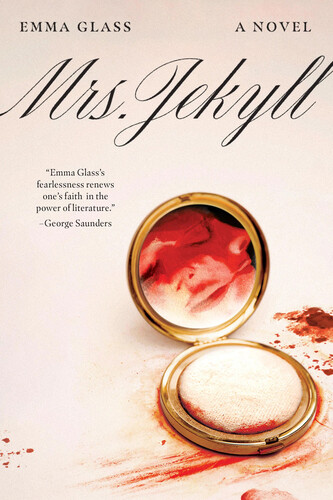
While this is labelled a gothic and advertised as "a powerful feminist reimagining of Robert Louis Stevenson's gothic classic", that's more than a little misleading. Neither of those details is unfair in context but this is literary fiction first and foremost, the sort of novel that would be more likely to be nominated for the Booker Prize than a Bram Stoker, and prose poetry next. In fact, in those scenes when our Mrs. Jekyll turns into Mrs. Hyde, the author shifts entirely from prose poetry to just poetry and she's equally comfortable with both. If this is horror, gothic or otherwise, it's only a long way down the list from all that.
That Mrs. Jekyll is actually Mrs. Winter, Rosy Winter, a schoolteacher in charge of Reception Class B, meaning very young children, five years of age. She's also been married to Charlie for five years and that's gone very well too. Most importantly, given where we're going, she's young. Too young to find a lump under her breast while bathing after a workout at the gym. While she finds it early, it's already too late. She has cancer and this novel is an exploration of grief, not of a life lost but of a life not to come, told by a woman who's dying achingly young before she really gets a chance to live.
While that's the clear story arc that runs throughout the novel, for the most part in chronological order, it's told in unusual fashion. The chapters are almost all notably short, many of them only a couple of pages, and everything in them is impressionistic. Emma Glass isn't interested in details of stories in any way other than how they can serve as moments or even glimpses of moments. It's as if she isn't writing at all but painting her chapters in words, which, of course, is a great way for any poet to approach their creations.
And, just like poetry, this would be easy to read aloud. In fact, it's almost meant to be read aloud and it would carry some serious weight if done right, with a poet's attention to tempo, intonation and emphasis. The only reason I won't underline that more is that there are also linguistic tricks here that would be challenging to adapt to spoken word. Chapter four, which is only ten pages in, loses all punctuation and some coherence to mimic the intensity of an orgasm. Even when there's dialogue, there are no quotation marks. We flow through whole conversations in narrative form. Ironically, it's Rosy telling us her story, though Charlie might do it justice, being a newsreader on radio by profession.
If Rosy Winter, an agreeably ironic name given the circumstances, serves as the Mrs. Jekyll of the title, eventually we have to meet her Hyde. That doesn't happen until a third of the way into the book, when Nola appears, her sections delineated by unfolding in freeform poetry instead of the poetic prose that represents Rosy. We don't spend much time with Nola, though when we do, it's usually for a longer chapter. Her first lasts fourteen pages, which may be double any of Rosy's.
It isn't just the style that changes but the tone too, which makes these sections easy to delineate even if we don't immediately grasp that Rosy is Nola. Even if we do, we may not realise that these sections are actually happening, rather than being dreams or metaphors. That's made clear over time but it's important to grasp it quickly to catch the full effect of what's happening and give us sufficient time to examine why. Then again, this is a quick book to read, so it wouldn't be too hard to just start it over again if we find that we still have questions after it ends. It's hardly obscure in its metaphors but a second time through may well bring new depths.
Frustratingly, I can't dig remotely deep into analysis without spoiling it. This is the sort of novel I would love to discuss at a book club, where everybody in attendance had read the whole thing so, like me, is aching to deconstruct it down to its nuts and bolts. It's also the sort of novel where the discussion could and probably would take a wildly different path from book club to book club, the percentage of readers being female only the most obvious reason for that. In many ways, it looks at what it means to be female, how the various roles traditionally assigned to that gender break down completely when faced with early death by tumour.
Of course, there's that "powerful feminist reimagining of Robert Louis Stevenson's gothic classic" too, but it seems to be that it's a loose framework indeed. Sure, it's there, but the meanings that sat behind the original don't translate directly. This isn't about good and evil or any of the other takes on the duality of human nature that have been read into Stevenson's novella. That doesn't mean it isn't about anything, because it's about plenty of things, but along completely different lines. This reprises 'Strange Case of Dr. Jekyll and Mr. Hyde' about as closely as 'Forbidden Planet' reprises 'The Tempest'.
It's a fearless book and one worthy of much praise. I'm just not particularly sure how well it would play to a horror audience expecting something closer to 'Jekyll and Hyde'. Then again, the horror audience isn't what pop culture thinks it is, so maybe it'll find readers there beyond more literar- minded people who might actually prove more restricted in their outlooks. Either way, it carries a serious punch. ~~ Hal C F Astell
|
|