|
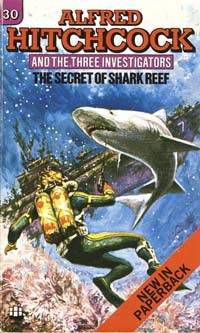
It seems odd to jump into the future at the very beginning of this review, but this is the thirtieth book in 'The Three Investigators' series and, not that writer Dennis Lynds, as William Arden once more, or anyone involved in releasing the book knew it at the time, it marks a point of transition. Alfred Hitchcock had played a crucial role in the first novel, 'The Secret of Terror Castle', which led him to agree to introduce the case. That led to another and another and he would eventually put his name to thirty cases, this one being the final one for the great director.
After all, the series began in 1964 when he was already sixty-five years old. This book saw print in 1979 when he was eighty. He died the following year and the boys subsequently took 1980 off, the first time that they'd done so since the series began. In fact, there had only been two years, 1975 and 1977, when only one book was published. Usually there were two. Clearly the publishers were unsure how to continue without Hitch being involved, even in fictional form. And that's fair, given that none of those first thirty books, at least in the British editions and I believe the original U.S. editions too, featured an author's name on the cover. However, Hitch was there on all thirty.
Fittingly, he wraps up this novel: "Grinning, the famous director watched the boys file out of his office and wondered what exhausting adventures they'd become embroiled in next." They would come soon enough, starting in 1981, but with a new name introducing them, who we'll meet next month, in 'The Mystery of the Scar-Faced Beggar'. So, thank you, Alfred Hitchcock, for agreeing a strange deal, to be fictionalised as an important but peripheral character in a children's mystery series. It was where I first encountered your name, long before I saw any of your films.
But, enough of the maudlin introduction. What's up this time on Shark Reef? Well, Shark Reef, or more properly, Shark Reef Number 1, is a new oil platform, the first outside the Channel Islands. No, not Guernsey and Jersey and the others in the English Channel as I would have immediately assumed when I first read this on original British publication in 1979. These Channel Islands are in the Santa Barbara Channel off Los Angeles. Of course, the environmentalists aren't happy, what with a big spill only a decade earlier in 1969, and so Bill Andrews is sent to cover the story. That's Bob's dad, of course, and he takes the three boys along for the ride.
There are protests planned, with lots of boats going out to Shark Reef to make a public show, all the more with the press along. However, there's a brief feelgood moment before we embark for the platform, when Bill introduces the boys to John Crowe. He's the chairman of the committee protesting the platform but he's also a mystery novelist. The boys are fans of his, but it turns out that he's a fan of theirs too and he asks for one of their famous business cards. I like that. It's not a huge thing on the surface, but it really is when you think about it. That they then get to work a case together is just the icing on the cake.
And, of course, there's a case. They all travel out to the protest with Capt. Jason on his boat, the 'Sea Wind'. However, they have to head back early when they realise they're surprisingly running low on fuel. The captain, who's highly experienced, had calculated for twelve hours of fuel, but it will only last ten or eleven, with absolutely no obvious explanation. Jason had thought about and discarded a bunch of reasons and Jupe follows suit with a few more. They check every logical box and, as the mystery deepens through repetition, their response to it is top notch.
Of course, Lynds sets up a backdrop full of suspicious characters for us to consider. The most likely are the more extreme elements on either side. Within the protest, that's the Connors Brothers, Tim and Jed, a pair of reactionary abalone divers. On the oil company's side, it's Mr. Hanley, who serves as its president. All three of them practically encourage conflict and, sure enough, a fight soon erupts, even though all three of them have mysteriously vanished by the time the police are able to break it up.
There are other people to suspect too, in a more subtle way. Paul MacGruder is the rig manager but he's a voice of reason on the oil company's side, very possibly the only one. There are a whole slew of other protestors, Crowe at their head. Then there are a couple of Japanese characters in the picture: Yamura, a mysterious businessman who keeps showing up everywhere and a young gardener called Torao who's just started working for Crowe. Lynds quickly makes it clear who the principals are, though, which does limit our options.
All in all, I enjoyed this one, even though most of it isn't particularly surprising. The setup is good and there are plenty of cool moments on offer, one of which in particular would have been worthy of a Clive Cussler novel. The hurricane coming in at a crucial moment feels a little clichéd but it's handled well enough, even forcing the newly sabotaged 'Sea Wind' to dock on Shark Reef Number 1, which sets up some obvious conflicts and some clever dynamics for the next few chapters.
Hitch appropriately mentions in his introduction that all three of the boys have to step up to the plate this time out and they all do a great job. This one isn't another Jupiter Jones show. There's a nod back to 'The Mystery of the Silver Spider' that I rather liked, though it's Pete who gets the credit for that scene this time out instead of Bob. He gets his own challenge and meets it with an impressive couple of solo chapters, where he's separated from his fellow investigators.
I really can't say much more about 'The Secret of Shark Reef' without spoiling the titular secret. What I can say is that I liked the historical background here, which takes a different approach to the usual one. Lynds especially liked to focus on the old Spanish heritage of California, but this is a book with a much broader scope. It didn't take long for me to figure out who the bad guys are, though it took longer to figure out what they were after. The one thing I hadn't figured out until right before it's revealed is the identity of the diver, a crucial detail. Had I fully realised what the MacGuffin was instead of just mostly, that would have been a gimme, but it was unusual enough to keep me in the hop.
If there's a negative side, maybe it's the perhaps inevitable cop-out at the end, when Hitch asks a few questions to clear up loose ends. This one really doesn't count as a spoiler, so I'll explain. The initial conflict was always between a big oil company and environmentalist protestors. In the end, both win, kinda-sorta: the oil company gets to implement a lot more safeguards, but they also get to drill for oil in a new somewhat sensitive location. I guess that's the appropriate way to go, but, especially given the current anti-science approach of the U.S. government, it feels like a loss.
So, next month, the first adventure in a new era without Alfred Hitchcock to introduce the case. I do remember who takes over, but I don't remember why, so I'm keen to find out in 'The Mystery of the Scar-Faced Beggar', with the authorship baton passed back to M. V. Carey for a couple of books. ~~ Hal C F Astell
For more titles in this series click here
|
|