|
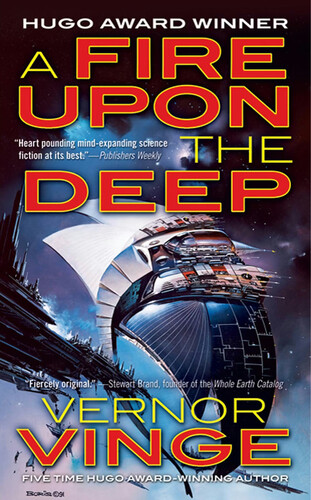
After a couple of years with Lois McMaster Bujold's 'Vorkosigan Saga' winning the Hugo Award for Best Novel, 1993 came in strong and resulted in a tie. The big winner that year was Connie Willis's 'Doomsday Book', which won the Hugo, Nebula and Locus awards. This tied for the former and was nominated for the other two. Kim Stanley Robinson's 'Red Mars' was also nominated for all three, but across two years, winning the following Nebula and coming second in the Locus race, with 'The Hollow Man' by Dan Simmons' also ahead of Vernor Vinge.
The reason I bring that up is that it feels like an award winner from the very outset. It starts with big ideas and they only get bigger. Vinge gives us small stories at the local level, with characters we can follow and situations we can sympathise with, but also a stupendously large backdrop at a galactic scale with outrageous numbers applied to events so vast that we can't grasp them other than knowing they're ridiculously huge. Hilariously, the one real negative from the hindsight of a mere three decades is how wrong he got the scale of the "Known Net". It probably felt prescient in 1993, but it's as laughable now as the use of payphones in 'Neuromancer'.
We start with an ancient archive, five-billion years old and stored at the quantum level. It's in the Transcend, the highest of four galactic levels not arbitrary in nature but which reflect the physics in play within them. The Unthinking Depths are the closest into the galactic core and most tech is non-functional there, leaving life at a primitive level. The Slowness, which contains Earth, is more sophisticated but still with serious limitations. The Beyond allows faster than light travel, true AI and other paradigm-shifting advantages. Above them all is the Transcend, the realm of Powers or what we might think of as gods. Crucially, civilisations can ascend or descend through these zones, not least because the boundaries between them can and do move.
The civilisation that discovers this ancient archive is a human one, from the Straumli Realm in the Beyond, but they find more than mere data. Information can be sentient in the Transcend and the Power that soon becomes known as the Blight gradually gains awareness and compromises them. Once it flowers, it takes out the frigate in a fraction of a second but the cargo vessel just escapes in time, sparking the rest of the story. It lands on a planet at the bottom of the Beyond where the Olnsdot family who captain it are quickly attacked by the local population. Parents Arne and Sjana are killed and their children, Johanna and little Jefri, end up with different factions of locals.
Meanwhile, as the Blight starts to wipe out or take over entire civilisations at a time, the rest of the galaxy starts to pay attention, communicating through the "Known Net", a discussion system that's more like Usenet than the World Wide Web. At one nexus on the Known net, called Relay, a mission spins up with the belief that the Straumli cargo vessel got away with a sort of cure for the Blight. They manage to escape Relay right before the Blight takes it out and the chase is on, with the 'Out of Band II' not far ahead of at least three different fleets with three different purposes.
While that's the plot, it's really not the most important thing here. In fact, that's pretty simple in many ways, a cross between a rescue mission and an antidote quest. The Blight is the big bad, just at a scale beyond anything I've ever read before. There's one point here in which a vigilante fleet destroys an entire civilisation, something we learn as a brief aside, and it's not remotely close to being responsible for the most deaths. By the end of this book, thousands of civilisations are gone and the death toll, cited in the trillions, truly must be orders of magnitude beyond that. Numbers here are so big they cease to have meaning.
However, at the other end of the scale, where we can actually quantify things, the good guys are few in number. There are only four characters on the 'Out of Band II', with the entire galaxy's fate in their hands, and only one is unmistakably human. That's Ravna Bergnsdot, a librarian from the Sjandra Kei civilisation, who's won three years of work study on Relay. Another might be, though it's hard tell how much so. He's Pham Nuwen, supposedly thawed out from the wreckage of a ship but truly the agent of a Power called Old One. We learn that quickly but have to wait until almost the end of the book to figure out how much of him and his memories are real and have validity in the absence of Old One, only the first Power to be eaten by the Blight.
That leaves two Skroderiders, Blueshell and Greenstalk, who resemble ornamental trees and are completely reliant on the skrodes they ride: part wheeled transportation mechanism à la Daleks, part memory bank to cater to their utter lack of short term memory and part symbotic cybernetic support system. They've been unchanged for billions of years, yet another reminder of scale, just in case we needed another one. These particular Skroderiders are much travelled traders and an impeccable link between the human characters and the myriad alien species. In fact, while Ravna is the only absolute human on the 'Out of Band II', she's also the only absolute human on Relay.
If Vinge's greatest achievement here isn't his ability to frame small emotional stories against the largest backdrops, it's his xenobiology. The aliens he gives here are truly alien and the two trader Skroderiders with a couple of centuries of history together aren't close to being the most vibrant. That's surely the Tines, the local population that the Olnsdots encounter, because they're hybrid doglike creatures who can't function particularly well on their own, as singletons, but can connect together to become Packs, not in the social sense that we expect but where Packs are effectively single minds with single identities.
That gets weird quickly but does help to explain why their names are so convoluted. For instance, the first such we meet is Peregrine Wickwrackrum, but he's a Pack of four Tines: Wic, Kwk, Rac and Rum. When Rum is killed, he becomes a Pack of three, but then assimilates (if that's a good term to use) Scar, who's lost the rest of his Pack, to become four again, as Wickwrackscar. Just to make that even more complex, Peregrine seems to be quite a decent sort but Scar was part of the Pack that killed Johanna's parents so she understandably doesn't want Peregrine near her. Also, while Peregrine is entirely male, some Packs are of mixed gender and can reproduce within themselves.
I found all that fascinating, once I got my head round it. Vinge does a lot of explaining here, which won't surprise you, but he doesn't do as much as he could have done. We have to figure out plenty of details for ourselves. Even if we grasp the hybrid nature of Tines quickly, we still have to learn the deep ramifications of how Packs really work. He gives us a map of the Zones of Thought, but it oddly leaves out the Transcend, which counts for a quarter of them. We realise Pham Nuwen isn't a typical character but how and why shifts throughout the book. While Skroderiders are sentient and Skrodes are not, that doesn't mean we fully grasp the relationship between the two quickly.
In short, it's not remotely surprising to see this nominated for the biggest awards and at least co-win one of them. I haven't even mentioned the twists and there are a few of those, including one that's a real doozy. I haven't talked about how this is high concept science fiction but the conflict between Woodcarver and the Flensers, the two factions of Tines we meet, is mediaeval and close to fantasy in its outlook. And I haven't mentioned the prescience that leads Vinge to describe his "Whole Net" as the "net of a million lies". This was 1993. Windows 1995 hadn't come out yet, so a majority of the public had no idea what a graphic user interface was. That quote is notably ahead of its time.
Unfortunately, the rest of it isn't. I've rightly talked up how powerfully Vinge handles scale. When the evil gets loose, it eats up civilisations in heartbeats. When the 'Out of Band II' needs to test its antenna swarm, it just moves out "a couple of thousand light years" to look at the results. It visits a drydock on Harmonious Repose for refitting that's an arc ring a kilometre wide and forty million long. And yet, speculation about the galaxy being eaten alive by a Class 2 perversion reaches the dizzy heights of five thousand messages an hour. There are a million different viewpoints. When a four-hundred-second video goes viral, it's uncompressed and practically crashes the whole system.
As prescient as the "net of a million lies" was in 1993, Vinge completely failed to apply the concept of scale to his use of bandwidth. Civilisations routinely using faster than light travel and artificial intelligence who post to the Known Net through even three or four layers of accurate translation are stuck with lower bandwidth than most of us had in our phones during the Y2K crisis. With their spiffy new antenna system, the Skroderiders have an immense "thirty Kpbs link to Relay". Clearly Vinge did not see YouTube coming, let alone the rise of streaming media in 4K. I'd guess he might fix that in a new edition, but I have to wonder if he did it in the subsequent books.
I have the first of those on the shelf, in a Tor Essentials edition. That's the prequel, 'A Deepness in the Sky', which I should dive into soon. That originally came out in 1999, but there's a direct sequel too, 'The Children of the Sky' from 2011. Also, Vinge's former wife, Joan D. Vinge, set a number of works in her 'Heaven Chronicles' in the same universe as these books. Next up for me, 'Doomsday Book', which might seem a little odd, because, while it'll be new to me, I've read its initial sequel, 'To Say Nothing of the Dog' ~~ Hal C F Astell
For more titles by Vernor Vinge click here
For more Hugo winners click here
|
|