|
I found this fifth issue of 'Amazing Stories' a little disappointing. There's an H. G. Wells short story and a Jules Verne novella, but both seemed weak to me, especially compared to their work in the earlier issues. Every Wells thus far has been excellent and the Vernes have all been enjoyable. I'm assuming this is a temporary dip in quality but it's odd for both to dip at the same time. Even the piece I was looking forward to the most disappoints a little, not because it's poor but because it's not willing to move the story along much from the first instalment. But c'est la vie.
Before I dive into the fiction, I want to talk about Hugo Gernsback, the editor of 'Amazing Stories'. His introduction to this issue isn't noteworthy but underneath it as a note: "Mr. Hugo Gernsback speaks every Monday at 9pm from WRNY on various scientific and radio subjects." What that fails to get across is that WRNY was Gernsback's own radio station, launched in June 1925. He was one of the most important radio hobbyists at the time and one of the most prominent, starting out in 1905 by creating the Electro-Importing Company to import specialised radio kit from Europe. This was a store on Fulton St in New York then a mail order catalogue.
In 1905, he produced the first commercial home radio set, the Telimco wireless, guaranteeing that it would be received a mile away, a major claim for a device that cost $7.50. He founded magazines to cater to this hobby: 'Modern Electrics' in 1908 and 'Radio News' in 1919. The former renamed to 'The Electrical Experimenter' in 1913 and proved a strong source for some of the reprints that I've been reading in 'Amazing Stories', including the 'Mr. Fosdick' series. WRNY followed in 1925 with a massive ability to experiment with what he was publishing. In 1928, WRNY transmitted television images, the first standard radio station to do so. Sadly, as far as I can tell, none of its broadcasts are extant today.
Anyway, back to the fiction, which includes two brand-new short stories, even highlighted as such with a star on the contents page, along with a bunch of reprinted material. Two of the latter are novels being serialised, the middle instalment of G. McLeod Winsor's 'Station X' and the first in a three-part run for Garrett P. Serviss's 'A Columbus of Space'. The latter was first published in 1909, the former in 1919. The Verne is 'Dr. Ox's Experiment', a novella from 1872, and the Wells a short story called 'The Empire of the Ants', from the 'Strand Magazine' in 1905. That leaves a poem by Leland S. Copeland that's new here, and another 'Mr. Fosdick' from 'Modern Electrics' in 1912.
Oddly, that may be my favourite piece here, because it's as outrageous as the prior month's 'The Feline Light and Power Company is Organized' but a little more realistic. Only a little, I must add, as Mr. Fosdick's latest idea is to revolutionise the undertaking industry by electroplating corpses. Eben Stetzle wants in on this scheme, so Fosdick uses him as a guinea pig with hilarious effects. It falls on us to have sympathy for more Mr. Stetzle, but he's an overt racist who manages to offend black people and Native Americans in short shrift, so we enjoy his frustration even more.
Jacque Morgan wrote five 'Mr. Fosdick' stories for 'Modern Electrics' between 1912 and 1913 and I've now read three of them; all that would see reprints in 'Amazing Stories'. I'll have to seek out the other two, 'The Afro-American Cataphoretic Process Col, Limited' and 'Mr Fosdick Goes in for Synthetic Chemistry', just to see how the series played out. Fosdick is as inept as Dr. Hackensaw is capable, but, after those in the previous two issues, there are no more of his stories either, even though there were forty-five of those. I've been working through those in 'Science and Invention' and I've found that they're much more serious and substantial than the 'Mr. Fosdick' stories.
The two new stories are pretty solid too, though they're not classics of the genre, neither author ever saw publication with another story and one ends rather conveniently. That's 'High Tension', by Albert B. Stuart, M.D., and, like its author, it's about a medical doctor, Dr. Reginald Carter, an impressive but socially awkward brain surgeon. Only Dr. Bryan can ever get anything out of him, a detail that helps when the police visit him with news of a murder. As this only runs five pages, the detective angle is inevitably shallow but it's a decent enough tale of mad science until that overly convenient ending.
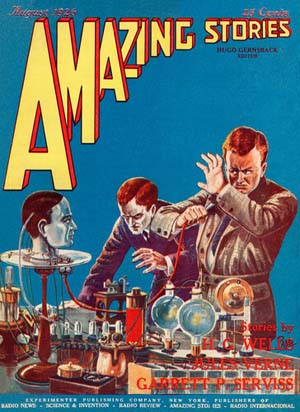
M. H. Hasta's 'The Talking Brain' is even more obviously mad science and most of the comparisons I felt are from titles that came much later. Prof. Murtha is so dedicated to science that he's rather akin to H. P. Lovecraft's Herbert West, who first appeared four years earlier. In a similar conceit to 'High Tension', only Prof. Harvey can get anything out of him and they work together on Vinton, a blind patient who wants to see again. However, after Harvey joins an expedition to the north, he returns to find Murtha changed and Vinton dead, but, as you can see in the cover art, his brain is kept active.
If either that cover art or my brief synopsis hint at Jan in the Pan in 'The Brain That Wouldn't Die', an iconic B-movie from 1962, then you're on the right lines, but the tone felt more reminiscent of 'Johnny Got His Gun', an even later movie from 1971. With both those firmly in the future in 1926, the comparison made within the story is very different indeed, to Edgar Allan Poe's 'The Facts in the Case of M. Valdemar', which was reprinted in the very first issue of 'Amazing Stories'. It's easy to see why, but the later comparisons are much stronger. And where is Poe anyway? This started out with reprints of Verne, Wells and Poe, almost as a triumvirate, but it's drifted into Verne and Wells as a double act instead.
Talking of reprints, that's what all the other stories are, starting with the first of three parts of 'A Columbus of Space', by Garrett P. Serviss, author of the short story, 'The Moon Metal', in the prior issue. As the title suggests, it's a planetary romance, originally published in 1909 in 'The All-Story Magazine'. Edmund Stonewall, a highly talented scientist, masters atomic energy and suckers his friends—Jack Ashton, Henry Darton and the narrator, whose only name given is Albert—into test driving the spacecraft he's built. Notably he doesn't tell them what it is first, so they assume it's a balloon and only find better understanding when they're on their way to Venus.
It's a reasonably short trip at twenty miles per second, taking them sixteen days or so, even given slowing down for a couple of atmospheres, and what they find isn't far from what you might think they'll find in a planetary romance from 1909. They start on the dark side, which is populated by a community of gorillas who sway their heads to hypnotise, rather like cobras; live underground to escape the freezing surface temperatures; and worship our planet. Then they journey to the light side, where they find beautiful telepathic women piloting airships.
What stood out to me was how dubious the decision making is. Stonewall and his friends seem like decent people, but they shoot one gorilla dead at the slightest provocation, then another pair in a more understandable act to stop priests from sacrificing Albert to the Earth. As if that was just a warm up, they then pile a host of them onto sleds to whisk to the light side, which proves to be a terrible idea, all dying on that insane rollercoaster ride except Juba, who they take into the craft. What are the odds that they'll shoot down an airship to avoid a collision? Pretty strong, I'd say.
To be fair, it's fun enough for early twentieth century sci-fi hokum, but I won't pretend I expect to get anything more than that out of the remaining two thirds. I do expect H. G. Wells stories to be much more substantial, but my modern expectations consider 'The Empire of the Ants' a cheat of a story. Capt. Gerilleau takes his gunboat up the Amazon to help the people of Badama to repel a dangerous invasion of ants. It's a great setup and Gerilleau is a selfish idiot, maybe also a coward, so there's plenty of opportunity for things to go horribly wrong, but it only really happens once, a tragic incident when Gerilleau orders his second in command, Lt. da Cunha, to a horrific death.
Given that setup, you're no doubt writing the rest of the story yourself, based on over a hundred years’ worth of nature on the rampage stories and monster movies. In this instance, however, you would be wrong in almost all respects. We never learn where these ants came from, just that they are larger, more aggressive and more intelligent than expected. The engineer accompanying the captain, Holroyd by name, doesn't get to take over as hero, as likely as that seems. And there's a distinct lack of conflict, the gunboat merely turning round to go home and warn the authorities. In 1905, that probably felt like a powerfully pessimistic way to end, but in 2026, it feels like all the juicy bits were left out, including what seems like the entire second half of the story.
I wanted a lot more from 'The Empire of the Ants' and I wanted a lot more from the Verne novella, 'Dr. Ox's Experiment', originally serialised in France in 1872. It's another mad science story but the focus is more on satire that went over my head. The town of Quiquendone in Flanders isn't on any maps but it's been there forever and it's outrageously quiet and peaceful, but that peace comes through sheer lethargy. Its council does nothing and has a grand old time doing nothing. Nobody ever gets into trouble because they can't be bothered to actually do anything. Even the music is implausibly slow. Their opera to real opera is funeral doom to regular heavy metal.
Enter Dr. Ox, who's setting up the town to be lit by oxyhydric gas, but we soon learn that's merely a front. Instead, he's going to spice everything up with a secret gas. The opera performance that we get to experience is scheduled for six full hours, but is done in eighteen minutes. The lethargy of Quiquendone is stripped away, to the degree that fights break out and they even declare war on the neighbouring town over a perceived insult received in 1195. No solution is found except by convenience, which renders the novella with almost an 'Asterix' feel. It's fun enough but slow and can't compare with any of Verne's better known works.
With acknowledgement of the poem by Leland S. Copeland, 'Aspiration', that's clearly only there to fill space at the bottom of the final page of 'Dr. Ox's Experiment', I'll dive into the serialisation I was looking forward to the most, G. Mcleod Winsor's 'Station X'. I had a blast with the first part, which escalated powerfully, and wanted the second to follow suit. Sadly, it doesn't, though I liked the reasons why it doesn't go anywhere for a while. Winsor is setting us up for a conflict between Venusian and Martian powers and the former restricts our hero, Alan Macrae, from returning to Station X with Prof. Rudge until Mars is the opposite side of the sun to Earth, thus restricting the Martian's influenced.
It's worried that the Martian might control Alan, but it ends up controlling Prof. Rudge instead, a state of affairs that prompts a vast amount of intrigue bouncing back and forth but little forward momentum for the story. I'm still eager to find out how this one wraps up, though, so I'll be diving right back into it next month with almost as much anticipation as I had this time out. There will be another Wells short story, the beginning of another Verne novel, along with the continuation of 'A Columbus in Space' and a new story by Alexander Snyder that was intended for this issue. Most of all, though, I'm looking forward to a reprint of a hoax from a New York newspaper in 1835. ~~ Hal C F Astell
For more Amazing Stories titles, click here
For more titles by Hugo Gernsback, click here
|
|