|
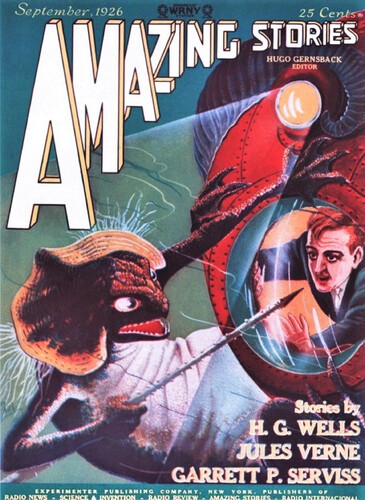
As a stark contrast to the previous month's 'Action Stories', which boasted "No Serials! All Stories Complete!", this issue of 'Amazing Stories' is almost entirely serials. Of the five stories here, only one of them is complete, a novelette by Alexander Snyder. The other four, one novella and three noevls, all appear as serialised parts, two first halves and two final instalments. The mindset still feels odd to me, having to wait a month before being able to read the next part of a story, but I'm starting to forget what it was like to have to wait a week to watch the next episode of a TV show. I thoroughly appreciate binging, which, of course, books have allowed us to do for centuries.
The conclusions are to Garrett P. Serviss' 'A Columbus of Space', which wraps with this third part, and Jules Verne's 'The Purchase of the North Pole', told in only two. They're very different novels, but both were reprints. The Verne was published in book form in 1889 and the Serviss in 'All-Story magazine' from January 1909. The different in style in twenty years is impossible to miss.
'The Purchase of the North Pole' is a thoughtful piece of speculative fiction that throws out a wild proposition and then follows the ramifications of it, though I must add that there's an awful lot to be said about the issue of consent that Verne carefully avoids. After all, the plan of the Baltimore Gun Club, having purchased the North Pole, is to remove our planet's axial tilt. There are benefits, not just the rendering temperate the arctic and thus opening up to mining, but the regulation of seasons and even days into simple cycles of twelve hours of light and twelve of darkness.
However, there are also drawbacks, which Verne raises here. Devastation from sea change would be immense. We know a lot more about ecological disaster now because we're experiencing it but this plan would melt the ice caps completely, wiping out whole swathes of populated land. Similar destruction would be wrought by air change. This is a huge deal, but Barbicane and Nicholl vanish and all that's known is that they're intending to fire their immense cannon on 22nd September, at which point it'll all be a done deal. What sort of arrogance does it take to be so sure of yourself as to destroy whole nations and the civilisations within them and think it good work?
I like their setup, though. A cannon so large that firing a missile would move the earth's axis isn't a trivial affair. They simply dig an immense hole in the side of Mount Kilamanjaro, into which the projectile, weighing a hundred and eighty thousand tons, is placed, on top of a ridiculous amount of very special explosive. And... well, let's just say that there's a catch and Verne had telegraphed that a little through the character of Alcide Pierdeux. While the world panics about an impending doom, he sits back and chuckles and Verne telegraphs the reason why too. I liked this one, but the way we think about the plan at its heart has surely changed over time.
Only a couple of decades later, 'A Columbus of Space' takes a vastly different approach. Instead of an outrageous supposition extrapolated through science and mathematics, it goes for planetary romance, with a genius creating a spaceship powered by atomic energy and takes his friends for a spin without letting them know that it's to Venus. That's Edmund Stonewall, who serves as both a boffin scientist and an action hero in this story, and by this point, he's won the heart of the local princess, Ala, who's been stolen by the jealous Ingra in Edmund's spaceship.
That's the cliffhanger to take us from part two to part three, but the good guys are on the case. I love that Juba the apelike Venusian shadow dweller grabs the ship as it takes off and holds on for the duration. Edmund merely gives chase in another vessel. Panic resolved, we run through some more action, an expedition into the zone of tempests trawling in giant spiders, flocks of bats and the dark side of the planet. It's been twenty months but Juba does get to go home. Edmund and Ala get to the altar, but the novel is almost done and Serviss wraps it up in brutal fashion, ending up with only the narrator making it back to Earth to tell this wild tale.
It's a fun enough ride but it's pure fluff, especially preceding the Verne in these pages. It's a very different read to his short story, 'The Moon Metal', originally published in 1900 but as recently as July in 'Amazing Stories'. He'll be back in November, with another serialised novel, this one 1911's 'The Second Deluge', published in four parts, but I seriously ought to go even further backward to 'Edison's Conquest of Mars', a sequel to a knockoff of Wells's 'War of the Worlds', serialised in the pages of the 'New York Journal' and containing a whole slew of firsts.
I enjoyed both these conclusions, but was especially eager to dive into the beginnings, albeit for a couple of different reasons. One is the overdue elevation of H. G. Wells, a presence in every issue thus far, from short story length to full novel. First up is 'The Island of Dr. Moreau', a story I know pretty well but which I don't believe I've ever actually read. I've been looking forward to that one. The other isn't a novel I've heard of, but it's new, not just to these pages but period, which is a big deal at this point in 'Amazing Stories', because it's the first original novel thus far.
It's 'Beyond the Pole' by A. Hyatt Verrill, the cover story and it kicks off this issue. It's a lost world story, set in a similar warm land within the Antarctic as in James de Mille's 'A Strange Manuscript Found in a Copper Cylinder'. I liked that and I like this, which follows the same setup but populates its lost world with a notably different civilisation. It's introduced in a framing story by Dr. Abbott E. Lyman, an ornithologist on Kerguellen Island, where he notices a manuscript secreted within an object that's tied to the leg of an albatross. It's by Franklin Bishop and it's reproduced verbatim, with copious footnotes by Dr. Lyman.
Bishop was a whaleman, the first mate on the 'Endeavor' out of New Bedford in 1917. It heads for the South Shetland Islands seeking sea-elephant oil, given that the cost of oil has rocketed during the First World War. We call those elephant seals today and they were hunted to near extinction in the nineteenth century primarily for lamp oil. However, Bishop doesn't get that far, as his ship is taken in a storm, collides with the ice and sinks. Two boats get away, leaving Bishop and Olaf the carpenter behind. Olaf dies in winter but Bishop wanders around, finds one of the boats, with the captain and his men all dead, and is then discovered by an eight-foot-tall telepathic lobster that's wandering about on its hind legs.
You might imagine that this is a fever dream, but Bishop is actually in great shape, having plenty of food to sustain him. His only problem is being stuck there alone, but that's soon solved as this giant lobster takes him back to its advanced civilisation and we can get down to business. Much of this first part is devoted to the setup and the initial wonder of this lobster world, where they use a miracle material, that seems likely to be metallic sulphur, and perhaps atomic energy. It's very talky, because the lobsters don't, being telepathic, but that's par for the course for the era. Thus far, I'd love to visit, not least to enjoy their zoos and museums. Conclusion next month.
And so to the Wells, which is a real treat. While I've generally enjoyed the reprints of Verne, the Wells stories have mostly blown me away, only one not living up to expectations. Frankly, if I have a single takeaway thus far from the first seven issues of 'Amazing Stories', it's to read more Wells. There's plenty on my shelf. I'll continue through these pages but also update my index so I can see what isn't coming and dive into that on the side.
The setup to 'The Island of Dr. Moreau' echoes that to 'Beyond the Pole', in that there's a framing story, in which Charles Edward Prendick introduces his uncle Edward, who boarded the 'Lady Vain' in 1888 but was presumed lost at sea soon afterwards, only to be picked up in a small open boat of a different vessel, the missing schooner 'Ipecacuanha'. What follows is his story, which is suitably outrageous and reprinted verbatim.
It turns out that the 'Lady Vain' collides with a derelict ten days out from Callao, which is in Peru, and goes down. Prendick drifts for eight days, losing his two companions who go overboard during a fight, so he's the only one rescued, by the 'Ipecacuanha'. The captain isn't friendly but there's a passenger who is, Montgomery by name, which is a good thing given that, when the ship reaches its next stop, the island where Montgomery works, Captain Davies throws them all off, not merely Montgomery and his menagerie of animals but Prendick too. So he finds his way ashore alongside the puma, the llama, the stag hounds, the rabbits and a strange deformed man with an ugly face.
It's not Montgomery's island, of course. It's Dr. Moreau's and it doesn't take long for Prendick to remember the scandal that prompted a departure from England. He explores and finds that the scientists are conducting live vivisection. Assuming that he'll be an imminent victim, he runs and that's when this gets really special, because he meets the beast men. Tellingly, Prendick accepts them as men with animalistic features, because they can speak and reason, rather than animals that have been uplifted through experimentation. That may be partly due to him coming from a time before this novel could affect popular culture, but it's an important distinction to make.
He's puzzled by the rituals, which carry so much emotional power today after a century not just of adaptations of this story but a vast amount of other stories influenced by it. There's resonance to the litany of the Law, led by an Ape-man. "Not to go on all-fours; that is the Law. Are we not Men?" It's a reinforcement chant, but it's shockingly affirmative too and the second litany is tough too: "His is the House of Pain. His is the Hand that makes." It's impossible not to read this without the subsequent century affecting but I wondered just how this would have played in 1896. It's a horror story for sure. I'm eager to roll into the conclusion next month.
That leaves room for only one short story, which is 'Blasphemer's Plateau' by Alexander Snyder, a new author to 'Amazing Stories' and a relatively unprolific one compared to the other authors in this issue. While Verrill's novella was new, he'd been prolific in the pulps since 1901 and varied in genre. His most regular fiction market up until this point had been 'Sea Stories', but it shifted to 'Amazing Stories' here. 'Beyond the Pole' is a novella but it would be followed by six novelettes by the end of 1927. Snyder, however only had a handful of stories in print, though they included one each for 'Action Stories' and 'Sea Stories Magazine' and a vignette in 'Weird Tales'.
'Blasphemer's Plateau' is a highly appropriate story to follow 'The Island of Dr. Moreau', as it has a similar mindset. Gary Mason drops by the Plateau of Dr. Oliver Santurn unannounced, which is a shocking idea to the locals. They're old friends, but haven't seen each other in ages, at least since the doctor established his private establishment here a decade earlier, with a menagerie and an aquarium. He's working on "Immortality and the Resurrection via the laboratory route". There's plenty of science in this science fiction story, placing it somewhere between Verne and Wells, the sweet spot for anyone trying to sell new fiction to 'Amazing Stories'. It also has a dark edge that leads to a suitably emphatic conclusion.
And, with acknowledgement of a couple of entirely palatable poems by Leland S. Copeland, there clearly to fill empty space at the end of stories, and an ad to announce an unusual new magazine from Experimenter Publishing called 'Money Making'—"on how to increase your income"—that's it for the October issue. Next month, the conclusions to both 'Beyond the Pole' and 'The Island of Dr. Moreau', plus the beginning of Garrett Serviss's 'The Second Deluge', a short Verne story and a reprint by Murray Leinster from 'Argosy' in 1920. However, Gernsback remains overly ambitious, so 'The Diamond Lens' by Fitz-James O'Brien, "crowded out of the September issue" won't appear in November either, even though it's promised. ~~ Hal C F Astell
For more Amazing Stories titles, click here
For more titles by Hugo Gernsback, click here
|
|