|
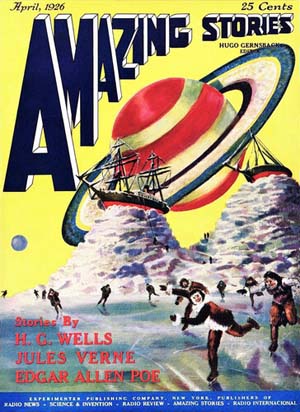
This month constitutes a major centennial for the world of science fiction and it gives me a great opportunity to start up a new ongoing project. One hundred years ago, in April 1926, the American public was able to read, for the very first time, a new pulp magazine that was dedicated to science fiction, or at least what editor Hugo Gernsback, the man whose name is remembered every time they hand out a Hugo Award, called "scientifiction". It was 'Amazing Stories', which he suggested in his page-long introduction would contain "charming romance intermingled with scientific fact and prophetic vision".
He initially uses three well-known authors as examples, scientifiction being "the Jules Verne, H. G. Wells, and Edgar Allan Poe type of story". Sure enough, all three show up in this first edition, as it only contained reprints; the first original story would arrive in issue two as a sequel to one of the reprints in the first. Gernsback promises a lot of Verne in the future, but kicks off with half of 'Off on a Comet', originally published in France in 1877 as 'Hector Servadac'. The Wells is a short story, 'The New Accelerator', first published in 'The Strand Magazine' in 1901, as is the Poe, the famous 'The Facts in the Case of M. Valdemar', from 1845.
This project will allow me to discover other names from the pulp era, whether obscure then or just obscure now. I know the three already mentioned but, when Gernsback brings them up again, just listing surnames, he adds a fourth: "Poe, Verne, Wells, Bellamy". Who's Bellamy? I have to believe he's talking about Edward Bellamy, author of 'Looking Backward: 2000-1887' but is it entirely fair to seat him alongside the other three as "real prophets"? That says more about Gernsback than it does about Bellamy, I think.
So, while I've read the Wells and Poe before, albeit a long time ago, and may have read the Verne, I know nothing about G. Peyton Wertenbaker, George Allen England and Austin Hall, who made it into the contents of this first issue alongside them. More unknown (to me) names will follow with each issue and I'm looking forward to meeting them all.
Wertenbaker's 'The Man from the Atom' was reprinted from the August 1923 edition of 'Science and Invention' and is the story that obtained an original sequel in the following issue of 'Amazing Stories'. It's interesting enough, as a tale of a man who straps on a friend's invention to increase or reduce size through atomic manipulation and takes it to serious extremes, growing to the size of the universe and back. There's a vicious twist but the science falls apart pretty quickly and that doesn't help the story.
Wertenbaker wrote a number of scientifiction stories but moved away from it after 1930 into what I might call general fiction but the Encylopedia of Science Fiction calls regional fiction, using a new byline of Green Peyton, his first two names. However, he returned to science, if not science fiction, later in life, after stints on the editorial board of 'Fortune' and as a contributing editor to 'Time', working in aerospace, helping with a physiological study of Mars and eventually writing speeches for NASA.
England's 'The Thing From—Outside' is more of a weird tale than a science fiction story, but it's a yarn about a monster (for want of a better term) popping in from another dimension and shaking up an expedition in the frozen wastes of Canada not far from Hudson's Bay. I liked this one for its mood because England stirs up good paranoia and madness, but it's another reprint from 'Science and Invention', this one from April 1923, that doesn't stand up to its billing here.
Unlike Wertenbaker, England was best known for his fiction with over three hundred stories to his name by the time he died in 1936. He wrote a string of novels, starting with 1910's 'Beyond White Seas', perhaps most famously his 'Darkness and Dawn' trilogy of post-apocalyptic reconstruction. However, he was also an explorer and contributed articles to 'The Saturday Evening Post'. Given that the bulk of his work was already behind him at this point, I wonder if this story was the best choice Gernsback could have made.
Hall was a cowboy when he took up writing and, perhaps unsurprisingly, wrote a great many more westerns than he did any other genre, but he also penned science fiction and fantasy for 'All-Story Weekly'. It was they who first published 'The Man Who Saved the Earth' in their issue dated 13th December, 1919 and I can see that it's one to remember as a story of calamity on a global scale by alien hands. However, while it's certainly effective in its breathless urgency, it runs for seventeen pages and could have easily have been done in seven.
So for the new names to me. All three stories were enjoyable in their way but I doubt I'm going to suddenly find myself seeking out these authors' bibliographies any time soon. On the other hand, it would be easy to imagine someone discovering Verne, Wells or Poe here doing exactly that. I'm not going to suggest that these are their greatest works, but each is worthy and I'm happy to find my way back to them.
The Verne is the cover story, with the bizarrely striped planet within the rings supposedly being a far too close view of Saturn. Those skaters are also having far too much fun given the context this cover art ignores. As the new title, 'Off on a Comet' suggests, we take quite a journey on one, the self-dubbed Gallia, as it follows an orbit within our solar system. We start out on Earth, in French colonial Algeria, with Captain Hector Servadac preparing for his upcoming duel with the Russian nobleman, Count Wassili Timascheff. It's all over a girl, of course, which makes it extremely ironic that they end up on Gallia with a growing number of other men but not a single woman.
The initial conceit is scientifically dubious, as the core of Gallia plunges into our atmosphere and steals an impressive chunk of our land and sea, before plunging back out again and continuing on its way, atmosphere apparently intact. Gernsback is aware of this and points out that "the initial and the closing extravagance" aside, it seems scientifically sound. These bookend extravagances, well, not so much. Everyone in this story really ought to be dead before it has much of a chance to begin. Fortunately they aren't, because I enjoyed this romp quite a lot, more and more as it went on.
Of course, I've only read the first half thus far, because I'll have to wait until May 1936 to read the conclusion, but it's told with gloriously Victorian-era morality, across characters from a swathe of different countries, all who happened to be in the area of the western Mediterannean when the comet pounced. Servadac and his adjutant, who uses the name Ben Zoof, are French, though they are on assignment in Algeria at the time; France remains on Earth. The count and his crew are all Russian, including the highly capable Lt. Procope, who captains his yacht. Eventually they discover others.
A good chunk of them are British soldiers stationed on the Rock of Gibraltar but they're happy to keep themselves to themselves. A bunch more are Spanish peasants who spend much of their time dancing. However, there's also a cheerful young Italian girl called Nina and a German Jew, who is, well, let's just say that Verne's playfulness with stereotypes doesn't work here. He's a stereotype, sure, but he's a relentlessly dedicated stereotype too and, at least to our hindsight of a hundred and fifty years on, he's quite frankly painful to read. There's someone else too, who's recording a lot of scientific data and sharing it with what little of the Earth remains on Gallia through unusual means, like messages in bottles. However, we won't meet him until the second half.
I liked this a lot, as ridiculously as it begins, because it's such a cheerful take on apocalypse. These characters are stolen from their planet and, while they don't realise that immediately, can't not figure it out when Gallia dips inside the orbit of Venus and out past the asteroids. When we leave the story, they're hunkered down in a cave system next to an active volcano, because the comet is literally freezing so far away from the sun and it hasn't started to turn back inward yet. Yet only a stereotypical Jew, who doesn't believe anybody about anything, has a harsh word to say about it. It isn't only the Englishmen who keep calm and carry on here.
I liked the Wells a lot too, but it's a relatively short story that sets itself up and wraps itself up without any messing about. Like the Wertenbaker tale, it features a man testing an invention created by another, but here it's both of them who do so together. The inventor is Prof. Gibberne and he's created a liquid that speeds up the human metabolism thousands-fold. After our intrepid pair take a tiny sip, the world shifts into slow motion. They climb out of the window, wander about and get up to shenanigans, entirely casually, all inside what everyone else in the world would see as a mere second or two. It's textbook short science fiction and it's a lot of fun, even when Wells is careful enough to set boundaries.
The Poe is a timeless story too. M. Valdemar is dying but he knows it and, when he's notably close to death, he summons the narrator, who uses mesmerism to hypnotise him in the moment before it happens. What follows is conversation with someone before and after they die, the moment at which M. Valdemar replies to a question with, "I have been sleeping—and now—now—I am dead!" is a magic moment from nineteenth-century genre literature. It's also a relatively short story but its final paragraph is gloriously over the top, enough, surely, to have garnered complaints in 1845. It reads to me—in a very positive way—like gore movies play to many.
The context that Gernsback doesn't provide here is that this story counts somewhat as a hoax, as many thought, on its original publications in both the 'Broadway Journal' and 'American Review', that it was an entirely factual account rather than a fictional story. It wasn't, of course, and that soon became apparent, but that merely encouraged strength in response to it. Then again, if it's still got power well over a century and a half later, then it's a heck of a story. Was it in truth Poe's "most gruesome tale", as James M. Hutchisson called it? I'll have fun researching that.
I intend to continue onwards reading and reviewing issues of 'Amazing Stories', which released on a monthly basis and adding in other pulps as I see fit. I've been meaning to dive into 'Weird Tales' for a while and should have done so on its centennial in March 2023. I can start late, however, and catch up after the fact. It certainly hasn't hit its heyday yet, from a centennial perspective.
I’m also looking forward to more ads, which are always wonderful portals into the past, but there aren’t many of them in this initial issue.
The inside front cover promises we could be earning “$50 to $250 a week in work that is almost romance”. That’s by becoming a radio expert by sending off to the the National Radio Institute for their free copy of Rich Rewards in Radio. The back cover matches that with “Earn $60 to $200 a Week” after completing a twelve week course in electrical training at the Coyne Electrical School. These are ads I’d expect in a science fiction pulp from 1926.
What I wasn’t expecting were the other two.
The first is a self help ad from the North American Institute, which is as vague a name as I’ve ever heard. Just 15 minutes a day can turn a “human clam” into someone able “to bend others to my will, how to dominate one man or an audience of thousands”. It’s just “developing the natural power of speech” that everyone has, and they have also a free book on offer, How to Work Wonders with Words.
The other offers plots in “the most beautiful homeland in America”, namely Villa Tasso just east of Pensecola. Nowadays, that’s a suburb of a small town called, I kid you not, Niceville. Is it somewhere Dr. Seuss dreamed up?
Let’s see what they’re advertising next time in May 1936. ~~~ Hal C F Astell
For more Amazing Stories titles click here
For more titles by Hugo Gernsback click
here
|
|