|
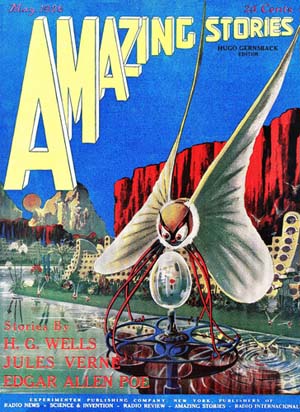
The first thing we see on the contents pages of these early issues of 'Amazing Stories', before the magazine's name itself, is a strange sketch of "Jules Verne's tombstone at Amiens portraying his immortality". His grave does actually look like this, with a marble Verne breaking out of his grave to reach towards the stars. It's a striking image and it cleverly sums up what Hugo Gernsback was trying to do with this magazine. However, it also highlights just how much Verne he was planning to include within its pages.
This second issue wraps up with the second half of his 1877 novel 'Off on a Comet', originally titled 'Hector Servadac'. That takes up half this issue, while the first quarter is devoted to the first part of his earlier novel 'A Trip to the Center of the Earth'. There are four other short stories here and one of them had never been published before, but they take up only twenty-four pages between them. Fortunately, I'm a fan of Jules Verne, the second most translated author in the world after Agatha Christie, but this does seem to be a little close to overkill.
Talking of translations, Gernsback made a poor decision here. 'A Trip to the Center of the Earth' is, of course, what we tend to know as 'Journey to the Centre of the Earth', the title of choice earlier this this as well as later. It was Verne's third novel to be published, after 'Five Weeks in a Balloon' and 'The Adventures of Captain Hatteras', released in book form in 1864 without being serialised first. It was translated into English twice in the nineteenth century and sadly this is the first of the two, an anonymous translation published by Griffith and Farran in 1871 which took major liberties with Verne's story, right down to changing his character names.
And so, Professor Otto Lidenbrock becomes Professor Von Hardwigg, his nephew Axel is renamed to Harry and his goddaughter Gräuben, with whom Axel is madly in love, turns into Gretchen. The story is largely intact, but this translator re-wrote whole sections of it, so it's hardly an authentic Jules Verne novel. Gernsback should have licensed the Frederick Malleson translation published a heartbeat later in 1877 by Ward, Lock & Co. Perhaps he didn't have that option, given how much he talked in the introduction to the first issue about bulk licensing.
For anyone who doesn't know the story of 'Journey to the Centre of the Earth', the professor finds a parchment inside one of his books, a historical account of Norwegian princes who ruled Iceland. That's a rare volume but the runic manuscript is unprecedented, as Hardwigg realises that it's a lost work of Arne Saknussem, a sixteenth century scholar and explorer persecuted for heresy and his works burned publicly in Copenhagen. Somehow this one survived and it details how to travel into the planet through the extinct Icelandic volcano Snæfellsjökull, or Yokul of Sneffels here.
I've read this before but forty plus years ago and very possibly in a condensed children's version, but I've seen multiple film versions and know the story best through them. What leaps out to me here are two things.
Firstly, there's the inquisitive eye of the explorer. We never get bogged down in the way 'Twenty Thousand Leagues under the Sea' does with its endless underwater observations of fish, but we're paying serious attention to what's around us, as Hardwigg and Harry travel to and over Iceland to get to the volcano. What's more, we're doing so not merely as an explorer but as a scientist of the general sort of the nineteenth century, far adrift from the specialists of today. Thus Hardwigg is a geographer, a geologist, a cultural anthropologist and a whole slew of other disciplines, and each perks up at different things. Apparently, Icelanders only heat their kitchens. Who knew?
The other is a firm reminder of how different basic assumptions were in the nineteenth century. For instance, we all know that the mile is made up of 1,760 yards but that's not an old standard. It was agreed on as late as 1959. The miles our party travels in Iceland are Danish miles, so comprise 8,000 yards each or four and a half times as long as the ones we expect. Prices are in rix-dollars, an English term for the silver coinage used across Europe and named differently in each country. The equipment Hardwigg carries includes a chronometer set not from the Greenwich meridian but for one in Hamburg. Their light underground is made with Ruhmkorf's coils, which are induction coils. The only liquid they take is scheidam rather than water and I can only guess that it's schnapps.
Anyway, they make it to Iceland and hire Hans Bjelke, a taciturn duck hunter as a guide. He's able to get them to the volcano before the kalends of July, which is the point when the shade from the peak of Scartaris just covers the entrance. They venture inside and, as the anonymous translator tells us in his brand new chapter headings, "the real journey commences". However, that doesn't happen until chapter fourteen and this first part of the novel ends after chapter fifteen, so we're not going to get too far towards the centre of the Earth this time out. See you next month for the rest.
At the other end of the issue, however, we get the conclusion to 'Off on a Comet'. If you'll recall, a passing comet, dubbed Gallia, has sliced through the surface of the Earth, trawled up a chunk of the western part of the Mediterranean along with the few people there at the time. Back in orbit, it carries them inside the orbit of Venus before turning outwards and we left the new inhabitants of the comet hunkered down in a cave system by an active volcano because, out towards Jupiter, it gets pretty frickin' cold. We pick up where we left off, fortunately not too far before the comet's orbit turns it back in towards the sun.
The key discovery at this point is Prof. Palmyrin Rosette, whose body our protagonists recovered at the very end of the first half. He's still alive and conveniently turns out to be Hector Servadac's science teacher, however briefly, back at the Lycée Charlemagne. He's a gloriously contrary soul and one dedicated to the task of capturing every scientific detail of the comet using what tools he can find around him. There's a good use here for decimal French coinage, given that they're made to exact weights and diameters that can provide a baseline for measuring the entire comet.
Verne throws in endless detail here, much of which we're likely to skim over today, even though a good deal of it is still accurate. That doesn't, however, apply to the astronomy, a science that has moved on leaps and bounds because of advances in technology. When the comet reaches Jupiter, we can see all four of its moons. Saturn, of course, has double that. I believe the count is up to 115 for the former and 292 for the latter. Sorry, Jules. Also, while Verne has Rosette utilise the metric system for his measurements, as we might expect, most stellar distances are in miles. Cappella is 340 millions of millions of miles away. How do I picture that? When they're not in miles, they're in leagues, which is worse still. So Gallia is 220,000,000 leagues from the sun? What's that in libraries of Congress?
I enjoyed the heck out of this story but, for all Rosette's admirable measurements, it's built on an incredibly flimsy premise and the ending is even more outrageous than the beginning. It's been a hundred and fifty years (less one) so I'm not sure the usual rule of spoilers applies but I'll happily spoil this one. After exactly two years—convenient, that!—Gallia's orbit returns it to Earth and a balloon is all it takes for most of the people it stole to get back home safely. The English soldiers stationed at Gibraltar don't make it, because Gallia split in twain this time around, almost at the finishing line. What's more, nobody else apparently noticed this double global phenomenon and therefore doesn't believe a word of the story. Yeah, no. This one has to survive on fun alone.
While that covers most of this issue, there are those four short stories in between the two Verne novels. There's another Poe and another Wells, plus a sequel to the G. Peyton Wertenbaker story from April 1926, 'The Man from the Atom', imaginatively titled, I kid you not, 'The Man from the Atom (Sequel). The fourth is 'The Infinite Vision' by Charles C. Winn, hardly a renowned author as it may well be the only story he ever saw published. Having read it, I can understand why.
The Poe is 'Mesmeric Revelation', first published in 'Columbian Magazine' in August 1844 and thus predating 'The Facts in the Case of M. Valdemar', reprinted in the previous issue, by over a year. I mention that because they're both stories of mesmerism, but they're as wildly different as chalk and cheese. This one, which takes place mostly as a conversation between the unnamed narrator, dubbed P., and Mr. Van Kirk, respectively the mesmerist and the mesmerised. It's philosophical in the extreme, built around the question, "What is God?" It's dense in the extreme, not remotely as accessible as 'M. Valdemar', though with an ending that quietly foreshadows it.
The Wells story, 'The Crystal Egg', is much better and, two of his stories in, I have to wonder why I haven't delved into his shorter work before. I think I have a collection or two on the shelf, but I've only read his novels. This is a longer story than last month's, first published in 'The New Review' in May 1897. The crystal egg of the title begins at the curiosity shop of C. Cave, naturalist and dealer in antiquities. While a couple of eager buyers want to snap it up at the outrageous price of £5—a princely £573 today—Cave decides that he won't sell after all. He's discovered its secret.
It turns out that if you look at it from an angle of about 137° from the direction of an illuminating ray of light smaller than 1mm diameter, a moving alien world appears within it. The assumption is quickly that it's the planet Mars, which has an active population. Today, we'd see this technology as a webcam, one with an extraordinary range, but I wonder how readers in 1897 pictured it, with no experience of television, let alone the wonders of the internet. As the story builds, it becomes something far more than that and could be considered a brief prequel to 'The War of the Worlds'. That was written between 1895 and its serialisation in 1897, so at the same time.
It seems entirely believable to me that Charles C. Winn read 'The Crystal Egg' and took it as a big influence on 'The Infinite Vision', originally published in 'Science and Invention' in May 1924. The premise here is that telescopes suck and Glenn Faxworthy isn't afraid to say so to a meeting of the International Astronomical Society held at the Holton Observatory in the Andes, which boasts a forty foot mercury reflector. He has the chutzpah to ask them for a cool million bucks, with which he'll "build you a telescope which will reveal the molecules of the rocks of the moon."
He's no bluffer. He's a man of his word and, ten years later, he's refitted this observatory with his new creation, a strangely altered telescope that does exactly what he promised and more. All it took, he explains, is a "previously unknown element" with miraculous qualities, which he's named Lucium. Quite frankly, whenever a science fiction story relies on a "previously unknown element", I'm immediately doubting the scientific genius of its creator and this is no exception, but Winn is far from done and he takes his story in a similar direction to Wells. It's pseudo-scientific bunk and its message appears to be that scientific advancement leads to destruction. I thought that sort of thing started with the atomic age!
What's left at this point is 'The Man from the Atom (Sequel)', which details further adventures of Kirby, the man who grew to the size of the universe in the previous story but shrank back down to a planetary level at the end of it, in search of the Earth. Instead he found himself on "a planet of the star Delni". I enjoyed this one more than its predecessor, but it drifts from science fiction into fantasy rapidly. The men are the brains on this world but its stupid women are still brainier than us. That includes Vinda, the daughter of a physicist king, who takes an interest in him, learns his language quickly and comes up with a solution to get him home to boot. What a gal!
Clearly, Hugo Gernsback still had plenty of work to do to fashion 'Amazing Stories' into something that looked forward rather than backwards, an odd thing to say for what was a pioneering science fiction magazine. However, two issues in and he's managed to bring us precisely one new story. As enjoyable as the rest was (or wasn't), this feels very much like a fiction spinoff of one of his major publications, 'Science and Invention'. I'm looking forward to the magazine finding its feet and I'm not sure how long that will take.
I'm also not sure how it was paying for itself, given that there are still precious few ads. The inside front cover is the same suggestion from the National Radio Institute that we could become radio experts "in work that is almost romance" as the previous issue. However, there's another page of products before the contents that's a joyous glimpse into the past. It's from Johnson Smith & Co. of Racine, Wis. and it's made up of endless gmimicks, some real (but presumably cheap) gadgets, more practical jokes or novelties and some unexpected signs of the times.
There's luminous paint so you can make your clocks visible by night; itching powder and exploding cigarattes; and stage money so "each person of limited means" can "appear prosperous". There's a realistic looking cartridge pistol that only shoots blanks and the "Little Giant" typewriter that's apparently "a first class writing machine for $1.50". Less predictable are the books, which I always find fascinating. There's one that teaches ventriloquism in 32 pages and another twice its length that details how to make all sorts of toys and machines. There's a 200 page "midget bible" that's the size of a postage stamp. And, oh hey, there's a history of the Ku Klux Klan. Well, that changed the tone of the page!
At the end of the issue is the same sales pitch for plots of land in Villa Tasso, Florida and not a lot more. Before it is a column ad for the School of Engineering of Milwaukee that suggests we could become electrical experts over a series of courses that will propel us into "this big-pay field". The back cover is where the fun is though, because it's all about Ex-Commissioner Richard E. Enright's quest to disclose the horrors of "White Slave" Traffic. If that sounds like a moral crusade to you, I probably shouldn't point out that it's actually a new series in 'Police Stories', begun in April 1926. That magazine is for you "if you love action, mystery, thrills". Well, OK then. ~~ Hal C F Astell
For more Amazing Stories titles click here
For more titles by Hugo Gernsback click
here
|
|