|
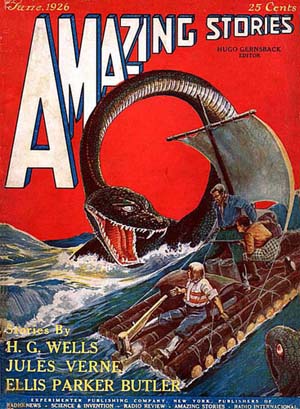
The first two issues of 'Amazing Stories' followed a relatively consistent template, prioritising the work of Jules Verne but not neglecting H. G. Wells and Edgar Allan Poe. Those classic names, all in reprint, were backed up with a smattering of shorter stories from lesser known authors, only one of which was new and that a sequel. Here, that starts to change. The cover story is another Verne and Wells isn't far behind it, but the contents page is expanded, with half as many stories again as the previous month, two of them being published for the first time. What's more, the tone is very different, because as much as editor Hugo Gernsback is still hyping scientifiction as a term, I don't think that describes everything here.
Of course, the Verne and Wells come closest, even though there's plenty of fantasy in the former and the latter is a disaster story on a grand scale. The new G. Peyton Wertenbaker and the much-anthologised Murray Leinster certainly play in the scientifiction sandpit too. Furthest away could be the Charles S. Wolfe and the Otis Adelbert Kline, both weird tales—indeed the latter originally saw publication in 'Weird Tales' in 1924—but for the trio of comedy stories. Sure, these are based on science but they're comedies first and foremost and they set the stage for more to come in the same vein. They're all cute and fortunately also short, careful to not outstay their welcome.
But let's dive in and see how it all plays out. Prof. Von Hardwigg, the frustratingly renamed Prof. Otto Lidenbrock in this inferior translation of 'A Trip to the Center of the Earth', certainly counts as a scientist. We rejoin him and his party fifty leagues from the Icelandic volcano that served as their portal to the world beneath and he's diligently continuing to take scientific measurements, hourly on compass, manometer and thermometer. It's down, down, down and occasionally up, up, up but then down, down, down again. Fully half of this middle instalment is just slogging along.
There are obstacles, of course. They take the wrong path and almost run out of water, only Hans, "the grave and impassable Icelander", saving the day once more by hacking his way with a pickaxe through two feet of rock to puncture an underground stream. That's pretty dangerous given that they're under the ocean, but it works out. There's one point where Harry, the Axel replacement, has been so engrossed in geology that he finds himself without his companions. Then, a hundred miles below the surface of our planet, the lamp goes out and he's completely alone. That's scary.
Eventually, they reach the Central Sea and we can get back into the sort of adventure we tend to remember either from earlier reads of this novel or from the many film and TV adaptations. The forest of mushrooms is always trippy and the bones of giant creatures too. Hans builds a raft and we set out across dangerous waters, eventually witnessing a fearsome kaiju battle: icthyosaurus vs. plesiosaurus. That scene and the naming of their departure point as Port Gretchen (instead of Port Gräuben, as it should have been) makes us realise just how much debt Sir Arthur Conan Doyle owed to this book when he wrote 'The Lost World'.
We leave the novel after discovering an elephant's graveyard for prehistoric creatures, a notably timely event given that just a day ago as I write, I was reading about an ancient whale graveyard in the Indian Ocean that extends for over seven hundred miles in the Diamantina fracture zone, a series of dives identifying skeletons of extinct whales, including one that's over five million years old. This sort of thing is straight out of Verne. What's notable by the Central Sea, but presumably not in the Indian Ocean, is the presence of a human skull. A whole body even! Wait, many of them! That's a heck of a point to break for a month!
'A Journey to the Centre of the Earth', to use its usual English language title, first saw publication in 1864, while the Wells dates only to 1897, when 'The Star' was published in the Christmas issue of 'The Graphic'. It's a disaster story that starts at the edge of the solar system and gets inexorably closer as it runs on. Initially, it's Neptune that's suffering, as a passing luminous extrasolar object is affecting its orbit, but then they collide and the resulting star, for want of a better term, moves ever closer to us, Jupiter's gravitational pull placing it on a direct course.
For a while, it seems that all hope is lost and certainly the proximity of this star prompts changes of a devastating nature across the globe. Natural disasters multiply: with earthquakes competing with floods and hurricanes to cause the most damage. Volcanoes erupt. The Himalayas melt. The sun continues unabated but night ceases to exist. And then, just as the end seems nigh, the star is shifted just enough off its course by the gravitational pull of our own moon to preserve humanity, or at least a tiny subset of it.
It's a powerful piece, worthy of its status as a classic. It was hardly the first such planetary disaster story, even if we discount novels like Verne's 'Off on a Comet', serialised in the previous two issues of 'Amazing Stories', in which the visiting planetary body merely carved off a chunk of our world as it passed by, apparently without a lot of notice. What hit me the strongest though was its ending. This star has destroyed most of civilisation, the most devastating event in the history of mankind. However, peering our way from Mars, astronomers don't notice much change. The continents are still there. All this star seems to have done is shrink what they believe to be ice around the poles. We're apparently not even worthy of mention.
Behind these two, the most successful scientifiction story is 'The Runaway Skyscraper' by Murray Leinster, which first saw print in a major publication, what was called in 1919 'Argosy and Railroad Man's Magazine'. It's one of two stories here to acknowledge a debt to Wells, the lead characters referencing 'The Time Machine', just as the lead in Wertenbaker's 'The Coming of the Ice' reads a copy of 'The Sleeper Awakes' while waiting for the story to manifest. Both are appropriate books to mention, of course, this one because the New York skyscraper of the title shifts oddly back into the past, its contents and inhabitants otherwise unscathed.
It's a neat idea, played into by a strong first line: "The whole thing started when the clock on the Metropolitan Tower began to run backward." From there, time shifts into reverse: cars outside in the street drive backward, the sun rises in the west and gradually the rest of the city disappears, leaving them in the Manhattan Island of millennia earlier, surrounded only by forests and Native Americans. The hero is Arthur Chamberlain, a young engineer facing bankruptcy, and his leading lady is Estelle Woodward, his trusty stenographer.
As American engineers tended to do in stories of the teens, he's able to save the day, even though Leinster only has a flimsy explanation for what the problem actually was. While we know him as a science fiction writer today, he was a versatile pulp writer, starting out in the general pulps, then tailoring stories to the genre magazines, a detective story here, a western there, even a romance under a pseudonym when needed. He has fun with his characters, including a bank manager who's having a wonderful time in the past. He throws in a neat twist during the finalé, after the pivotal problem is solved, and even a romance for good measure.
By comparison, 'The Coming of the Ice' reminds me how little I thought of G. Peyton Wertenbaker in the previous two issues. This one's follows a similar path with no better results. However, while the previous stories involved the unwary subject of an ill-advised experiment growing in size, all the way to galactic scale, this one involves the unwary subject of an ill-advised experiment finding himself immortal and outlasting the human race, or what it had become two hundred millennia in the future when a new ice age finally kills us off.
For all that Gernsback talked up scientifiction, stories supposedly based on sound scientific ideas and principles, this one is clearly nonsense from the outset. Apparently, we would all be immortal if only we didn't reproduce. Something changes in our bodies when we do that to prompt us to age and die. Once Sir John Granden figures out this secret and applies it to his friend Dennell, closing certain organs off, whatever that means, he extends into the future. I liked that he falls behind a couple of hundred years in, unable to keep up with human evolution even with a dozen degrees. I didn't like a lot else.
The other serious stories are 'Whispering Ether' by Charles S. Wolfe, a story from the March 1920 issue of 'Electrical Experimenter', and Otis Adelbert Kline's 'The Malignant Entity' from the final Edwin Baird issue of 'Weird Tales' in 1924 before Farnsworth Wright took over. They're both weird tales and I enjoyed them but they're hardly the greatest examples of the genre and I was shocked to see Gernsback including them, even after George Allen England's 'The Thing from—Outside' in the very first issue. They seem to go against his goals for the magazine.
'Whispering Ether' features a safecracker as a lead, which is pretty cool, and he explains to us in a slang-ridden narration why Proctor's "in the bug house", having been declared insane by a trio of alienists. Oscar, that crook, explains how a gang wanted the doctor's formula for chero, which is a powerful explosive, but won't pay his price. Suddenly that becomes a mind machine story with an acutely quick ending and a quirky result to playing with "the length of the emitted wave". It's okay as such stories go and so is the Kline.
While Wolfe was a regular contributor of stories to magazines like 'Electrical Experimenter' and "Science and Invention', I hadn't encountered his work before. However, I've read multiple books by Otis Adelbert Kline, who wrote a number of Edgar Allan Burroughs knock-offs and became the literary agent of Robert E. Howard. He was also an assistant editor for 'Weird Tales' and actually helped to compile the issue that featured this story after Edwin Baird had been fired. Again, it's okay but it's hardly a great story.
It's called 'The Malignant Entity' and it's about, well, a malignant entity, one that was created by Prof. Albert Townsend, who has theories on creating life from inert matter. He's already dead as we begin, though the news takes a little time to reach Dr. Dorp and his writer friend, Mr. Evans. It arrives with Chief McGraw, a detective, who's puzzled as to how Townsend can have died just a day before but already be reduced to a whitened skeleton, still dressed, on the floor of his lab. It isn't hard to figure out from the title alone where this will go and the setup guarantees it.
And so to the comedies. There are three of them: one of five stories about 'Mr. Fosdick' by Jacque Morgan, from 'Modern Electrics' in November 1912; a standalone by Ellis Parker Butler, from the June 1910 issue of 'Hampton's Magazine'; and an ephemeral new piece in the 'Doctor Hackensaw' series of stories by Clement Fezandié, dozens of which saw publication in 'Science and Invention' from 1921 to 1925. Each of those seems to involve a dedicated invention, while this one covers an abundance of them, none in particular detail. I'd like to read more of these and there will be one in the next issue.
It's at once the weakest of the three comedies and the most imaginative, because of how far the inventions go. The formula seems to be that Dr. Hackensaw invents stuff and Pep Perkins learns about it. However, the five inventions here include early takes on a couple that we use frequently today, the most interesting being machine translation, something pioneered in 1891 in a story by Milton Ramsey called 'Six Thousand Years Hence'. However, Fezandié explores the tough nuances of language rather well, especially when not restricting this invention to English.
The potentially pioneering one is a voice-to-text device called the Dictation Typewriter that easily predates the many examples of voice as a user interface that I can find. However, this was 1926 so Dr. Hackensaw's goal is "a substitute for the gum-chewing, face-powdering, flirting stenographer, and type-writist. This machine is warranted never to have a fit of the sulks." Damn. Judgemental much? There's also an autopen, something first patented in 1803, but multipled a hundredfold for authors and celebrities, and an automatic judge, using the logic that the man in the wrong always hires the best lawyer, thus the worst lawyer should alway win.
I should mention Dr. Hackensaw's notable failure here, the gynaionometer, a device to measure a woman's age. Yes, that's dangerous and yes, that's the punchline. So to Mr. Fosdick, the hero of a series of tall tales by Jacque Morgan, who comes up with a "Seidlitzmobile" here. What's that? It harnesses the power of Seidlitz powder for use in transportation. What's that? Good question, but every druggist stocked them in 1912, it seems, and they didn't warrant explanation even in 1926. I looked them up: they're laxatives or digestion regulators. Now the jokes make sense and they do write themselves.
That leaves my favourite piece, which is 'An Experiment in Gyro-Hats', introduced by probably the best of the full page illustrations that have introduced each of these stories from the first issue. It revolves around the question of what to do with the space inside top hats and that leads to Anne, the daughter of a hatter falling unhappily in love with a staggerer. Apparently, she met him on a boat during a stormy journey on which everyone staggered. Walsingham Gribbs, however, kept on doing it once they reached dry land. So her father places a gyroscope into a top hat and holds it on with vacuum suction. Problem solved, even if there are hilarious side effects. I liked this a lot.
And that's it for issue three of 'Amazing Stories', except for the presence of a few new ad-lets, to use the term used to hawk the space for them at six cents a word. Gernsback pimps out his famous novel, 'Ralph 124C 41+', unfortunately underneath the latest product of the Eugenics Publishing Co., which is Alfred W. McCann's exposé of how every modern ill is caused by improper food. It has a ring of truth to it but quickly veers into the sort of conspiracy theory nonsense that we've sadly got used to from Robert F. Kennedy, Jr. I'm hardly going to argue in favour of more preservatives or artificial colours, but I'm pretty sure that the long list of diseases provided, down to cancer and tuberculosis, are necessarily caused by them. I'm just shocked that autism isn't on the list, but it's 1926, after all. ~~ Hal C F Astell
For more Amazing Stories titles click here
For more titles by Hugo Gernsback click here
|
|