|
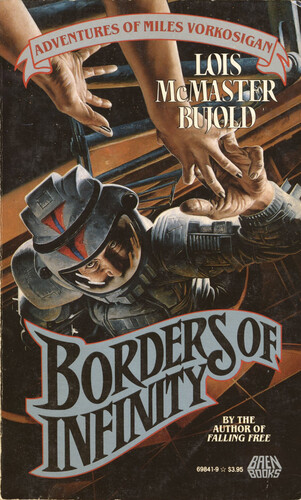
After creating the 'Vorkosigan Saga' universe with her first novel, Lois McMaster Bujold bounced around within it, thus forcing readers into the time-honoured decision as to whether to read it in publication order or according to its internal chronology. However, it seems that there are other complicating factors that I don't believe are her doing. I certainly can't blame her for not winning the Hugo for Best Novel until 'The Vor Game', the seventh book in the series, so I started late and then jumped back to the beginning. However, this book is another good example.
Technically, the next novel after 'Falling Free' is 'Brothers in Arms', which was released in January 1989, with this one following it in October. However, this isn't really a novel at all. It's a collection of three novellas, the first of which appeared in September 1987, in between 'Ethan of Athos' and 'Falling Free', in an anthology called 'Free Lancers'. The others followed it and indeed 'Brothers in Arms', appearing in 'Analog' in May and August 1989 respectively, though they're presented here according to internal chronology which does not match publication order. The annoyingly skimpy framing story was new to this book in October.
So, there's logic to warrant reading this before 'Falling Free', after it or after 'Brothers in Arms'. However, the former wouldn't be appropriate because 'Labyrinth' features a quaddie musician, a concept that would make absolutely no sense if read before 'Falling Free'. So should this be read before or after 'Brothers in Arms'? I can't be sure yet, but I went with before because all three of these novellas fit into the chronology before that novel, Miles Vorkosigan being twenty, twenty-three and twenty-four respectively. I'm hoping it will lead me into 'Brothers in Arms', in which he is also twenty-four. I'll find out for sure next month!
The good news is that all three novellas are excellent and they play here in relative isolation, so none of them mess with the flow of the book as a whole, even though one is a detective story, the second is more of an action piece and the third is a prison drama. The bad news is that little effort was put into the framing story, which amounts to a mere thirteen pages across four chapters that open, close and bridge. In essence, Miles is a captive audience in a hospital bed and Simon Illyan is visiting him to question him about his finances, because there's some plot brewing to investigate him for enriching himself in office. He isn't and the novellas theoretically explain why.
In reality, none of them really have much to do with finances, though we can easily see the cost of certain decisions in the title novella. There's never any real danger to him from this plot and it's a stretch to believe that Simon Illyan, who runs the Barrayaran Empire's secret service, buys into its validity even a little. I guess he has to dot his i's and cross his t's, but that isn't much of an idea to hinge a framing story onto. It doesn't shock me that the framing story hasn't ever been reprinted whenever the novellas have.
The three are different enough that it's hard to pick a favourite. In the end, every one of them is my favourite, at least in a particular way. 'The Mountains of Mourning' is a relatively quiet piece, especially when compared to the others, but it's tighter than it seems, as detective stories ought to be. While Miles is the lead, it belongs to the women, whichever side of the core moral question they happen to be on. By comparison, 'Labyrinth' is all action and intrigue. It dives deeply into the concept of normality. 'The Borders of Infinity' wraps things up in appropriate fashion, as a sneaky and cleverly crafted story for a character like Miles Vorkosigan. It's rarely what we think it is.
The first woman of note in 'The Mountains of Mourning' is Harra Csurik, a mother who perseveres in reporting her baby's death as murder, eventually shearing through the bureaucracy thwarting her by hiking the four days to her lord's country estate to appeal to him in person. He listens and appoints Miles as his Voice, sending him off to find justice in Silvy Vale, not least because the case appears to be about being different, something close to Miles's heart. The baby had a harelip, so would be seen in rural areas as a mutant and often killed in favour of further attempts at healthy babies. In this case, Harra believes the murderer to be her husband Lem.
So we have a detective story set against a cultural backdrop. Throughout the earlier books, we're constantly reminded that while Barrayar appears to be a force beyond its planetary borders, it's not many generations from feudal barbarism. Characters from other planets, like Miles's mother, Cordelia Naismith, might suggest that it has a way to go yet and this story backs that up. It's clear as soon as Miles reaches Silvy Vale that he's considered a mutant himself by his own people, even though he isn't and he's their lord's heir, which adds weight to whatever he decides. Of course, he solves the mystery but it's what he does afterwards that matters most.
'The Mountains of Mourning' won both the Hugo and Nebula awards, meaning that it was Bujold's first Hugo win, after a nomination for 'Falling Free', and her second Nebula, because 'Falling Free' won there. The other two novellas didn't win anything, so it would be easy to imagine them being a step down but they aren't. They're both excellent stories in their own right.
Miles is undercover as Admiral Naismith in 'Labyrinth', because he's on a mission to the wretched hive of scum and villainy that is 'Jackson's Whole'. We were heading there in 'Ethan of Athos' but never got there. It's good to finally see what it's like. The Houses dominate on this planet and it's good to finally bump into them as well. Initially that means House Fell, because the Free Dendarii Mercenaries are there to buy weapons. However, that's only a cover story, because they're really there to transport a man from House Bharaputra to an asylum planet. And yet it's House Ryovan that dominates, because Miles's captain, Bel Thorne, pisses off its baron over a girl.
Now, this isn't just any girl. This is a quaddie musician, Nicol, who has mastered the double-sided hammer dulcimer, which she plays from a null-G bubble in a float chair. Her contract has ended up with Baron Ryovan and she wants out of it. Bel is rather happy to accept just one Betan dollar for passage. This isn't about Nicol, though, it's about Dr. Canaba and the MacGuffins that complicate his retrieval, especially given their location, given that they've been injected into a supersoldier, an "eight-foot genetic cocktail with fangs", now in possession of House Ryoval.
I liked this because of its action, especially after the relatively quiet investigation in the previous novella. I liked it even more because of its intrigue, the opening scene at House Ryoval vivid and decadently vibrant. Best of all are the characters and how the story unfolds, given that every one of the principals is notably different. Miles himself, of course, is short and stunted. Bel is a Betan hermaphrodite. Nicol is a quaddie who needs technology to survive on this planet. And Taura is a, well an "eight-foot genetic cocktail with fangs". They're the heroes, all superlative regardless of their supposed deformities.
That leaves 'The Borders of Infinity', which is at once simpler and far more devious. It's set on the planet of Dagoola IV in a top security Cetagandan prison camp. Like many straight to video sci-fi flicks in the eighties and nineties, it has an innovative design. Everything's under a simple dome, giving the impression of a gigantic arena, but the prisoners are left to do as they will. There's no interacting with their captors, except when food is delivered through a random gate at a random time.
On the face of it, Miles walks into this prison as a captive to rescue one prisoner, a military genius called Col. Guy Tremont, who had delayed the Cetagandan's inevitable takeover of Marilac at the Siege of Fallow Core for a ridiculous amount of time. However, when he finds him, he's practically comatose and dies shortly afterwards. His mission has failed and now he's stuck in a Cetagandan prison, having already been attacked, beaten up and stripped naked. So, he decides to honour the spirit of his orders rather than the literal wording of them and suddenly we have a story.
I can't talk much about this novella because it relies on a twist that I can't even approach. Suffice it to say that what we think is happening as Miles enforces himself on the prison population is not what is actually happening. Well, it kinda is, but it isn't. Am I helping here? No, so I'll shut up. It's a novella that tells a particular story and does it well but ends up serving to enhance the character of Miles Vorkosigan even more. No wonder there's a 'Vorkosigan Saga'. These are the actions of a character who deserves a saga of his own, even if he's not the only Vorkosigan of note.
And so that's 'Borders of Infinity': three excellent novellas, one of which won multiple awards, in a weak presentation whose framing story isn't worth the paper it's printed on. Ignore that and dive into the three thoroughly different stories it pretends to link. ~~ Hal C F Astell
For more titles by Lois McMasters Bujold click here
|
|