|
The two obvious pulps for me to review on their centennials in 1926 are 'Amazing Stories', the new scientifiction kid on the block, and 'Weird Tales', now somewhat established in its fourth year, but there were many other titles on the newsstands and I plan to dip into some of those too. I've been corresponding recently with Phil Stephensen-Payne of Galactic Central, a pivotal information site about pulps (and other things) and he's kindly sent me monthly lists of what was available in each month in the late twenties. With some pulps publishing weekly or fortnightly, a monthly tally of a reader's potential purchases reaches the level of two hundred and forty. What's more, that count will only grow in the thirties.
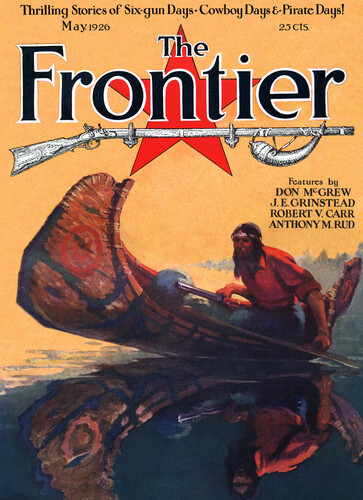
Needless to say, I'm not reviewing two hundred and forty pulps a month; I couldn't even read that many if I tried! However, supply plays a crucial role here. Most of those books simply aren't online for us to download and my own pulps only go back to 1933. So, the one other readily available title online for May 1926 is this one. I'm interested in 'The Frontier' for two reasons, the first being the presence of a story by Anthony M. Rud. I'm a big fan of a 1934 novel of his, 'The Stuffed Men', and he also wrote 'Ooze', which was the cover story to the first issue of 'Weird Tales' in March 1923. He would become a pulp editor himself, helming 'Adventure' for a few years from October 1927.
The other reason is that 'The Frontier' represents a genre we don't tend to see nowadays, that of frontier fiction. Glancing at the couple of dozen available issues online, they include a predictably large amount of westerns. However, while western pulps included nothing else, 'The Frontier' had a wider remit. The cover novel here is a South Seas pirate story and the magazine took readers to many other frontiers; the March 1925 issue, for instance, covered police in British South Africa, a Shinto temple in Okinawa and the jungles of both Brazil and Borneo along with the Santa Fe Trail. I expect that much of what I've read from Jack London would count as frontier fiction and the next issue, as detailed in 'The Trading Post' section would include an Alaskan story as well as one set in Arabia.
Here, it would be mostly westerns, plus a decent non fiction article about Australia's gold rush, if it wasn't for that lead pirate story. It's 'The Devil's Caldron' by Don McGrew, which is unrelated to an earlier pirate story that led 'The Frontier' in September 1925 called 'Devil Jordan's Treasure'. I rather enjoyed it, not least because he threw everything but the kitchen sink at it, not content to simply have fun with pirates but to trawl in mutinies and cannibals on the journey to an inevitable buried treasure on a remote South Seas island. The happy ending is a little quick in the telling but it's solid enough. As with all these pieces, it's not just illustrated with small drawings but with the first letter in each paragraph included in a square drawing that drops eight lines.
Like everything here, the language is pretty accessible, though "caldron" doesn't have its usual U, even in American, and "cutlas" only has one S. However, the N word is spelled exactly as you might expect; is it less racist that it's used in an entirely matter of fact fashion without apparent malice or more? It crops up a few times, initially because privateer Jerry Blunt forced forty black men to bury his treasure then walk the plank in the anchorage, but later too. Oddly, given such language, this isn't a racist story, the ship's owner weeping over a dead black servant and the Usagos, black sun worshippers rescued from cannibals by the good guys, prove worthy allies, knowledgeable in folk medicine and both willing and able to fight.
The ship is the 'Anthony Wayne', a three mast schooner captained by a Dutchman, Van Tassel, with an extremely thick Dutch accent; it's consistent but often hard to understand, making it arguably the story's worst aspect. It's yoost var doo much, jess? It starts out off the eastern seaboard on a journey from Portland to Savannah but they pause to rescue Roaring Bill Donovan and everything changes. He saves them from a pirate attack and they get away with four brass chests of treasure and, through his knowledge, a map to much more. So, in Savannah, they collect the ship's owner, George Bellew—also the uncle of the narrator, young Jack—and Judge Pemberton, and then set off for the South Seas.
The contents page looks busy, but that's deceiving. 'The Devil's Caldron' counts for almost half of the page count while the next two items are done in a page and a bit. The page is the lyrics to an old cowboy ballad and the bit is a two paragraph glimpse at the old "graft" of trail toll bridges. I'd guess the former is a regular feature, albeit a brief one, and the latter just there to fill a small bit of space. In similar vein, there's a later poem, 'The Western Mail' by Ben A. Miller, and a half page piece on Ben Wright, a militiaman who massacred Indians under a flag of truce, hardly the sort of character deserving of these words.
Then again, the other non fiction article is about Sam Bass, a train robbery whose haul of $60,000 in gold from a Union Pacific train in 1877 is apparently still the most valuable such ever pulled off in the United States. There's also a half page piece about how overgrazing ruined the grasslands of America, but that's not listed in the unreliable contents page which has the opening pieces in a completely different order. 'The Frontier' may have been in its third year in 1926 but someone on the staff definitely dropped the ball here. More of interest are the short stories, of which there are four.
The Anthony Rud, 'Chaparejos', is decent, its title holding a double meaning. Chaperejos are just chaps, the sort of leather trousers that cowboys wear, but this particular pair are given here to a five year old boy who has only worn kilts up until that point. For another, it looks like it's Spanish slang for "suckers", a pretty good way to describe Haj Maddox, who makes the story possible but isn't in it much. Mostly it's about Toi-Yabe Tolman, former outlaw and now honest prospector; the tough local sheriff, "Stun-Bruise" Stone Bellinger; and young Dickie, that five year old boy whose mother died giving birth to him and whose sheriff father dumped him on a series of nannies.
It's an odd story because it's more interesting when it's not forcing a plot. For instance, it's highly negative about Mormons but very complimentary about the Chinese, the most selfless character in the story being Chong Yen, who runs a restaurant and laundry. However, Dickie's mother was a Mormon girl sealed for marriage with a Council member she'd never seen. She loved Bellinger and he her so they eloped together, only for the state of Deseret to sent a progression of men to kill him for his sin. Apparently, "love on the part of woman was not then considered of importance in Deseret".
By comparison, my favourite story is surely 'The Waters of Bowlegs Creek', as straightforward and predictable as 'Chaparejos' keeps us on the hop. It's about McClellan Barry, an engineer who quits his job on a team building a railroad in Arizona to team up with John Marshall in farming a plot of land. Clell is a traditional western gentleman, honest and hardworking, and it's impossible not to get behind him when he encounters obstacles, human or otherwise. Perhaps it ends a little easier than it should with too neat a bow but it's a satisfying story.
It's by J. E. (Jesse Edward) Grinstead, a regular writer for 'The Frontier' who knew what he wrote about. It was his father who was the engineer rather than him but he grew up on a farm like what Clell's would become in time. Instead, he went into the newspaper business, starting as a printer but founding one paper and, after moving to Kerrville, Texas, because his wife had the same lung ailment as his character Marshall, bought and renamed another. After serving Kerrville as mayor and House District 99 as a state congressman, he took to writing western fiction, under a variety of pseudonyms, racking up dozens of novels and numerous short stories and articles. Based on the letters in the Trading Post section here, he was a reader's favourite and it's easy to see why.
Less impressive to my thinking are the stories by Alanson Skinner and Robert V. Carr. The former is one of a series set among the Sauk Indians that had already been running for two months with one more to go. It's more comedy than western, a tall tale about a pair of cousins, Winking Bear and Bright Horns, the latter inadvertently landing and then trying to free himself of 'A Bride Too Many'. Skinner was an anthropologist known for his ethnographic work with Native Americans; it shows in his inclusion of multiple distinguishable tribes within this story. I seriously doubt Robert V. Carr was an anthropologist, because his depiction of the Sioux in 'Yellow Iron' is pretty savage. It's a story about gold, as the title suggests, but more about the character of Don Aletes, a quiet gunmaker who follows his uncle's dream after his death and discovers a new life on the trail.
All in all, this is an enjoyable issue of 'The Frontier' but I'm not going to have a chance to read too many more. While there are a couple of dozen issues available online, from before and especially after a rename to 'Frontier Stories' for the December 1926 number, the next one is May 1927, so I have a full year to wait for that. After a couple more in 1929, the next is dated Winter 1937, partly because it fizzled out in 1934 with many missing issues over the previous couple of years but then came back as a quarterly in 1937 and ran relatively smoothly until 1953. Fortunately other pulps are available, so I can sample those instead. It's going to be a fun ride.
I haven't been able to talk much about adverts in 'Amazing Stories' because there aren't many at this point, but there are plenty here. In fact it even identifies a "Frontier Advertiser" section. The ads are different too: a Sheaffer fountain pen that they guarantee for a lifetime, Topkis athletic underwear that looks like something a Mormon runner might wear. Those are full page ads, along with the inevitable free book, this one aiming to teach you why should become a draftsman. $10k was a lot of money in 1926. Earning that much, you could certainly afford a dozen "breath-taking tales of adventure and romance" from Garden City Publishing. All 12 for $1.98. There's even Ivory soap, which is still a thing, merely costing more than 5c a bar nowadays.
At the half size, there Aladdin houses that you order through the mail in kit form, like a boss Ikea project: seven rooms for under a grand; Lynco arch cushions on which to rest your tender feet; an inevitable muscle builder offering the "most amazing results ever achieved"—just look at Zbyszko the Great or Arco the Magnificent. In case you're "ashamed of your English", you can fix that with a free booklet from International Correspondence Schools. Once you're done, you have a choice of typewriters. Down in the small ads, E. S. Givens is so sure of his treatment for blackheads, eczema and pimples that he'll bet $1000 cash on it.
There are more ads at the back too, including tobacco ads because smoking was more encouraged than discouraged in 1926. Silent screen beauty Julia Hoyt states that she loves "the fragrance of good pipe tobacco", which may or may not mean Fresh Tuxedo. One page later, "the overwhelming choice of experienced smokers" is Camel Turkish & Domestic Blend Cigarettes. As far as I'm aware, they lasted a lot longer than Fatima, whose approach to advertising is to point out that it's more expensive than the popular brands.
If you're not a smoker, there are full page ads for Fleischmann's Yeast (which tones up the entire system, even in worried seventeen year old girls), Autographic Kodak cameras (to keep a story of the children), Prest-O-Lite storage batteries (for motor-cars and radio) and, in colour on the back cover, Adams Black Jack Chewing Gum (with "that good old licorice flavor!" There was something for everyone on the Frontier in 1926, it seems. ~~ Hal C F Astell
|
|