|
It's been a while since I've reviewed a Hugo winning novel, at least deliberately so as part of that ongoing project of mine. I began in January 2019 with a review of 'The Demolished Man' by Alfred Bester, which won the first Hugo for Best Novel in 1953 and continued on with every other winner from the fifties to the eighties, my review of 1989's winner, C. J. Cherryh's 'Cyteen' posting in May 2023. Once I'd completed four decades, I collated all those reviews into an Apocalypse Later Zine, which is available in print from Amazon.
And then I put that project on pause, partly because I had a bunch of other projects that I wanted to work and partly because I was getting ahead of myself. If that initial zine covered four decades of winners, then the next zine should do likewise, from the nineties to the twenties, which means that I'll wrap with the 2029 winner, to be awarded at the 87th Worldcon in what is currently likely to be Dublin that August. However, if I knuckle down and review one every month from now until then, I'll be ready for that book in May of that year. So, hey, let's start back up and give me three months of leeway!
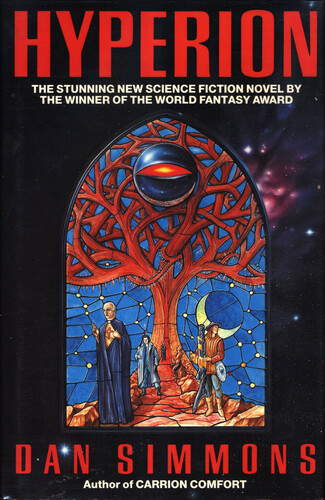
The 1990 winner was 'Hyperion' by Dan Simmons, which is an outrageously ambitious book that is impossible to categorise. From the very beginning, it's both fantasy and science fiction; as it runs on, it trawls in horror; and yet it's as rooted in the past as the future, its very structure echoing a work first published so long ago that we're not even sure when. That's what has become known as 'The Canterbury Tales' by Geoffrey Chaucer, from around the year 1400. The eighteenth-century romantic poet John Keats is a principal character, kinda-sorta, and the very world of Hyperion is a nod back to his unfinished epic poem of the same name.
One reason why it won so much acclaim, winning not only the Hugo but the Locus Award, is that it lives up to its ambitious promise, except for a single detail, which is that it doesn't end. It's a vast book, my Headline Feature paperback nudging past five hundred pages, but it only begins a story and gets us to a crucial point, at which point we need to roll on into 'The Fall of Hyperion' to learn how it all ends. That's not a huge problem for me in 2026 because that book's on my shelf and I can dive into it in February. Back in 1990, when Worldcon attendees voted half a story to win the Hugo, it could have been. Fortunately for them, 'The Fall of Hyperion' came out in March and Worldcon didn't come around until August. Maybe enough of them had read both books.
Initially it feels like it fits well into the winners roster because it's reminiscent of the authors who won in the decade before it. Early on, it feels like David Brin, who had won in 1984 and 1988, with a touch of William Gibson, who had won in 1985. As it rolls on, it trawls in C. J. Cherryh, who had won in 1982 and 1989, especially once we reach the Scholar's Tale. It's deep worldbuilding, covering an array of approaches: geography, history, culture, even theology, though it's never as dry as I have found Cherryh thus far. Compared to the titles those authors won with, what Simmons brought to the table is his genrebending.
From the very first page, it's clearly science fiction, hurling out new words and terms like confetti. It's about planets, spaceships and interstellar communication, painted with language like diskey, gymnosperms, interdiction fields, fatline and projection pit. However, it's also clearly fantasy, as the dangerous mission about to be launched is a pilgrimage to tombs protected by the Shrike. It's to be comprised of seven people, each chosen by the Shrike Church and the All Thing, though none are followers of the Shrike. So we shift into a quest narrative under threat of interstellar war.
The seven are varied. Fr. Lenar Hoyt is a Catholic priest, though Catholicism largely died off after Old Earth ceased to be habitable. Col. Fedmahn Kassad, the Butcher of South Bressia, is a military man of legend. Martin Silenus is a poet who was born on Old Earth centuries ago not long before it died. He reminds me of the Wandering Jew archetype, even though he isn't Jewish. Sol Weintraub, a scholar, is however, and he arrives with a baby girl in his arms. Brawne Lamia is a detective, of a cyberpunk futuristic noir type. Het Hasteen is the Templar captain of the kilometer-long treeship that will transport them all to Hyperion. And, wrapping up the company is the Hegemony Consul. Simmons floats intrigue early by suggesting that one of these seven is an Ouster spy.
I'm sure I need to explain a whole lot of that, which Simmons does effortlessly even though it's rather complex. We're in the 28th century and the Hegemony of Man is a vast federation of planets that are linked by farcaster portals that allow instantaneous travel between worlds. Silenus, when it's his time to talk, mentions a home he once lived in that boasted thirty-eight rooms sprawled over thirty-six worlds. The Hegemony has a tentative alliance with the TechnoCore, a civilisation of AIs that were created by men but left us to pursue their own projects. The third species in play at this point are the Ousters, formerly human but substantially modified. A war between the Hegemony and the Ousters seems imminent.
Within that vast backdrop, we find ourselves primarily focused on a single world, Hyperion. It was colonised by humans, some descendants of whom are still there, but it currently remains outside the Hegemony. Every one of the pilgrims has a connection to Hyperion, but we don't learn any of the details until they tell their respective stories. The only one we know about immediately is the Consul, as he was the governor of Hyperion for eleven years before leaving. The reason that most people know about the planet is that it's the home of the Time Tombs, which remain a mystery to archaeologists because, while they're empty at present, they're apparently moving backward in time, and the Shrike, a three-metre-tall killing machine who serves as their guardian.
Tellingly, what I've covered so far as really just an introduction. That's how deep Simmons goes in this novel. We learn much more as we go, because the pilgrims decide to tell their stories in turn, about why they were chosen for this pilgrimage, and those stories constitute the vast bulk of this novel. There is progression to the framing story but we really don't spend much time there. Most of this book unfolds in flashback as the pilgrims explain how they're connected to Hyperion or the Shrike or the Tombs. These stories are substantial enough to count as novelettes or novellas; the first, the Priest's Tale, taking up eighty of the hundred pages comprising the first chapter.
I can't talk much about these stories because of spoilers but I can say that they unfold in different voices, as they should. The Priest's Tale is almost a lost world story, set on Hyperion, mostly about Fr. Hoyt's colleague, Fr. Paul Duré's quest to find the rumoured Bikura people. It often feels a lot like Conrad's 'Heart of Darkness', told in journal form, and it boasts an exquisite scene of horror. The Soldier's Tale seems like a romance with a ghost in the machine. The Scholar's Tale could be considered a curio, prompted by a side effect of working in the Time Tombs. The Detective's Tale is cyberpunk noir, a character called Cowboy Gibson a clear homage to author William.
My favourite may well be the Poet's Tale, which speaks of the joys and travails of living many lives as an immortal, but without ever bringing up immortality. His continuation is the result, I believe, of future medical breakthroughs, albeit only available to the rich. His first 'Dying Earth' book sold in the billions. Martin Silenus is a foulmouthed wordsmith who often quotes old poetry verbatim and Simmons often allows him to be the clown of the group. There's certainly dark humour within his story, not least when he suffers a stroke and finds that, for quite some time, he can only speak nine words, all of them swearwords.
I can tell you so little about these stories that there are crucial characters to the story who I have not even mentioned once, or at least only hinted at. There's so much I haven't mentioned that I'd wonder if I've even provided a starter for you. What I'd suggest is that you dive in for yourselves, if you haven't read this before, as long as you ensure you have 'The Fall of Hyperion' ready for the moment you're done. The ending is easily the worst thing about this book, because it isn't one. It gets to a crucial point that we've been waiting to reach for five hundred pages, only to discover a lack of further pages.
If you do, you're going to find it rich and dense but always engaging. My favourite moments are a mix of thoroughly important ones to the grand story arc and incredibly minor details that have no importance to the broader story. For instance, early in The Priest's Tale, we learn that Fr. Duré, a learned man by all accounts, has notable gaps that are fair for the twenty-eighth century but do seem odd to us reading in the twenty-first. His journey takes him to Cat Key and then the chain of islands below it called the Nine Tails. He notes in his journal that he's unaware of any mythology that boasts a cat with nine tails. I love that meaning can be lost over centuries and that Simmons built that into his narrative.
So, next month, 'The Fall of Hyperion', because I want to know how this story ends. ~~ Hal C F Astell
For more Hugo winners click here
|
|