|
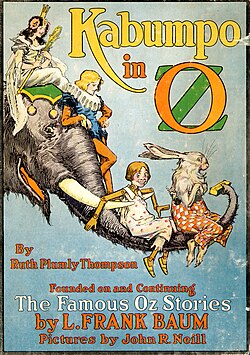
While this is the sixteenth book in the 'Oz' series, it's only the second to be written by Ruth Plumly Thompson, the new Historian of Oz. The instinctive response of any critic will be to compare it to both its predecessor, 'The Royal Book of Oz', as well as the fourteen books before it, all written by L. Frank Baum. I can certainly say that she found her voice first time out and she continues here in much the same vein, adding a quest narrative to give the story more focus. However, I'm not sure if it's better than the previous book or not. It is and it isn't.
One of her more obvious introductions to the world of Oz is her playful use of language. There are spoonerisms, alliteratively named characters and many puns for names, starting in the very first paragraph. The latter are the most successful for me, because they're often clever and funny. I'm rather fond of cooks called Stirem, Friem and Hashem. We spend time in Rith Matic and the Illumi Nation, the best aspect about each being its name. By comparison, the spoonerisms are dire, not even properly formed, and the alliteration is annoying. We had the Doubtful Dromedary and the Comfortable Camel last time out. Now we have the Curious Cottabus, who's fortunately far more than his name.
The best alliteration happens when Thompson isn't trying that hard, starting with the country of Pumperdink. The king is Pompus the Proud, his queen is Pozy Pink and their son, who's celebrating his tenth eighteenth birthday (I like that), is Prince Pompadore. It's all neatly alliterative without any need to throw in an adjective. He's not Pessimistic Pompadore or Painstaking Pompadore or even Paradoxical Pompadore. He's just Prince Pompadore and he generally goes by Pompa, to be easier on the tongue. His best friend, wingman and sidekick in all ways is the titular Kabumpo, an Elegant Elephant. Ugh, there's the alliterative adjective.
The plot literally arrives during an explosion. Prince Pompa's cake disappears and reappears and then explodes. Suddenly, there's a scroll, a mirror and, of all things, a doorknob. At this point, at least, the scroll is the most important, because it carries a threat. Prince Pompa must marry the "proper princess" within a week or the entire kingdom of Pumperdink will disappear. While there is a Princess of Follensby Forest nearby, she's a thousand years old and ugly to boot. So, Kabumpo secretly spirits Pompa out of his kingdom so he won't fall prey to that fate. Instead, they could go to the Emerald City. Is there a more proper princess than Ozma herself?
I can imagine that Kabumpo was a polarising character. He's often annoying, not to mention vain, but I'd suggest that there are reasons. I believe he's male, but he comes across like a drag queen, acutely fond of fashion and jewels and naturally flamboyant. Now that the gay sidekick has been codified as a trope, I wonder if there were earlier examples than this one. He was popular enough in 1922 to warrant a return as a lead character in three other books in the Famous Forty, over and above more fleeting reprises. After all, this is Oz. Most characters have to get a mention at some point, if only to avoid complaining fan letters.
The worst parts of this book to imagination. Baum wrote episodic novels that led lead characters from A to F with an imagination that made us relish B, C, D and E. Thompson seems to have more focus on story but panders to that episodic approach by giving us new places for her characters to encounter on the way from wherever to wherever else. Baum was hit or miss, of course, which is a likely result for that sort of approach, but he had far more hits than misses. Thompson isn't doing well on this front, at least not with the City of the Figureheads in Rith Metic or the Candlemen of the Illumi Nation. These both felt cheap to me, as if the author had just looked around the room and waited for a pun to come to her, then milked it for all it was worth.
So the Figureheads are literally people whose heads are numbers, and the Candlemen are people who are tall and thin and whose heads are on fire. Neither is a particularly good creation, but the saving grace is Thompson's wordplay. Baum would likely have come up with better people, but he wouldn't have had as much fun with them as Thompson. The Figureheads' ruler is, well, a ruler. He is every inch a king! That means that Count It Up isn't in charge, even though he's the lead pencil. Those are glorious puns and I am eager for more. There aren't as many in the Illumi Nation, but I do like them trying to light Kabumpo's tail on fire, thinking it to be his wick.
Fortunately, there's another thread of story for Pompa and Kabumpo to collide with. This one has to do with Ruggedo, who's apparently a Gnome rather than a Nome and who's still Ruggedo, even though the magic from the Fountain of Oblivion has apparently worn off. He was Roquat the Red before he drank from the fountain, only going by Ruggedo after forgetting his name. Why would he remember everything else but not his original name? That seems like an error to me. Anyway, he's living in the Emerald City but, with the aid of Wag the Rabbit, has dug his way into the caves underneath, where he's writing his freshly remembered history on six rocks.
It's down there that he discovers Glegg's Box of Mixed Magic, which contains all sorts of wonders. The Instantaneous Expanding Extract makes Peg Amy, a doll carved by Cap'n Bill that Ruggedo's stolen from Trot, a tenth too big, Wag just the right size for a human and Ruggedo himself three quarters of a mile high. Now Ozma's palace is stuck on his head like a hat, which isn't pleasant for the regulars inside it when he wanders off to the west, tall enough now to simply stride over the Deadly Desert without touching it.
He leaves Peg Amy and Wag the Rabbit behind and, once Pompa and Kabumpo reach the Emerald City to find that the palace isn't there any more, they team up to chase down Ruggedo. I liked the late scenes during this section of the book, because they have purpose and we know what it is. It's clear that Thompson had a much deeper visualisation of what her books would end up as when she started them than Baum ever did. That makes them a lot more coherent and allowed for depth of character as the landscape shifts around them.
In fact, that happens literally here when they find the Runaway Country, which adopts Peg Amy as its princess. It runs right over the Deadly Desert too without incident, meaning that Thompson's obviously happy to give us multiple ways to do that here in a series that rarely gives us one. I can only remember a handful of ways over Baum's fourteen novels. Ozma's magic carpet was one. The Nomes digging under it was another. Flying worked for Cap'n Bill and Trot, as well as Kiki Aru. And the Shaggy Man, with companions, crossed in a sand-boat. So that's four ways in fourteen books. Thompson just gave us two in a few chapters.
Eventually, Thompson wraps everything up with a nice neat bow. By that point, we've all figured out how that'll happen, so it's both predictable and convenient, but it's still a lot of fun to get to that point. Thompson grows both Prince Pompa and Peg Amy very nicely indeed. Even Kabumpo is a little less annoying by the end of the story. She's also mastered how to cram a bunch of regulars into a story without slowing it down, along with another bunch of new characters too. Given that Buam was terrible at that and didn't get much better by the end of his run, it's impressive to see that Thompson is already past that and on to the next challenge.
And so you can see why I can't answer my own basic questions. Is this better than 'The Royal Book of Oz'? Well, it is and it isn't. Thompson is clearly finding her feet but she's already there on many fronts. Are her first couple of books better than Baum's? Well, they are and they aren't. She's far better at story and I'd say she's better at character too. However, her imagination isn't up to his by any stretch of the imagination, except when it comes to wordplay when she's in a whole other league. However, not all her wordplay is successful. And all that means that I need to read more! Next month, it's the turn of 'The Cowardly Lion of Oz' in the spotlight. ~~ Hal C F Astell
For more titles in this series click here
|
|