|
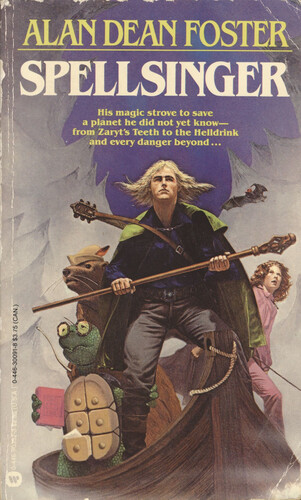
There's irony in my reviewing 'Spellsinger' this month. I pulled it down off the shelf because it was August's selection at the CASFS book social, but, even though I read it, I wasn't able to join the call to discuss it. It apparently went down pretty well, as I expected it might, given that the author is a local boy here in Arizona and a thoroughly reliable writer. I was eager to dive in because I've read and reviewed all his 'Humanx Commonwealth' novels (which reviews are collated in print) and the 'Spellsinger' series was the other one I remember my mother enjoying way back in the day.
What I found was that it's a very different series in tone, while keeping some recognisable Foster aspects. It's fantasy rather than science fiction, but there was also fantasy in 'Pip and Flinx' and in the broader 'Humanx Commonwealth' series that was a subset to. However, it's earthy fantasy, a raunchy, unrestrained, irreverent antidote to the clean cut high fantasies so popular before it. It feels like a deliberate subversion of a genre but one that has no interest in diving all the way into the underground. So it's bawdy but there's no actual sex. Life is cheap but it's not gratuitous, once we get past the prologue, at least. It indulges but isn't addicted, whatever the vice.
After a brief note to wonder why Foster chose "half a fortnight" in the second paragraph instead of the far more typical "week", I'll try to ground us. A wizard discovers that a great evil is afoot in the world, so he reaches out into the void of space-time to grab someone who can help. It's a huge effort, so he sleeps through the sacking of Pelligrew, the nearest civilised town to the Greenlands, and suddenly the bad guys cook and eat the children. We're still in the prologue, but that's as bad as the gore gets. This isn't a horror novel.
Meanwhile, Jonathan Thomas Meriweather, a prelaw student in our world smokes some weed and finds himself being stabbed by a sword wielded by a five-foot-tall otter in maroon velveteen pants. It's perhaps understandable that he thinks he's high. They're in the Bellwoods near Lynchbany Towne, and Mudge, the Cockney otter, has a feeling that he's the someone the wizard grabbed out of the ether, so brings him to him. That's Clothahump, who's a turtle with drawers built into his shell. We also meet Horace, a giant robin mailman and Pug a giant bat, Clothahump's familiar. It seems like Jon-Tom isn't in Kansas anymore.
Initially it all seems like a mistake. In this world, maths is magic and Clothahump's magic aimed at an engineer. Jon-Tom is a prelaw student and would be musician, but he also works part time as a janitor. A sanitation engineer. "So ends civilisation," mutters the turtle. However, it's pretty clear from the outset that Jon-Tom is going to be the Spellsinger of the title, whatever that it is, and it turns out that it's his music that counts as his particular brand of magic. Late in the first half, he's able to try out a twelve-stringed instrument called a duar and as playing 'Purple Haze' generates, well, a purple haze, he experiments and we have a story.
Most of this is an absolute joy. Foster clearly had a lot of fun getting down and dirty for this book, starting with Mudge's delightfully regional accent. He's as far away from RP as it gets and speech from him tends to involve a lot of apostrophes. He's only the first of a string of delightfully drawn and admirably delineated sidekicks for Jon-Tom, though he's far more of a guide as we begin, the Earthman utterly out of his depth everywhere he goes and thus a prime target, even if he's also a foot taller than absolutely anyone else.
For instance, after getting run out of Lynchbany after a mass brawl at the Pearl Possum, they find refuge at Thieves' Hall, but they're promptly thrown out of there too due to a misunderstanding. The single aspect that stood out to me here as odd is the unusual laxity when it comes to species. As I mentioned earlier, there's no actual sex in this book, but it floats around the action with such regularity that we start to wonder if there was sex but we blinked and missed it. And, if it did, it's likely to have been weird, because there's no taboo about species. Jon-Tom plays cards at Thieves' Hall to pass the time, wins a sexy she-wolf from her boyfriend for a few nights and can't grasp why she wants to go through with it. It's his polite rejection of her that gets them thrown out.
You'd think he'd have learned in Lynchbany, a town named for the lynching of Tito Bany, a ferret conman, as the Pearl Possum isn't merely an inn but also a strip club, with a sexy ermine working the stage with style. It's there that he and Mudge acquire Talea, an old cohort of his who rescues them. However, while they're both thieves, she judges his lechery and fondness for exaggeration to be abhorrent. Sexual chemistry immediately arises between Jon-Tom and Talea, a human like him in a world where most of the people are talking animals in clothes. It seems pretty likely that they'll hook up at some point but I couldn't guess as to whether it'll work out or not.
Meanwhile, Clothahump tries for another wizard and hooks Flores Quintana, a girl Jon-Tom had a crush on back in college. She isn't remotely like what he thought she'd be like, seeing her beauty as a curse and much preferring to earn respect for her brawn. She joins the team too and, as this runs on, so do Caz, an exquisitely polite gentleman rabbit but inveterate crooked gambler, and a Marxist river dragon by the name of Falameezar-aziz-Sulmonmee. Yes, you read that right. He's a Marxist river dragon and he's merely the most obvious aspect to suggest that Foster conjured up this story while high as a kite.
That may be a problem for some readers, because the idea of maths being magic but music being maths so music must also be magic does have truth to it but manifests here in the sort of way that only really makes sense under the influence of narcotics. After Jon-Tom's 'Purple Haze' suggests a connection between what he plays and what he gets, he tries for transportation with a rendition of the Beach Boys' 'Little Deuce Coupe' and gets a forty foot L'borian riding snake with saddles. It seems that some translation happens to local reality.
I rather enjoyed how much cheesy opportunity this gimmick provides Foster, so I'm eager to see if it gets funnier over time or starts to drag. What I found the biggest problem is that this book has no intention of telling a complete story. This feels like the first half of a duology or maybe a third of a trilogy, but it takes its time because of that and hasn't particularly got anywhere by the time the pages run out. For a story sparked by the presence of a great world-ending evil, we don't even learn about the bad guys until the second half and what we see of them is mostly a tease.
They're the Plated Folk, led by Skrritch the Eighteenth, Supreme Ruler of Cugluch, Cokmetch, Cot-a-Kruln, and of all the far reaches and lands of the Greendowns. They're insectoid, she's a praying mantis and, given that she does eat the head of her chamberlain, I guess there was some sex here after all. We do get a glimpse from the Plated Folk's point of view but only briefly. They're a loose coalition of species who have consistently failed to take over the world for eons but keep planning for that eventuality and are now placing their faith in the Manifestation, whatever that is.
Surely, we're going to learn a lot more about that in the second book, 'The Hour of the Gate'. This is currently a series of eight books, though Foster hasn't written one in over thirty years, so likely won't extend it further. The initial batch ran six books, from 1983 to 1987, so maybe this is a sextet and I'll have to wait quite a while to grasp the series arc. I'll happily stick with it though so I'll find out soon enough at a book a month.
For now, I can't say much about the story because, beyond being good guys vs. bad guys, where the good guys are far from pure and the bad guys are cannibalistic insects, that's all still to come. The biggest successes thus far are in character and tone. Every single member of the good guys' team is thoroughly different from each other. It's oddly human dominant for a world that isn't, but only Talea is a local. Even then, there are more talking animals in their number than humans, and each is from a different species, with a different accent and very different goals in life.
The tone is perhaps even more of a success, which is saying something. From the very first scenes in Lynchbany Towne, this is thoroughly down to earth and refreshingly so. The place is full of mud and slops and stink without revelling in it. It's fundamentally uplifting fantasy with characters we can care for, even if we'd probably want to smack Mudge's nose for something about five minutes after meeting him. This is a long way from grimdark, even if it doesn't smell like it. Being another planet, Foster has free rein, but I have to wonder if it really is another planet, given that Orion is clear as a bell in the sky. Did Jon-Tom and Flores travel through space or time?
Maybe I'll find out next month in 'The Hour of the Gate'. Maybe I won't. I have a feeling I'll be a lot more grounded after that one though. Is this series going to play out as a quest or as a war? It will no doubt dive deeper into character but will love win out over lust? And, if so, how quickly? Who's going to find a home here and who's going to feel out of place? Will our merry band grow further? What is this Manifestation going to be? Are we going to end up with Ralph Macchio duelling Steve Vai in the grand finalé? I have a heck of a lot of questions. Maybe next month I'll find answers. ~~ Hal C F Astell
For more titles by Alan Dean Foster click here
|
|