|
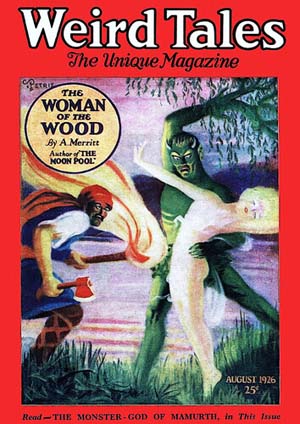
Volume eight of 'Weird Tales' continues to shine, with this second number boasting a stellar cover story, from A. Merritt, whose novel 'The Metal Monster' I reviewed last month for my 'Lost World-Lost Race Classics' project. There's a classic reprint from the French master of the short story, Guy de Maupassant, four strong contributions from female authors—one of them a continuation of a serialised novel—and both a Lovecraft and a Derleth.
What's more, there's a debut in print for Edmond Hamilton. He's maybe best known today for his science fiction, not least the 'Captain Future' series, published in the pulp of the same name, but who would go on to see no fewer than seventy-six short stories published in 'Weird Tales' over an impressive twenty-two year span, the other end of that roster being 'The Watcher of the Ages' in 1948.
The Merritt is 'The Woman of the Wood', a rare short story for him, but the one which would close out his only collection, 1949's 'The Fox Woman and Other Stories'. It's an excellent piece, placing a traditional rural fantasy in the context of war. McKay escaped the latter but not without scars, an open wound of "nerve, brain and soul". It's the inn he finds in the French countryside and the lake and forest around it that heal him, but then he realises its own pain, seeing it in the terms drilled into his essence.
Having already delivered countless delightful descriptions in each of the first few paragraphs, he dips deeply into personification: the forest marches on the lodge and its garrison responds with axes. Then it gets personal, as old Polleau's son chops down a birch. The forest then calls to him in the form of a spirit woman with no pupils. He answers and the rest is sad, lyrical and inevitable. Like so many stories that seem to sit outside of time, we can pull back to expand the story to play out on a much larger scale, building a sprawling history in our heads.
It's lovely stuff and it would remain Merritt's only contribution to 'Weird Tales', though it would be reprinted in 1934 as January's 'Weird Story Reprint'. Greye la Spina, on the other hand, was a veteran of the magazine already, with a novel, a novella and four short stories already published and a host more still to come. I'm looking forward to all those, because I'm enjoying 'Fettered', a novel on its second of four instalments here. I'm very much looking forward to how it will develop in its second half.
Sure, it's confirmed here to be the vampire story that we expect it to be and there's a lacy sheen of romance to it, explored in an archaic melodramatic style, but it's also a feminist piece, with the hero really a heroine, Bessie Gillespie; her twin brother Ewan a male victim; and Gretel Armitage a bewitching female vampire. With only four characters in the story, the sole pandering to gender norms is the knowledgeable doctor, who has trapped Gretel in marriage, being traditionally male.
He's Dale Armitage and most of this second quarter involves him explaining to Bessie what she's walked into and the latter doing what she can to stop the already fraught situation getting much worse. That happens when Dale is gone to stop a child bled dry by his wife from becoming like her, a ritual that happens only in dialogue but is brutal nonetheless: attending the funeral to locate the grave, digging up the corpse, beheading it, driving a stake through its heart and then filling its mouth with garlic. This is the sort of story where that can be recounted and yet still sit within a romantic framework.
Greye la Spina is one of the four female writers, though her unusual nom de plume could easily be interpreted otherwise. She was born Fanny Greye Bragg, but became Fanny Greye la Spina when she married Robert la Spina, the Baron di Savuto. The others are G. G. Pendarves, whose initials stand for Gladys Gordon; Wright Field, which isn't the outrageous aviation homage it seems to be but a subtle shortening of Daisy Wright Field; and Emma-Lindsay Squier, unmistakably feminine. She appears to be an author that I should explore as, while this was her only story to be published in 'Weird Tales', she was a prolific writer of genre stories for, of all things, 'Good Housekeeping', not a traditionally explored source for anthologies.
Her novelette here, 'The Door of Hell', is a good one that features an inexplicable mystery. Bob Lazelle knows that the Three Finger Butcher is dead, hanged for his crimes, but he also knows he saw him more recently. Similarly, Eddie Nugent knows Dago Tito, the Black Hand Murderer, can't plague the city any more, but swears blind that he saw him anyway. Now, murders committed to their templates are happening and their fingerprints are found at the scenes. Nick the Dick, Det. Nicholas Brunna, gets to investigate, everyone else being a journalist. It's neatly done.
Unlike Squier, Pendarves would be a prolific contributor to 'Weird Tales', with eighteen stories in total, which begin here with a rare reprint, 'The Devil's Graveyard' having been first published in 'Hutchinson's Mystery Story Magazine' in December 1924. It deals with an old family curse that's about to be rekindled, Giles the Thruster (yes indeed) aiming to return after centuries because a Radcliffe son with six brothers is about to marry an only Blackmore child, the two named ancient families with long heritages in this location.
In a more friendly manner, that means David and Maisie, with Giles the Thruster putting David's youngest brother Hirst to put to use as his avatar. What follows is an enjoyable occult battle with demonic forces, led by Sir Donald Fremling, a Van Helsing type who would be back in future issues for another novelette and a couple of short stories. Unfortunately, they weren't published close together, so I'll be waiting over a year for the next one and four more for the last. 'Hutchinson's' is another magazine I should seek out for material typically yet uncollected by forgotten female genre authors.
The Wright Field story, 'The Mad Surgeon' is as strong as the others and I'd love to read more of her work than she wrote. She'd seen one earlier story in 'Weird Tales', 'The Crimson Rosary', and would have two more in 'The Catholic World', but that's all for prose, as her other four published pieces were all poems, in a variety of magazines. This short story involves a man who's having his appendix removed also having a weird trip under ether. More time passes than you'd expect from that, perhaps, leading to some capable twists. I like this one a lot.
Of course, there are many male authors here too, the most recognisable nowadays being Merritt, Lovecraft, Derleth, Hamilton and de Maupassant. The latter, who had died young in 1893, delivers the 'Weird Story Reprint' in the form of his most famous genre story, the much anthologised 'The Horla'. It's a story of madness in the form of a diary, of a man who believes that an invisible being is visiting him at night to drink his milk and water and perhaps something else. He's in France but the madness has an unusual Brazilian origin and the story unfolds with a powerful slow burn.
H. P. Lovecraft wasn't famous in 1926 but, if the letters sent into 'The Eyrie' are anything to go by, he was a lot more popular with the readers of 'Weird Tales' than histories tend to remember. 'The Terrible Old Man' is a very short story, typically regarded as a vignette, that's done and dusted in only two pages. It's also a reprint, having been first published in 'The Tryout' in July 1921, but that was an amateur publication that he mostly wrote, even though it was edited by Charles W. Smith.
However short, it's an effective piece that has a strong urban legend feel. The old man of the title doesn't seem terrible at the outset but he is old, rich and feeble, so he's an obvious target for the three thieves who decide they're going to rob him. He's also strange, talking to pieces of lead he's suspended in bottles and pendulums that he's named. There's no explanation of how he beats the three thieves but they go in and don't come back out again. It's effectively dark and it's precisely the sort of story you can see imaginative kids telling their friends as they walk past the house.
Even though this was an earlier story reprinted, Lovecraft was a 'Weird Tales' veteran. August W. Derleth wasn't, even though he would go on to co-found Arkham House, publish Lovecraft in book form for the first time and give a name to the Cthulthu Mythos. 'The Devil's Pay' is only his second solo story, after 'Bat's Belfry' in May, though he'd co-written July's 'The Elixir of Life' with Mark R. Schorer. It's also short, only three pages long, and accordingly straightforward. It's a Five Minute Story about the Duke of Venice visiting Messer Gamani because he has an enemy he can't kill. He needs help and the Devil should be able to provide. It ends as well and as poorly as you'll expect in a predictable but effective piece.
So to the Hamilton and the beginning of a long and fruitful relationship for him in this magazine. In fact, he'd only be missing from one issue over the next eight months, that run including three novelettes and a novella serialised in three parts, starting in the September issue. For now, it's a short story called 'The Monster-God of Mamurth', which is a capable debut, well-defined, easy to unfold and agreeably on target for the "magazine of the bizarre and unusual".
An archaeologist stumbles out of the desert, collapsing into the camp of a couple of traders. He's unnamed but he tells his story, how he's been to Mamurth, a ruined city in the Igidi desert that's home to an invisible temple and an evil god. We visit it with him in his recollection and find it vast and maddening, looking out from a hundred feet above ground in a building he can't see at a set of unearthly footprints manifesting in a line towards him, surely those of the gigantic spider god he's seen carved on walls outside the invisible temple. It could have been more than it is, but it's a solid debut and I'm looking forward to seeing Edmond Hamilton develop as a writer.
There are weird creatures, plural, in B. Wallis's 'The Whistling Monsters', his third of many stories in these pages after 'The Abysmal Horror' and 'John Carroll, Legionary of Rome' a couple of years earlier. Deegan and Vance have been tied up and left to die by native Amirapas in the Guineas, an awful end under any circumstances but all the more so when they realise they're not alone. These octopus-like tentacled creatures aren't explained but they're thoroughly effective; Vance has to bite one of them to free Deegan's top half. The ending is decent but lessened by casual racism, of the sort I expected to see more often in these pages in 1926.
There are more natives in Alanson Skinner's 'The Tsantsa of Professor Von Rothapfel' and they're more effective, even though the story becomes easy to predict once we realise that the narrator isn't the titular professor. These natives are Jivaros, indigenous to Ecuador, where they're known for shrinking heads, the tsantsas of the title. The narrator is an American anthropologist who has patience and respect for the Jivaros, which is why he lives to tell his story to the Wanderer's Club. Von Rothapfel, well, not so much. As predictable as it is, it's well told with much anthropology, the result becoming almost a lesson in approaches.
For prose, that leaves 'The Other Vera', a short story by Willis Knapp Jones about a doctor unable to treat a girl who's entirely normal except for the rather unusual quirk that she can't be woken by anyone else once asleep, so calls in a medical missionary just back from Africa, who turns out to be exactly who's needed, for rather convenient reasons. It's a tale of African magic and curses and it’s going to be memorable to me through its happy ending being a young lady being thrown to the crocodiles.
That leaves a couple of poems, 'Starkey Strang' by Bertrande Harry Snell, his first of three such in these pages, and 'On Canton Road' by Samuel M. Sargent, Jr., also his first poem of three but with a short story, 'The Dane', published the year before. I do like the Snell, less for its structure that I would love to hear read by a talented voice and more for its unusual story. The Sargent is decent too but far more traditional in every way and thus more forgettable. It's a mood piece about the ancient house that can be found on Canton Road.
And so to the Eyrie, where we learn that the most popular story in the June issue was, by a great margin, Robert S. Carr's novelette 'Spider-Bite', which I liked a lot, too. There's also praise for H. P. Lovecraft, which seems to be routine in 1926, and Eli Colter, who's compared to O. Henry. There's also a letter from Manly Wade Wellman, of Wichita, Kansas, who appreciates that 'Weird Tales' is a home for modern writing, unlike most sources of "the fantastic and unusual in fiction".
Now, Wellman's was not a name that anyone would have recognised in August 1926, but he would go on to become a prolific and highly popular author for 'Weird Tales', albeit mostly not for some time. He was twenty-three in 1926 and would start selling stories a year later, firstly to 'Thrilling Tales' but including a short story in 'Weird Tales' in November 1927 and verse the following June. He wouldn't see print again in these pages until 1934 but would add twelve further stories and a novella in the late thirties, twenty-one more in the forties and another five in the fifties. ~~ Hal C F Astell
For more titles by Farnsworth Wright, click here
For more Weird Tales titles, click here
|
|