|
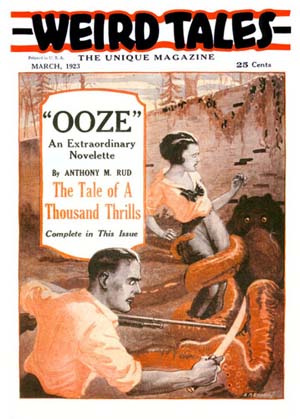
Having finally started into the legendary 'Weird Tales', self-described as "The Unique Magazine", last month with its May 1926 edition, Vol. 7 No. 5, I stated that, in addition to continuing through its run as part of my pulp centennial project, I'd also go back to the very beginning. Fortunately, it isn't particularly far, because it only dates back three years from there and with a notable gap as one editor and indeed one publisher gave way to another. This first edition was dated March 1923, its editor was Edwin Baird and its publisher was J. C. Henneberger's Rural Publishing Corporation of Chicago, Illinois.
Ironically, the man who would take over as editor in November 1924 and bring the magazine into both profit and its heyday was already around. His name was Farnsworth Wright and he served as first reader, the man who worked his way through the slush pile of submissions and passed up the stories potentially worthy of publication. He also wrote one of the twenty-two stories in the first issue, which is a crazy amount, especially as that count doesn't include three novelettes and the first part of a serialised novel. This was an ambitious first issue, with my digital copy counting 192 pages and even then probably missing a couple of full page ads. The next issue would follow suit, but it would shrink down to half that size after that.
Frankly, to posterity, Wright is one of the few recognisable names on the contents page. Anthony Rud was a prolific pulp author still known to some, including myself, and Otis Adelbert Kline was a well-known writer for his Burroughs ripoffs. Ironically, I've just written about him for this month's 'Amazing Stories' because the June 1926 issue of that included a reprint of 'The Malignant Entity', a Kline story from the final issue of 'Weird Tales' to be credited to Baird. I'll get back to that story in its original form next June before moving into the Wright era in July. If I stay on schedule, I'll be up to date at the very end of 2028. There are other notable names here, but only in the context of the time; their names haven't passed down the generations.
So let's dive in, starting with the three pieces that immediately stood out from the crowd. Firstly, there's 'The Dead Man's Tale' by Willard E. Hawkins, a novelette that counts as the first fiction to appear in 'Weird Tales'. That's followed by Anthony M. Rud's 'Ooze', which was the cover story for this first edition. Rud also provides the first letter to be printed in 'The Eyrie'. Then it's time for a novel, though 'The Thing of a Thousand Shapes' by Otis Adelbert Kline, serialised in two parts, is a pretty short novel on the face of it, with only nine pages here and thirteen in the following issue.
'The Dead Man's Tale' is an odd story because it follows a highly unsympathetic lead character on a highly unsympathetic quest to murder his best friend, using the Second Battle of the Marne as a clear opportunity to get away with it. He's Richard Devaney and he's about to shoot Louis Winston dead when an enemy sniper takes care of him instead. Even though he comes to in ghostly form to find Louis weeping over his body, he proceeds to haunt him because Velma Roth would have likely chosen his friend instead, following him back home to see them marry. Even then, he tries to take over his body, at which point we somehow manouevre into a happy ending. It's memorable but I'm not sure if it's entirely for the right reasons.
'Ooze' is decent enough but pretty straightforward. We're in Moccasin Swamp in the backwoods of Alabama where biologist John Corliss Cranmer apparently went mad and drowned his son and his daughter-in-law. He's promptly locked up in an asylum but escapes and comes back to Dead House as Daid House is becoming known. Our narrator figures out the real story, which involves a similar wall without entrance around the building that I remember from a later Anthony Rud novel called 'The Stuffed Men'. While still clearly pulp fiction, that's a much better read than this novelette.
At least 'The Thing of a Thousand Shapes' is promising, but it's less than half of a short novel, so I have to reserve judgement until it wraps up in the second issue. Billy's Uncle Jim, James Braddock, has died, so he travels back to Peoria to take care of things. Billy is a respectable bookkeeper who Braddock put through through college, but Uncle Jim was a student of psychic phenomena, with a number of books to his name on the subject. Perhaps that's why he leaves strange instructions for his nephew, asking that his body not be touched in any way until decomposition sets in. We realise why that night, though what Billy sees is still open to interpretation. I'm intrigued.
As those highlighted stories might suggest, while there's certainly quantity here, the quality isn't quite able to match it. There are a bunch of decent stories but few that rank any higher than that. There's 'The Grave', a war story by Orville R. Emerson that's absolutely haunting, a story that tells of the unburied dead but also the buried living, with an oberleutnant stuck under a shelled dugout for two weeks. It boasts an excellent ending. There's confinement terror in 'The Place of Madness' too, by Merlin Moore Taylor, a convict serving time for murder pleading with the chairman of the Prison Commission to abolish the dark cell. He tries it for two hours and goes mad, with his reason only returning "many weeks later". It's thoroughly effective, though the twist is predictable.
Other than that, the best short story here is probably the anonymous one, 'The Young Man Who Wanted to Die' credited to ? ? ? The lead character is anonymous too but he's been searching for his Lily May for years and finally given up. Instead, he decides to find out what comes after death by gassing himself. While the ending is a sweet inevitability, it's what happens before we reach it that matters, as this gets agreeably weird. Eons pass over vast distances, strange environments with weird creatures, all the way to a distant star where grisly demons indulge in wanton orgies. It's quite the hallucinatory vision and it's far beyond anything in this issue for sheer imagination.
These authors weren't nobodies, as the credits listed under their bylines suggest, stating they're the authors of this and that. Hawkins had many credits, though they were spread over quite some passage of time, general fiction in the early teens all the way to science fiction novels in the early fifties. Rud wrote anything for anybody, as I'm finding with stories in both 'Weird Tales' and 'The Frontier'; I know him from later novels. Kline I've also read in novel form, albeit mostly his Venus and Mars stories that are clear knock-offs of Edgar Rice Burroughs. Taylor was highly prolific too, mostly in the detective pulps like 'The Black Mask' and 'Real Detective Tales'.
Emerson is the exception here, because, rather disappointingly, he never published anything else. I'd have liked to have read a good deal more from him. I can't necessarily say the same about most of the authors represented here, though I have to admit to a fascination as to the genders of two stories in a row that fit the same bill. They're F. Georgia Stroup and I. W. D. Peters and I felt from the structure and approach of these stories that the former had to be female but the latter male and I wanted to validate that. Ironically, it turns out I was wrong, as F. stands for Fannie and I. for Idella, meaning that they're both female. Regardless, this was Fannie's only published story while Idella only had one other to her name, a detective story in 1920.
The Stroup story is 'The House of Death', which unfolds on a Kansas farm with an almost entirely female cast. Mamie Judy has been arrested for murdering her own baby and three women take it upon themselves to clean her house in her absence. In doing so they realise the real story behind the crime and find enough compassion for her to lie to the men who arrive in the final paragraphs to ask if they found any evidence. They've already burned it. It's a story that surely couldn't have been written by a man and I was right on that front.
However, the Peters, 'The Gallows' still feels like a bizarre story for a woman to write. It revolves around a man who's also in custody for a murder that he absolutely committed, but he's notably further along the process. In fact, he's waiting to be hanged, his death merely five hours away on his ninth wedding anniversary, though his wife Gladys is seeking a reprieve from the governor. It might end in a similar way to the Stroup except that he wants to die, to escape his wife. The man he killed was a conquest of hers and not the only one. He declines his last words and so manages to cheat the reprieve and escape his wife. It feels like the work not merely of a male author but a misogynistic one. I'm frankly shocked to discover that it was written by a woman.
There are so many other stories here that I either have to ignore them or run through them with little comment. I'll do that in order of appearance, starting with Julian Kilman's 'The Mystery of Black Jean', another prolific author who would be featured in the next three issues and another later in 1923. It's a tall tale about Black Jean, a six-foot-five French Canadian with two bears that he wrestles. He's a tough cookie who swaps eyes with one of them but can't win out against a tiny schoolteacher who moves in with them.
'Hark! The Rattle!' is a decent revenge story by Joel Townsley Rogers, also prolific in the pulps but who never wrote for 'Weird Tales' again. It's about dancers and snakes and we have to question if Bimi Tal is hypnotising Tain Dirk or vice versa? Apparently he's a mad sculptor with a rattlesnake's soul. Bryan Irvine's 'The Ghost Guard' is a capable ghost story in which the guard well known as the personification of cruelty reports for duty after his throat is slit and comes for the lifer who killed him. Irvine mostly wrote for detective pulps but would have three more stories to come for 'Weird Tales', all by 1927.
G. A. Wells and David R. Solomon both wrote across the genres but are represented here by their only 'Weird Tales' stories. Wells contributes 'The Ghoul and the Corpse', a tall tale with a typical inevitable twist, this one revolving around a prehistoric man who thaws out of a glacier in Alaska with a knife made of mastodon tusk. Solomon's is 'Fear', which boasts a gloriously meta opening line—"There were only five words", which is perfectly true—but doesn't add much more except a dab of casual racism and some irony wrapped up in the titular fear. Snakes! Why did it have to be snakes?
The third novelette is 'The Chain' by Hamilton Craigie, likely the most prolific author in this issue after Rud but, unlike him, not one who's been remembered long enough to get a Wikipedia page. He's also in the next three issues with a fifth story later in 1925. 'The Chain' isn't his best work, as an effective look at paranoia—Quarrier must hide documents from Hubert Marston, the Panther of Peacock Alley, who's already onto him—countered by an underwhelming revelation. Then it's a glimpse of a story, really just a vignette by future editor, Farnsworth Wright, called 'The Closing Hand'. It's over and done in just two pages and really counts as little more than atmosphere.
Herbert J. Mangham's 'The Basket', a relatively quiet story about the truth of a medium, was his only story for 'Weird Tales', though he published a dozen stories with various pulps, all during the twenties but for one in 1956, which makes me wonder if that was a different author with the same name. It's bookended by two prolific authors named Davis represented here by their only stories for 'Weird Tales'. They're otherwise very different, 'The Unknown Beast' by Howard Ellis Davis an effective enough beast-hunt led by a character who still had legs in him, but 'The Accusing Voice' by Meredith Davis a relatively straightforward revenge story perpetrated by a man supposed to have been hanged a dozen years earlier. The twist is decent but predictable.
The next three are at least unusual, albeit for different reasons. Walter Scott Story's 'The Sequel' is exactly that, to Poe's 'The Cask of Amontillado', cleverly revealing how that didn't remotely go how Montresor told us. You guessed it: he was a prolific pulp author on his only 'Weird Tales' yarn. 'Weaving Shadows' by W. H. Holmes boasts an occult detective, though I don't know if Chet Burke returned in any of the five stories he or she placed elsewhere, all in 1922 or 1923. That leaves R. T. M. Scott, probably best known for a character called Secret Service Smith, but here contributing a prehistoric tale about a tough and confident woman who travels, hunts, kills and chooses a mate only when she wants to. It's practically feminist, though the R. in R. T. M. stands for Reginald; it's occasionally shockingly brutal; and I'm not convinced it doesn't shoot itself in the foot at the end.
William Sanford delivers another excellent opening line with a first of six stories for 'Weird Tales', 'The Scarlet Night': "Dr. Langley was in love with my wife." However, it's only a decent story with an ambiguous ending, as the characters look at possibilities when a husband refuses to grant the divorce that's being sought. Joseph Faus and James Bennett Wooding wrote a few collaborations but this was their only one for 'Weird Tales' and, sadly, it can't live up to its expansive name: 'The Extraordinary Experiment of Dr. Calgroni' turns out to be pretty much what we expect it to be all along.
I rather liked 'The Return of Paul Slavsky', the first of three 'Weird Tales' stories by Capt. George Warburton Lewis, all showing up in the first five issues of 1923. However, it's poorly structured, as the search for a female supercriminal we think it is doesn't matter in the slightest, passing with a weird lack of explanation. Instead what matters is the train ride at the end, which turns out to be a real shocker. Finally, after the odd Stroup and Peters double bill comes another one that aren't as successful, Harold Ward's 'The Skull' a routine story with some joyous karma that's visited on a violent racist asshole, and James B. M. Clark, Jr.'s 'The Ape-Man' running on and on but reaching quite a notable setpiece to wrap things up.
All in all, it's quite the mixed issue, far too long for a debut that doesn't have any killer stories to warrant so many pages. A bunch are decent and a few do a bit more than that, but many struggle to make themselves heard above the crowd. Few of these authors would return, at least past the next handful of issues, even when they were prolific writers well-known at the time, if not today. I certainly can't call any of these out as names I would deliberately seek out, except, ironically, for Orville R. Emerson, who never wrote anything else. So it goes.
At least there were a bunch of ads to keep things busy towards the bookends of the issue. I could see room for many in between stories, but the layout took a different approach. The headings of stories are in a very large typeface size, the text runs as long as it does and then whatever blank space is left on a page, however much, is given over to a prominent notice about what's coming in the next issue. Eventually, they ran out of stories to hawk, so threw in an occasional news item or curiosity from around the exotic world. There's even a piece about Tutankhamen's tomb, found a few years earlier, that sprawls over half a page because that's what needed filling.
The full page inside cover ad is a routine one for the era, promising us $75 to $200 a week working as an electrical expert, once you've passed the Chicago Engineering Works' Home Study Course. Less expected is the full page ad promoting a book by prominent birth control advocate Margaret Sanger, 'Woman and the New Race'. It's not free but you don't have to send any money, just give a couple of bucks to the postman when he delivers it, along with the applicable postage, of course. Keeping focused on the ladies, there's another full page ad for Burlington Watch Company's little seventeen-jewel petite wristwatch (or a different one with twenty-one jewels). Each requires just a dollar down plus an undisclosed balance that you can "pay in small, easy monthly payments". No trust issue there, huh! I wonder how quickly that advertising loophole was legally closed.
At the back are a whole lot of further ads, suggesting that Rural Publishing Corporation brought them over from their existing publications, like 'Detective Tales', also 192 pages and advertised towards the back. The Martha Lane Adams Co. promises to make buying clothes pleasanter with their "free style book". We can pick up public speaking at the North American Institute, study the art of finger printing with the U. S. School of Fingerprints or "Learn Any Dance in a Few Hours" in the trusty hands of Arthur Murray. We can even acquire a limited-time-offer book of confidential reports from Secret Service Bureau Operator No. 38, who presumably has even more knowledge about finger prints than the school above.
If that's all too much, the smaller ads hawk the usual stuff, like typewriters, watches or guns from a novelty catalog. Egyptian Gem Importers offers a "mystic Egyptian luck ring" and a lot of other companies have their own rings to sell, from "mystic good luck rings" presumably not from Egypt through Arabian diamonds to some sort of fake diamonds that we won't be able to tell from real ones (or we can send them back). The text is blurred but it looks like "Coredite Diamond", maybe Creedite or even Cordierite. If they can't spell, I don't think I can trust them. ~~ Hal C F Astell
For more Weird Tales titles click here
|
|