|
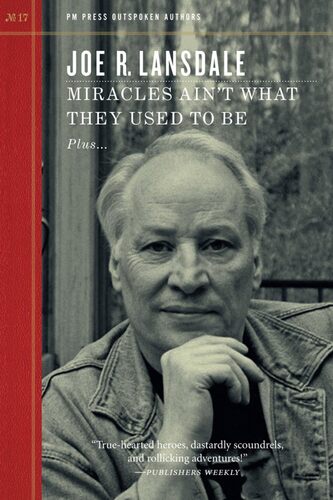
Joe R. Lansdale has written his 'Hap and Leonard' stories in fits and spurts, ever since starting out with what he thought would be a standalone novel in 'Savage Season'. However, he's outright said that 'Petrified Dreams', due later this year, will be the final book in the series. Given that I've now read and reviewed most of them, I really ought to catch up with the ones I haven't in time to wrap the whole series up when it's done. Some of those are odd entries, this one perhaps most of all.
It's really a miscellany, the seventeenth in a series from PM Press by 'Outspoken Authors'. All the contents were original to this volume, at least in book form; the last five pieces, coincidentally the ones beginning with D, are articles first published in the 'Texas Observer', a magazine that's been published bimonthly since 1954 by a 501(c)(3) non-profit, the Texas Democracy Foundation. There's a trio of short stories, two of which feature Hap and Leonard; an "outspoken interview" between Lansdale and Terry Bisson; the rant about religion that constitutes the title piece; and a notably decent bibliography to wrap everything up. It's a pretty slim volume but there's a lot here.
The two 'Hap and Leonard' stories are 'The Parable of the Stick' and 'Short Night', both of which would be adapted a year later into chapters in the mosaic novel 'Blood and Lemonade'. Neither is particularly long but they're both memorable and they underline crucial aspects of the series as a whole. In fact, 'The Parable of the Stick' became the start of that book, even though it wasn't the story in which Hap and Leonard met. Perhaps that's because it's less of a story and more of a life lesson.
At heart, it's just an opinion, a hot take from Hap and Leonard built around an old memory, going back to the time when Hap was being bullied at school as a kid. He'd transferred in from another school and a bigger kid thought he was an easy target and whomped him. Hap did the right thing and went to the principal, who told the kid to quit it and, as you might expect, the kid didn't do at all. He whomped him twice as hard. So his dad gives him the advice he needs and, rather crucially for the story to work, the principal backs him up and that's the end of that problem.
It's a short piece of only seven pages, told through a single conversation driven by Leonard, but it never becomes a single thing. It worked and Leonard takes that as the gold standard, but Hap has more doubts about whether it was the right thing, even if it worked back then, and whether it can translate into modern times. He also knows how wrong it could have gone. So, while Leonard has a tunnel vision take on it, Hap doesn't and that lends the piece substantial depth, far more than its skimpy page count might suggest.
Lansdale's prose also aids that immensely, as it tends to do. It's all homespun philosophy, told in a stunningly simple manner but it strikes gold nonetheless. One moment of poetry has the principal refer to "the mantra of the ignorant and the doomed". The best line is more deceptive. Leonard's talking about the problems Hap had in school, but flippantly adding 'Try being black in a formerly all-white school sometime." Hap replies, "I could try being black, but I'd still be white." That's the sort of apparently throwaway line that comes back to stop you sleeping because you suddenly get how deep it is. Lansdale's so good at that, he ought to trademark it.
'Short Night' is a bit more in depth, as a real short story, even though it's only half a page longer and practically counts as a vignette. Billie Sue is pulling a train. She's a big, fat woman, married to a baptist preacher, and she likes doing the whole senior class. That's why Hap's there but he opts out of his turn, disgusted with the whole scene. His classmate Mike does take a turn, even though he's gay, and gets to wondering if Hap might be too, knowing that his friend Leonard is. Of course, he pretends he isn't while testing the waters with Hap. It's more characterful, but less deep. The depth is with Mike rather than Hap.
These are important lessons in Hap's young life. Stand up for yourself when you need to, without ever becoming the bully. And go your own way, even when you'll get stick for it. Hap was there at that point in his life, but Mike wasn't. Maybe he learned that lesson later. We can hope so. These are lessons that pervade the story in between these two, which is called 'Apollo Red'. As far as I'm aware, it's a fictional piece but it's presented as a memory and backed up somewhat by 'Doggone Justice', one of those articles for the 'Texas Observer'.
The title character is a customer who drives up to his mechanic's in his shiny gold Cadillac to take his girlfriend's car home without paying for the work done. She owes for earlier work done too, so the mechanic stands his ground, even though he's pushing sixty. He's the lead character and he's Mr. Lansdale, the father of the boy who's working there for experience, presumably either Joe R. or a fictional avatar for him. Mr. Lansdale had long ago learned those two lessons that Hap faced and what follows is quintessentially tough without ever trying to be. He's a man of few words and fewer actions, but every one of them counts.
Just as there's no Hap and Leonard in 'Apollo Red' but it feels like there could have been, some of the other pieces hint at the same thing. They're not in the title piece for certain, which owns up in the end to being a rant. It's Lansdale's rant, tearing a new one in religion, especially Christianity, the title referring to the paradox that miracles nowadays seem woefully mundane if compared to what went down in the Bible. It's not hard to imagine it being Leonard's rant instead. 'That's How You Clean a Squirrel', the interview, asks an impressively varied set of questions but the only one not really answered is the one about Hap and Leonard. What do they never talk about? Lansdale says, "They never talk about you. Or me either." And that's that.
Similarly, they're in the articles without actually being in them, especially 'The Drowned Man'. So much of what Lansdale writes feels like it could be autobiographical, enough that it doesn't seem different when he's writing non-fiction. This is fact, but it's bled into his fiction. Hap and Leonard worked those rose fields too. I'm pretty sure they dealt with the same drowned man as well. It's a poignant piece. 'Doggone Justice' is the same sort of story as 'Apollo Red' and 'The Parable of the Stick' too. Certainly it imparts the same message: take care of your personal business yourself.
These aren't substantial articles, but Lansdale has a way about him. I've heard him talk in person and it felt, sitting in a conference room in a Tucson hotel, like I was really sat on a back porch with him in east Texas working through the cooler full of beer at our feet. 'The Drowned Man' has that sort of feel to it. So does 'Darkness in the East', which merely asks what noir is. He's written about it a lot, always in east Texas. 'The Day Before the Day After' is a sequel to 'Doggone Justice', with a neighbour who builds a shelter ahead of a tornado coming through. 'Dark Inspiration', opening up that set, reviews an Edgar Allan Poe exhibit.
This is very much a book for completists, especially as the stories about Hap and Leonard found a home in an official 'Hap and Leonard' volume soon enough. If 'The Parable of the Stick' doesn't hit the hardest here, 'Apollo Red' does and they're both essential Lansdale. ~~ Hal C F Astell
For more titles by Joe R Lansdale click here
|
|