|
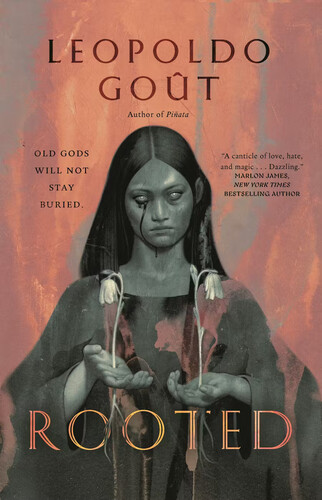
I enjoyed 'Piñata', Leopoldo Gout's first horror novel for Tor Nightfire, but this often feels like it's a slightly better version of the same thing. It's not a redux but there are a lot of common factors. Both are set in Mexico with Mexican leads, but those leads grew up elsewhere. Both tie back to a pre-colonial past which manifests afresh in the modern day. Both involve Nahua spiritualism and people who can see special things in visions. They're both good but this feels a bit more grounded and a bit more consistent. Read both of them but especially read the next one because he seems to be getting better with each successive novel.
As with 'Piñata', this starts in the past, the prologue here unfolding in Spain midway through the nineteenth century. The Pereira family is old school colonialist and Alfonso is inordinately proud of a statue that his grandfather brought back from New Spain, i.e. Mexico. It's a god, Xipe Totec by name, represented as a young man clad in the flayed skin of an older one. Alfonso's wife Anna Maria hates it with a passion but after she gives birth to Fernando, who comes out shrivelled, she touches the statue and receives a vision of the Templo Mayor in Mexico City. She kills Alfonso and nestles Fernando in his corpse.
Fast forward to today and Aurora and Ociel fly into Mexico City to work at the Museo Nacional de Antropológia. She's a lawyer, while he's an archaeologist. Both are Mexican but both also grew up in the United States and they met while studying at university in Madrid. The work they're doing is repatriation, bringing back Mexican artifacts from foreign lands, one of which, of course, is the Pereira's statue of Xipe Totec, which has been crated up ever since Anna Maria's episode. When it emerges, Aurora hears it talking to her. "The seed grows in its rotting hull."
Now, I should add that Aurora is self-medicating with psilocybin, a hallucinogenic mushroom, so it could be that the things she's seeing and hearing may be only in her head. However, it seems like she was seeing the "hole" in her mother's house even as a child, long before the mushrooms, so it could be that there's something going on here after all. Certainly something seems to happening on a broader basis, because the city is sinking. It was built on a lakebed and there's a long drought in effect that's cracking the streets and allowing flowers to rise up to reach the light.
If this isn't a literal take on the idea of the old becoming more prominent in the cracks of the new, then the Templo Mayor serves that purpose. It was built on solid ground, so it's remaining in place as the city sinks around it, thus becoming more prominent over time. As the drought extends, the people look at the old ways, especially in Xochimilco, where Nahua spiritual practitioners, known as graniceros, metaphorically emerge from the cracks of society just as the ghost pipe flowers do literally in the streets.
There was a lot of this sort of thing in 'Piñata' too, but it's balanced even more effectively here. It unfolds well as an ecological disaster novel, wrapped up in the clothes of folk horror, but it unfolds well as psychological horror too. The way the Aztecs were more simpatico with the land, planting trees with root systems that hold artificial islands together and cutting canals to link them is real and that makes it easy to buy into some of the more spiritual aspects of that. However, we simply can't say the same about what Aurora sees. We can read it as literal reality, spun out of that same folk horror, or as mere nightmares and hallucinations. Of course, as the book runs on, we're likely to shift more to one of those takes than the other.
Of course, the wonderfully horrific visual of Xipe Totec is woven into the fabric of the novel too, as he's the god of death and rebirth. While Mexican horror is on a serious high right now, by a bunch of different authors, this sort of imagery makes me wonder why there wasn't a heck of a lot more of it a heck of a lot sooner. Yes, I know one terrible reason but it doesn't seem to explain it fully. It may be that I've just missed what did manage to creep out in the background.
Goût, whose name didn't carry the circumflex on 'Piñata' but does here, has lots of gruesome fun with this imagery, that prologue with Anna Maria serving as an initial glimpse. It connects firmly to Aurora's heritage, which shouldn't surprise in the slightest, but in ways that often surprise. I'm not going to spoil the revelation she discovers in the box under her mother's bed but it's a peach and it opens up a whole slew of directions for her story to take. There's even what I'd have to call an effective literary jump scare at the museum that I similarly won't spoil; it would be glorious to see on film but it works shockingly well on the page, too.
There are other horrors here too that weave into the mythology of Xipe Totec. One is blindness, a condition that lends itself well to horror. Statues of this particularly god tend to feature an open mouth but closed eyes. Another is skin disease, which affects quite a few characters here, perhaps starting with Fernando in the prologue. Would a young mother in Spain almost two centuries ago use the same terminology we would today? I doubt it. Even the mantra feels horrific in this sort of context: "The seed grows in its rotting hull."
What stood out to me the most, though, even above that glorious imagery, is the way that Goût's able to riff around the topical issues he's playing with. Repatriation of artifacts is a major issue in the twenty-first century as colonised powers pressure their colonists. V. Castro also covered it in a horror context recently in 'Immortal Pleasures'. However, it's not merely a black and white issue in this book, even with the principal characters leading the charge. That's good writing. And with the hallucinogenic weirdness, the horrific imagery, the cultural deep dive and the natural ending, there's a lot to love. The fact that it flows so consistently is the icing on the cake. ~~ Hal C F Astell
For more titles by Leopoldo Goût click here
|
|