|
I read and reviewed Del Sandeen's debut southern gothic, 'This Cursed House' last year and found it fascinating. In some ways, this book does exactly the same thing, drawing a female character to an old house with a troubled history in a southern town and only gradually discovering its secret, a secret to which she's tied. However, it takes a very different approach, far beyond the detail of the female character being two (later three), the southern town being Savannah instead of New Orleans and the troubled history tying to racism rather than slavery.
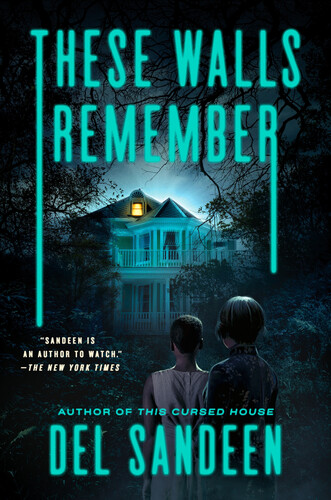
Haddie Taylor has died. She was an actress, but also black which limited both the range and depth of her roles. She retired to Savannah and lived there until her death a year ago. Her attorney has summoned her family, which amounts to two great nieces; sisters who lived very different lives. It seems that there are no cash assets but there is a property, at 724 Hartford St, though Haddie did try to burn it down before being confined to the psychiatric facility where she died. She left some papers, but they read awkwardly: "The house eats," she wrote. "Do not go into the attic."
Mickie is Mikaela Taylor-Hughes, a good girl. She tended to make the right choices and has lived a good life with a good husband, though he died recently and she was forced out of their house and into an apartment because of medical bills. She has nothing to return to in Macon. Dee is Delilah Taylor, who's almost Mickie's opposite. She's a bad girl who made every wrong choice possible, so married and divorced often, spawned an estranged daughter, optimistically named Joy, and left her latest mistake behind in Atlanta. Mickie isn't rich but Delilah's broke.
The structure is odd. We start with Mickie and Delilah inheriting the house and then travelling to Savannah to take ownership. It's a nice place, the oldest in the area, but it needs some work, not least to paint over the fire damage out front. Then we switch to Lewis Bell moving into the same house in 1910, which he built with his friend James. He's a success in the black community, running a feed store, and his wife Mae is pregnant with their first child. His mother was a slave but gained her freedom in the emancipation proclamation. However, this doesn't alternate between them.
There's more to Mickie and Delilah's story than Lewis's, so we have more chapters with them and fewer with him, though their respective threads both progress forward neatly enough. However, we reach the most horrific moment in the book, the one that shapes everything else, just seventy pages in or about a fifth of the way through. The one detail I don't understand in this book is why this was revealed so early and not kept back until the finalé. There's plenty to keep us reading on but almost all the mystery is stripped away with that moment.
It's a brutal scene, one created out of bad luck and bad timing but nailed home with a vengeance by man's inhumanity to man. There's nothing good in racism and we've all read or seen countless examples of how that sad reality can play into horror. However, this moment carries all the more impact because it would have been legally expected. It's morally wrong, sure, but the people who bear responsibility wouldn't have seen it that way at the time. They were just doing their jobs, as they were required to do, and had they known what their actions meant to Lewis Bell, they would have gone home and slept like babies. This moment is worse because of that.
And I'm not going to tell you what it is, because I'd see that as a spoiler, even so early in the book. Instead, I'll tell you that that moment grew into something that infiltrated the house and caused a succession of tragedies in the decades that followed. People disappeared in 724 Hartford St, an anomalous number of them. An effective jump scare of a moment means that at least one person committed suicide there. And, while Haddie lived there for an awful long time, it may have driven her crazy and prompted her eventual relocation to that psychiatric facility.
Now, it's affecting our sisters, especially Delilah. Clearly it's tied to the attic, but it's locked with no apparent key. However, Delilah breaks in shortly before that pivotal historic moment and she finds it empty, the only thing in there a shrine by the window, a circle of candles with a few highly personal artifacts inside it, ones that ought to have served as hints for a lot longer than just one chapter. Initially, they think that someone has been there, because those candles are tellingly lit, but there's nothing else to back that up and we're into supernatural territory for sure.
And so haunted house things happen in this haunted house, to Mickie and to Joy when she travels down to join her mother and aunt, but mostly to Delilah whose temperament is changing even in the earlier chapters and increasingly so, as time goes by. This isn't merely a haunted house story, it's also a possession story and Delilah is the one being possessed. One aspect that I found rather fascinating is that, she's not taken over in the typical movie sense where she's her at some points and the possessor at others. She's a teasing combination of both and, while that's horrifying, it's also an unusual opportunity.
Some of what follows is relatively traditional: the denial to acceptance, the research, a friend of their great-aunt who serves as a sort of occult expert. Some of it very much isn't and I thoroughly enjoyed the variety of characters. 724 Hartford sits in a black neighbourhood whose prices are on the up, so its neighbours are mostly older people who knew Haddie and judged her. However, one house is being flipped by a white couple, who seem friendly enough but make a terrible mistake. And there's John-Lester, born to a white mother and a black father; he's been what well-meaning neighbours call "slow" ever since his mum's dad did something to him. His dad went over with his shotgun and shot that man dead, ending up in the chair.
About three quarters of me liked how this progresses. It's all far simpler than 'This Cursed House' but it doesn't suffer for that lack of complexity. It's not the same story and the secrets that must be uncovered aren't directly applicable to the Taylors. Instead, Sandeen focuses on character and attitude. My favourite moment happens as early as the first chapter, when we're carefully set up to buy into Mickie being the good, capable and reliable sister and Delilah being the bad, lazy and unreliable one. Except she's the one giving money to a homeless man, even though she's broke. It clearly isn't as simple as it initially seems and that evolves wonderfully as the pages turn.
I liked Mickie immediately but also recognised her flaws. I didn't like Delilah to start with but she grew on me considerably. Joy is inbetween the two in many ways but she's also both of them one generation down. The dynamics between the three can be frustrating but they're fascinating too. The quarter of me that didn't like how this progressed was caught up in that frustration, not how they bicker and make up but in how often they changed their minds. The sisters showed up with a clear expectation that they'd do a little work, sell the house and split the proceeds, only to find a bunch of neighbours who want them to stay and make the place a home.
So they decide to sell, to stay, to sell, to turn it into a bed and breakfast, to sell, to stay, to sell, to make it a home, to sell, to turn it into a bed and breakfast. There's a steady stream of realtors in a consistent pattern of one visit. Some of them don't even get through the door. They show up in good faith and leave without it and I understand how annoying that must have been for them. It's not entirely unfair, of course, because the Taylors are continually learning more about the house and its history and secrets. I get that a scary experience might prompt them to leave, but, damn, they're wishy washy on this!
I've been careful about what I've let you in on and what I haven't, even though I've covered things that happen after things I haven't. Hopefully that underlines that there's a lot of character here, a lot of depth and a lot of emotion. There are things that felt acutely traditional, whether to the haunted house aspect of the story or the possession side. There are other things I won't spoil that felt original and even refreshing. There's less social commentary than I expected on race, but it's certainly there and not entirely relegated to the historical aspects. There's social commentary on another marginalised community too, which I didn't expect going in but did see coming.
Its most brutal moment aside, it's a lighter book than 'This Cursed House' and it's certainly much less complex. However, Sandeen takes advantage of the smaller principal cast to go even deeper into characterisation. I had no complaints on that front with the previous book and there were a number of wonderfully drawn characters in it, but the three primaries here are tangled in a web of traumas that Sandeen navigates with panache. Whoever thought a haunted house could work therapy? I look forward to more historical horror from her. ~~ Hal C F Astell
For more titles by Del Sandeen click here
|
|