|
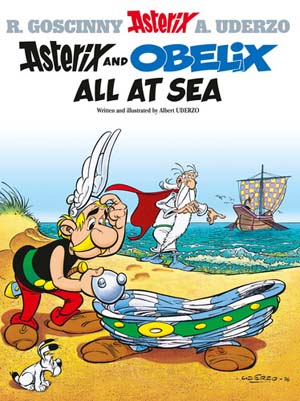
Albert Uderzo has been on quite the ascendancy of late with his solo 'Asterix' adventures, but this sixth outing as both writer and artist ends up as more of a curiosity in the series. It's consistently enjoyable but it can't seem to quite grasp what it wants to do. What it achieves most is to explain precisely why Getafix doesn't let Obelix have any magic potion. There are other key moments but that's the only one that's likely to resonate past this particular album.
We start out establishing the MacGuffin of the piece, namely Julius Caesar's personal galley. He's entertaining Cleopatra and her pet leopard when the news arrives with Vice-Admiral Nautilus, an officer promptly dubbed the Silliest Sausage in Rome. The slaves are revolting, you see—yes, that sparks the usual response—and a Greek by the name of Spartakis has stolen the galley, which is in search of a safe place to land its multi-national crew. The Brit in their number suggests they make for the Gaulish village that his uncle Anticlimax, from 'Asterix in Britain', told him about and that seems like the only choice they'll all agree on.
'Asterix and Obelix All at Sea' was first published in 1996, in its original French, which seems like an odd time to draw Spartakis so obviously as an homage to Kirk Douglas. That movie was a classic of over thirty-five years at that point and the actor had almost a quarter of a century left in him. My only guess, given that the album was also dedicated to him (as well as Uderzo's grandson), is that Uderzo was a fan and chose this as a way to celebrate Douglas's eightieth birthday. Hey, I'm a fan too. I'm not complaining.
Meanwhile, in the village, the Gauls are supping magic potion because they believe the four local Roman garrisons are massing together for an all-out attack. False assumptions abound across the entire 'Asterix' series for comedic effect, but this album in particular is built on them, this being a mere beginning. What the Romans are really doing is rehearsing their welcome for the returning Admiral Crustacius, though that's all naturally a front for their plans to recover the galley before it reaches the village, orchestrated by Vice-Admiral Nautilus, eager to no longer be known as the Silliest Sausage in Rome.
You can imagine how this goes and you'd mostly be right. Yes, the Gauls beat up the Romans. Yes, the galley reaches the village, because they literally carry it up the beach. That doesn't matter in the grand scheme of things, as much as what's gone on in between that. As always, Getafix dishes out magic potion to all his villagers—well, all the men; the women seem to have forgotten all the progress they made in 'Asterix and the Secret Weapon'—but refuses to give any to Obelix, as he'd fallen into the cauldron as a baby and is strong all the time. Obelix, of course, is just as upset as he always is. Well, here's where we finally learn why Getafix instituted that policy.
When Asterix asks, "What would happen if he drank some more now?", the druid says, "There'd be dangerous side effects" and "all my skill would be powerless to counteract them!" That's ominous and, sure enough, when they get back from beating up four garrisons of assembled Romans, they find that Obelix snuck back and drank an entire cauldron of magic potion himself. Now he's turned entirely to granite, prompting a procession of rock puns, an enlargement to Getafix's door just to get Obelix out of it and the druid to try everything to get him back to rights. Even Panacea kissing him on the nose isn't enough to bring him out of it.
Eventually, the problem resolves but only into the form of an entirely different problem. Getafix manages to figure out a potion to get Obelix back into living flesh, but he's now reverted to a far younger version of himself. He might be six and, while he's retained his faculties, at least the few he had, he's not happy about it in the slightest. He can't even eat three boars at a sitting now and he certainly can't lift a menhir. His strength is completely gone and, when he encounters Romans in the forest, they simply pick him up and carry him away. Now he's a MacGuffin too. By the time a rescue party attacks the Roman camp, he's a hostage on his way to Rome to serve as a bargaining chip in negotiations for the galley.
And so we go. There's actually quite a lot here but, with that setup in place, most of it is spent in a back-and-forth flitting around the ocean with the Gauls trying to retrieve Obelix and get him back to his regular age and the Romans trying to retrieve Caesar's galley. One stop takes us firmly into fantasy territory, because Getafix has Spartakis navigate them to Atlantis, where the high priest, Absolutlifabulos has the secret of eternal youth and, it seems, the secret of how to make cows fly and children and horses to merge into centaurs. Unfortunately he can't fix Obelix.
While that might be considered unusual, more unusual approaches to the series include an awful lot of magic potion drinking by non-Gauls. They let Spartakis's escaped slaves have some to attack the Romans and they accidentally let some fall into enemy possession, giving the Romans a clear advantage in one battle. Asterix is even knocked out by a cannonball, which is something new. We see a lot of the pirates, though rarely in the usual way. They're sunk immediately, but this time it was the Romans who rammed them and it's Asterix pulling them out of the water to make a deal with them. Giddy goat's horns! Of course, it all ends up where we expect, but the black pirate who mans the crow's nest gets to deliver a drum solo.
There are plenty of punny names, Admiral Crustacius and Vice-Admiral Nautilus merely the first of them, though we don't learn the names of any of Spartakis's band. The chef on the admiral's ship is Gluttonus and the high priest in Atlantis is Absolutlifabulos. By the way, what's left of Atlantis is what we know as the Canary Islands, just in case you wanted to rekindle your youth. We even learn the name of one of the pirates, though the one with the peg leg is simply known as Peg Leg. Not a lot of imagination there. Maybe the Cap'n's name is really just Cap'n.
It's all fun enough and Uderzo does a fine job with the art, as he always did, but it feels rather like he threw too much at the wall this time and not all of it stuck. Asterix and Obelix were supposed to be all at sea, but the album wasn't supposed to follow suit. Let's see how he does with 'Asterix and the Actress' next month. ~~ Hal C F Astell
For more titles in this series click here
For more titles by Albert Uderzo click here
|
|